Watching this chilling documentary is like being submerged in a night without end
In a famous scene from Carol Reed’s moody 1949 thriller The Third Man, shot in Allied-occupied Vienna, a war profiteer played by Orson Welles looks down from a ferris wheel at the tiny figures on the ground. “Would you really feel any pity,” he asks rhetorically, “if one of those dots stopped moving forever?”
It’s a chilling speech, but not as chilling as any sequence in NAZA, the forceful new documentary from the Israeli journalists Yuval Abraham and Rachel Szor (both members of the Palestinian-Israeli collective responsible for No Other Land, which won the Oscar for Best Documentary in 2025).
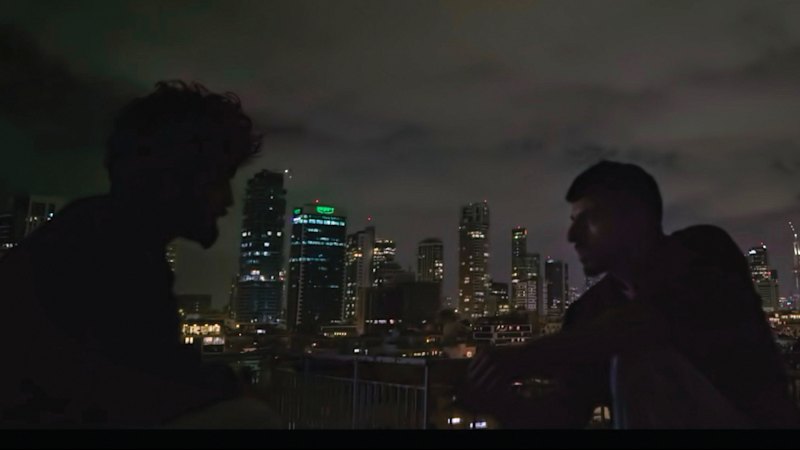
NAZA consists primarily of one-on-one interviews with two dozen Israeli soldiers and intelligence officers, shot at night on rooftops in central Tel Aviv. The anonymous subjects are reduced on screen to silhouettes, freeing them to speak with unusual frankness about their involvement – mainly from afar – in the killing of Palestinian civilians during the ongoing Gaza war (in response to Hamas’ October 7, 2023, attacks in Israel, in which 1200 people were killed).
The film’s title is an acronym referring to the number of civilian deaths, including children, officially deemed acceptable if it means the killing of one member of Hamas. According to one interview subject, anything up to 20 is taken for granted – but with authorisation, the number can go much higher.
NAZA has been widely discussed since its premiere at last month’s Venice Film Festival, and even before that much of the information it conveys had been reported in more conventional media outlets (in particular The Guardian, one of the film’s producers). What I hadn’t counted on was its power as a movie – which it undoubtedly is, as opposed to a piece of conventional journalism.
The noir atmosphere is central to the whole enterprise: why these men have agreed to open up to Abraham and Szor’s camera isn’t entirely clear, but the darkness seems to relax them, as does the seclusion of the rooftop setting. “You can see the city,” it’s said at the outset, “but the city can’t see you.”
At moments the interviews resemble therapy sessions – but self-examination only goes so far. Some interview subjects express regret, but in an oddly impersonal way. Others point out the necessity of following orders, or admit to enjoying their work – though this enjoyment too seems impersonal, nearer the pleasure of a video game than the satisfaction of a burning need for revenge.
Given that NAZA has been denounced by representatives of the Israeli state as antisemitic and a “blood libel”, a couple of points need making. First, while this is unabashedly a polemical film, there is no implication that the interview subjects are fully reliable witnesses, nor that everything they say can be verified.
On the other hand, factual questioning of their statements within the film has so far centred on a couple of relatively narrow issues: the role of AI in determining bombing targets, and one specific occasion when authorisation was allegedly given for a strike expected to lead to up to 500 civilian deaths.
None of this vitally affects the bigger picture – but equally, part of the point is that this picture remains distant, blurry, impossible to access in full. Everything we see refers to what we don’t: the glittering Tel Aviv skyline mirrors the largely offscreen ruins of Gaza, and the people visible in windows going about their business – washing up, typing, watching Netanyahu on TV – stand in for those elsewhere who lead equally ordinary lives, or once did.
At the climax of this compact and precisely shaped film, shadows lift to the extent of allowing us to witness certain things for ourselves. But overwhelmingly, the experience of NAZA is that of being submerged in a night without end.
Reviewed by Jake Wilson
NAZA is in cinemas from October 15

KioskNews shows a cleaned-up reading view extracted from the publisher’s page — the original always lives on their site, not ours.