Gujarat Hardlook: Inside the Rs 1,200-cr ‘rebirth’ of Sabarmati Ashram
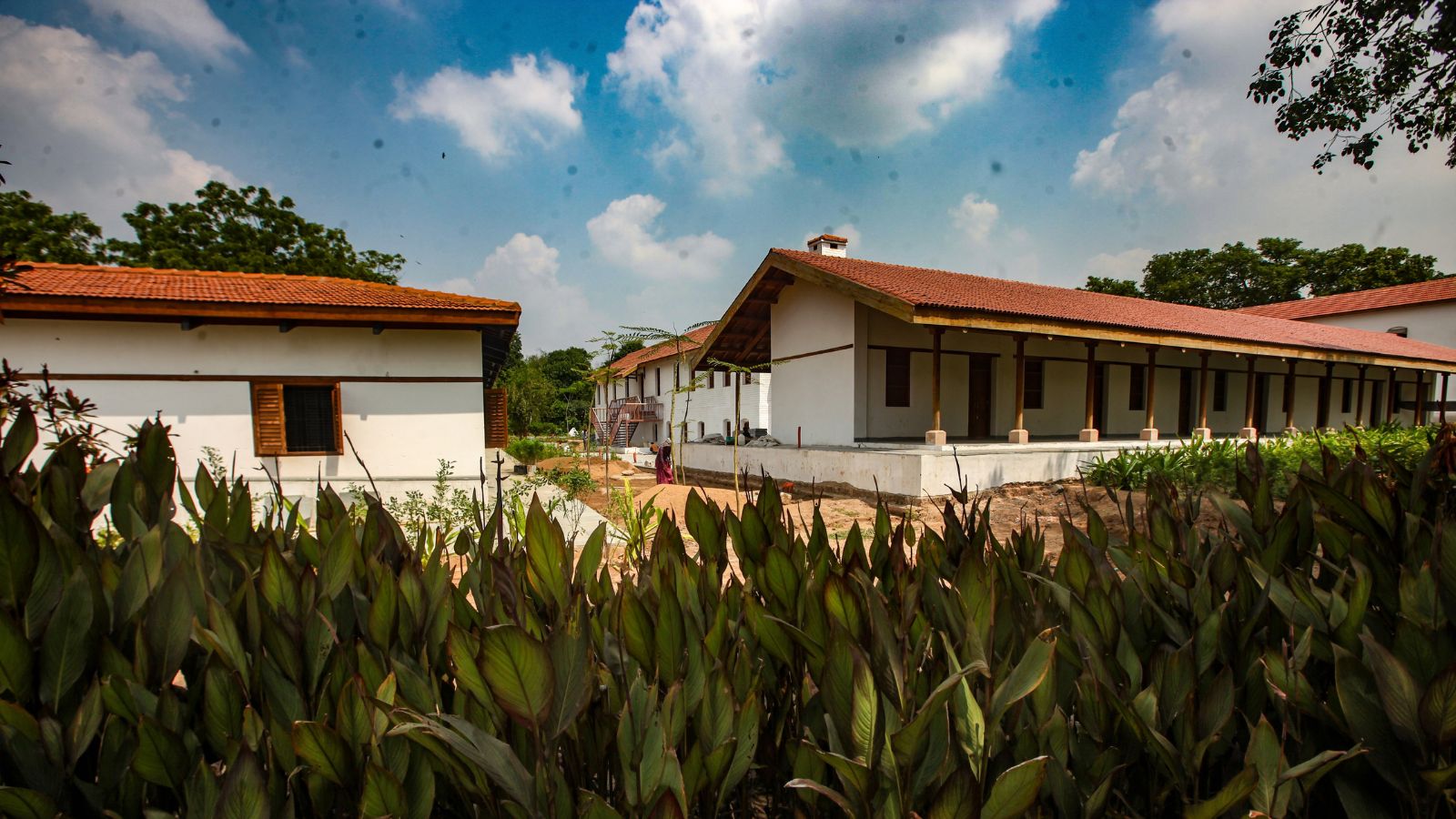
Under the Gandhi Ashram Redevelopment Project, most of the original ashram’s buildings have been restored. The project is now deciding how these buildings will tell the Mahatma’s story through museums, activities and experiences for visitors within the 55-acre space, write Parimal A Dabhi and Leena Misra.
IMAGINE A granite-paved pathway lit by Victorian-style lampposts, with ornate wooden benches along the way, taking visitors on a journey through the life of a barrister who became a “Mahatma” while fighting to free India from British rule.
A good part of that pathway is already complete. It is lined with baobabs from Madagascar, black neem from Thailand and exotic flora such as Mayan spinach from Mexico and bird-of-paradise. The walk through a series of repurposed buildings is designed to culminate in an arboretum called Mohan-to-Mahatma — the plants are colour-coded to mark each phase of Gandhi’s life.
That, though, is all in the ‘extended’ part of the project. At its heart is a five-acre space that feels frozen in time.
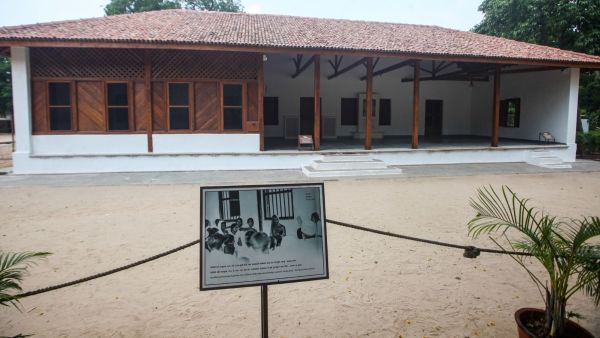
The Five Acres Frozen in Time
Here, visitors can walk through the house where Gandhi and his wife Kasturba once lived — a house that, every year without fail, marks Gandhi Jayanti with an all-faith prayer meeting open to the public.
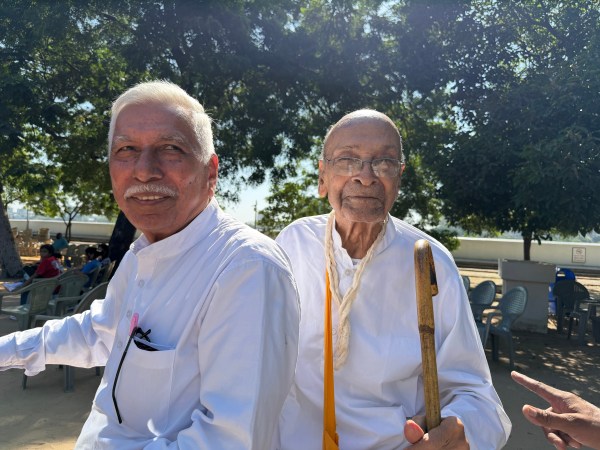
This year, on October 2, Vijaybhai Joshi arrived at the ceremony dressed in khadi, with a cotton hank around his neck and a walking stick slung over his shoulder. After the prayer meeting at Hriday Kunj — marking Gandhi’s 157th birth anniversary — he climbed onto the back of a scooter to head home.
“This country has not seen anyone like Gandhiji. We’ve been shaped by his ideology, and because we followed it, here I am before you at 104 years,” Joshi says, chuckling.
Story continues below this ad
Hard of hearing, Joshi pulls a small contraption from his bag — a funnel attached to a transparent pipe. To speak with him, one must talk into the funnel; he listens through the other end, pressed to his ear.
Born in Bihar in 1922, Joshi worked for a British firm and was posted in Pakistan. During the partition in 1947, his employer asked if he wanted to stay on. “No,” he told them, and asked instead to be transferred to his home state of Gujarat. He has lived in Ahmedabad since, where his family sings Gandhi’s favourite bhajan, ‘Vaishnava Jana To’, every evening.
Driving the scooter was 84-year-old Jesingbhai Parmar, a former Reserve Bank of India employee who reaches the ashram every Friday — “because that is the day Gandhiji died,” he says. On his visits, he spins 250 metres of yarn on the charkha at Hriday Kunj for over three hours. This October 2, he sat in the front row of the prayer meeting, spinning alongside children from the ashram’s school, which has since relocated outside the complex.
One Ashram, Six Trusts
Hriday Kunj — the house Gandhi built in 1917 on land he bought along the Sabarmati River a year earlier — was just one structure among several that made up the 120-acre ashram until 1930. Today’s redevelopment covers the 55-acre ashram itself, within a wider precinct of roughly 322 acres.
Story continues below this ad
After Gandhi’s death in 1948, the land was divided among six trusts tasked with carrying forward Gandhian thoughts and practices: the Harijan Ashram Trust (1939), Gujarat Khadi Gramodyog Mandal (1940), Sabarmati Ashram Preservation and Memorial Trust or SAPMT (1950), Gujarat Harijan Sevak Sangh (1952), Sabarmati Ashram Gaushala Trust (1952) and Khadi Gramodyog Prayog Samiti (1958).
The ‘Core’
Hriday Kunj sits within the five acres known simply as Sabarmati Ashram. On an average day, this stretch alone draws 4,000 visitors, says Kartikeya Sarabhai, chairman of SAPMT — whose first chairman, in 1949, was Sardar Vallabhbhai Patel. Several luminaries succeeded him, such as Ganesh Mavlankar, the first Speaker of the Lok Sabha, and Kartikeya’s late father Dr Vikram Sarabhai (known as the father of India’s space mission), to name a few.
SAPMT manages this core area, which includes Gandhi’s and Kasturba’s residence, Vinoba Bhave and Mira Kutir, Nandini Guest House, Magan Nivas, and Sanghralaya — a museum designed by late architect Charles Correa that houses the ashram’s exhibition and library.
A Vision, Delivered
Prime Minister Narendra Modi launched the Rs 1,200-crore redevelopment project in 2024. It envisions the ashram as one contiguous space across 55 acres; its buildings restored to how they stood when Gandhi was alive.
Story continues below this ad
The project is being executed by the Union Ministry of Culture and the Gujarat government through the Mahatma Gandhi Sabarmati Ashram Memorial Trust (MGSAMT), headed by Gujarat Chief Minister Bhupendra Patel. Retired Gujarat IAS officer I P Gautam is leading the project’s execution as Chairman of the Executive Council. Another retired IAS officer, I K Patel, is also playing a key role in the project as officer on special duty and member secretary of the Governing Council.
“It was the Prime Minister’s wish that we restore the ashram to how Gandhi left it in 1930, with modern facilities,” says a source associated with the project.
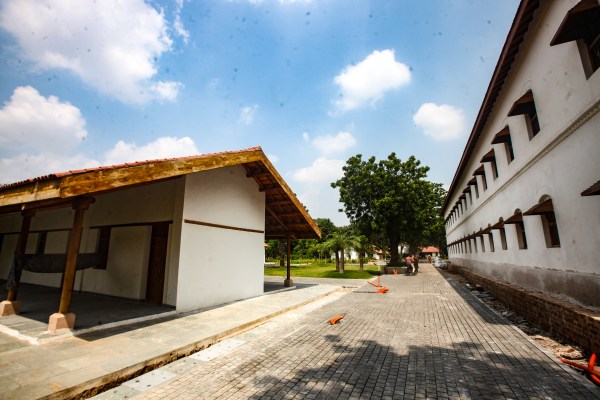
A public road that once split the land in two has now been closed and a large brick-and-concrete gateway has come up to serve as the new main entrance.
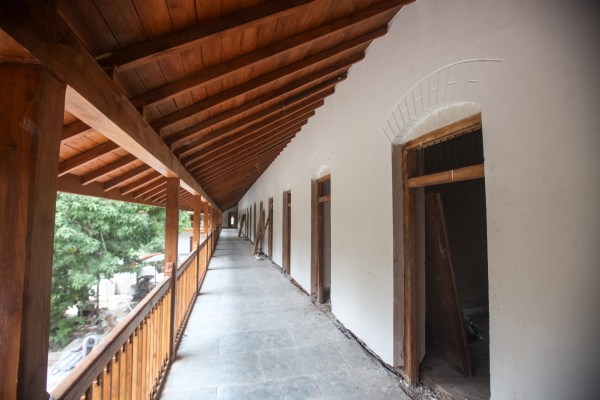
Beyond the SAPMT-managed core lies the part of the ashram now under restoration — buildings that once housed schools, hostels, teachers’ quarters, and units producing cloth, paper, leather and dairy products. This stretch, the source says, will take visitors through Gandhi’s life, “from the Champaran Satyagraha, where he became ‘Mahatma’, through the freedom movement, and till the British left India.”
Story continues below this ad
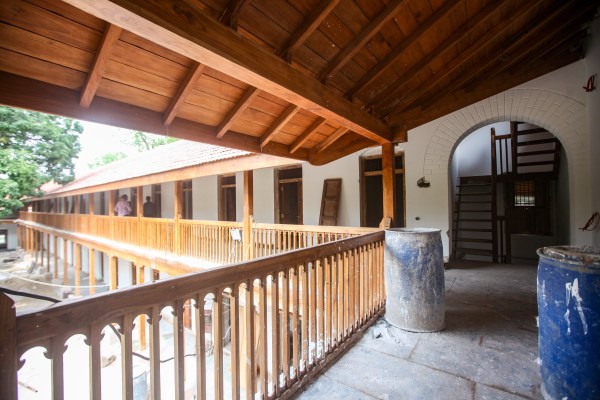
Restoring 28 Buildings, Developing 24 Museums
Inside what used to be the ashram’s ‘gaushala’ (cowshed), an artisan, Hirenbhai, dips bunches of coir fibre into a paste of Fuller’s earth, popularly called ‘Multani mitti’, and smooths it over a plinth. “We will finish it with lippan,” he says, referring to traditional mud plaster.
A marble plaque at the entrance notes that the structure was built in 1938 for Rs 7,200, funded by a donation from the Ahmedabad American Cotton Exchange Association Ltd, a private company founded in 1932. It is among the first of 28 buildings to be fully restored.
In one room, thatched roofs for a set of representational cowsheds — part of an upcoming museum — are in place. It is the only one of 24 planned museums being developed by the National Dairy Development Board (NDDB). The rest have been contracted to Paris-based Museum Studio, which is working in consortium with Ecofirst Private Ltd, a subsidiary of Tata Consulting Engineers.
Ahmedabad-based urban planner Bimal Patel’s firm HCP Design Planning & Management Pvt Ltd created the master plan for the project and executed the civil works using traditional methods. Sources say no cement concrete was used in any of the restorations.
Story continues below this ad
Of the 28 restored buildings, 24 will house museums. Activities once central to ashram life — papermaking and spinning among them — have been assigned to buildings within the wider precinct.
“It was Gandhiji’s idea that these activities should not just survive but also prosper. We will produce more khadi and more paper, so visitors to the ashram can buy them,” says a source involved in the project.
At the entrance, an “interpretation centre” will lay out what each space in the new ashram offers, helping visitors plan their visit around the time they have.
Keeping the Tranquility
SAPMT prepared a “concept note” meant to guide the MGSAMT’s work closely. Kartikeya Sarabhai recalls that Modi, as Gujarat’s Chief Minister then, had a clear vision for the revamped ashram even back in 2009, when the Trust first approached him.
Story continues below this ad
The PM, from the beginning, felt that whatever changes we make should be done in the context of the overall ashram, not as individual ones. He had that vision even then — it got articulated later,” Sarabhai says.
When Modi became Prime Minister and approached the ashram’s trustees about redeveloping the full complex, “Our only request was that the ashram’s core values — tranquility among them — stay at its heart”, Sarabhai says, adding that the government held to that promise.
He notes that Hriday Kunj, the Gandhis’ home from 1917 to 1930, originally stood amid an open maidan. “We will keep it in the maidan,” he says.
The concept note, Sarabhai explains, outlines the need to communicate what the ashram stood for in Gandhi’s time. It was a site for experiments in truth, non-violence, dignity of labour, respect for all religions and the removal of ‘untouchability’. “It was to be one of modern India’s most audacious experiments. The uniqueness of this experiment makes this site of immense significance to India and to the world,” he says.
Story continues below this ad
The new trust has left SAPMT’s management of the core area undisturbed. SAPMT has engaged Ahmedabad-based conservation architect Dr Rabindra Vasavda to restore its portion of the buildings.
Making Room: The Ashramvasis
According to sources, 307 claims were made by ashramvasis — long-time residents occupying 256 buildings— who had to vacate the premises. The MGSAMT offered three options: compensation by cheque, flats purchased by the trust, or homes in cooperative housing financed by the trust.
The trust has spent Rs 190 crore on rehabilitation so far. Of those relocated, 223 families — the largest group — opted for compensation, with payouts of up to Rs 90 lakh per family.
“We have treated them with respect. They were not encroachers,” said a source.
Only Krunal Rathod and his family, who occupy a cottage, are yet to evacuate. Their case is under litigation in the Small Causes Court. The Rathods’ fight concerns three properties which they claim were handed over to their predecessor by the trustee of the relevant Ashram trust around 1930.
The PM’s Stamp
Several personal interventions by Modi shaped the redevelopment’s final look: The pathway’s colour was changed from red to grey cobblestone; Victorian-style wrought-iron lamp posts will be installed throughout; red stone benches were replaced with ornate wooden ones.
What Visitors Can Expect
Original artefacts from SAPMT’s collection — a sari Gandhi wove for Kasturba, his cycle, his charkha — may be part of the exhibits, with security details still being worked out; parking for 250 cars and 25 buses to serve the higher number of visitors. At present, the Sabarmati Ashram sees nearly 4,000 visitors daily.
A food court near the entry gate that will serve ‘sattvik’ cuisine.
A souvenir shop featuring Gandhi’s three monkeys, carved from wood sourced from the original ashram.
A walkthrough ‘rainforest’ of medicinal plants and trees. The ashram’s original trees — peepal, jamun, asopalav, piludi, neem, gundo, mango, moringa — still stand in many places. Retired Deputy Conservator of Forest Jayant Solanki is overseeing this effort, assigned to the Heartfulness Institute, a spiritual organisation.
Ticketing: still undecided — though Kartikeya Sarabhai suggests “non-priced tickets” to regulate visitor flow.
Residential facilities for visiting Gandhian scholars, an idea still under consideration.
An artificial lake connected to stormwater drains to harvest rainwater. The lake was naturally tested in July when the city saw excessive rain, and water drained into it, filling it.
“The Ashram is my best and only creation. And the world will judge me by its results,” reads a quote by the Father of the Nation at the entrance of the MGSAMT office, as if summarising the project’s objective.
By the time the pathway reaches its end, visitors will have walked through more than a restored ashram — they will have retraced, tree by tree and room by room, the journey of a barrister who became one of history’s most enduring symbols of non-violent resistance.
Iconic Buildings Being Restored
Anand Bhavan: Constructed around 1920 as the ashram’s needs grew. Gandhi’s secretary and confidant, Mahadev Desai, lived here for a time.
Imam Manzil: Built in 1919 for Imam Saheb Abdul Kader Bawazeer, a close companion of Gandhi’s in both South Africa and India. He gave up his business to join the Satyagraha movement and stayed with Gandhi until he died in 1931.
Bal Mandir: Inaugurated in 1940 by Madame Montessori, this building trained the children of Dalit craftsmen and workers in the crafts practised in their own homes.
Junu Rasodu: Built in 1918 as a kitchen and dining hall with a storeroom cellar. Meals followed a strict ritual: a bell rang thrice, the kitchen doors closed after the second ring, and prayers began at the third, according to an account by the late Narayan Desai, Mahadev Desai’s son.
Somnath Chhatralaya: Built in 1922 to house the growing number of ashram residents, this 100-room facility later served as a hostel for female PTC students after 1955.
Jamna Kutir: Built in 1924 by industrialist Jamnalal Bajaj as a residence for his family during visits to the Satyagraha Ashram, which Gandhi later renamed Harijan Ashram. It later housed two ashram workers. (Restoration of this building is pending due to litigation.)
KioskNews shows a cleaned-up reading view extracted from the publisher’s page — the original always lives on their site, not ours.