When Trump and Xi meet they will discuss AI. 'Track Two' talks are already buzzing
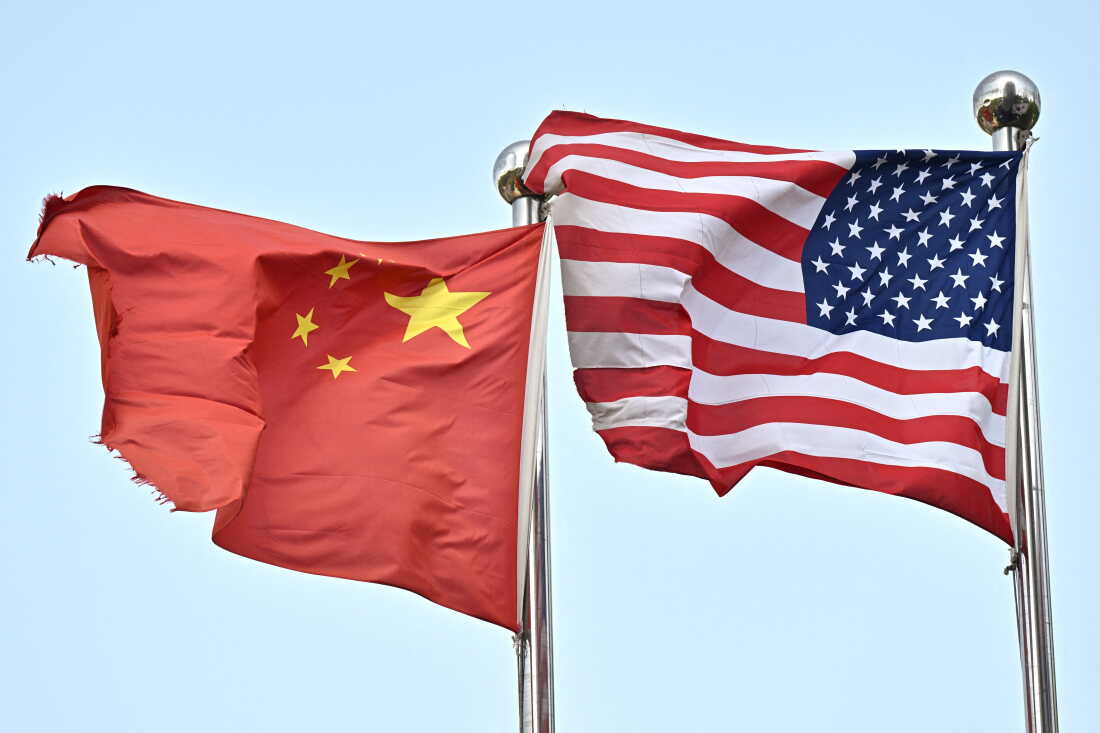
Chinese and US flags wave outside a technology company in Beijing, on April 17, 2025. (Photo by PEDRO PARDO/AFP via Getty Images) AFP hide caption
toggle caption
AFP
The United States and China are locked in a cycle of fierce competition and mistrust over artificial intelligence, and experts say the chances that President Trump and Chinese leader Xi Jinping can change the dynamic when they meet in Washington next Thursday are dim.
In the past few weeks alone, the Trump administration has accused Chinese AI companies of stealing intellectual property by "distilling" leading U.S. AI models, and threatened sanctions. Beijing, for its part, has poured scorn on U.S. restrictions on chip exports, and accused Washington of running a "Cold War playbook" to hold Chinese AI down.
It would seem there is little room, or appetite, for compromise. But former officials and policy experts say there is a buzzing bilateral dialogue — and a growing sense of shared concern about the dangers of AI — at the sub-national level in what diplomacy wonks call "Track Two."
For decades, government-to-government interactions, sometimes called "Track One" diplomacy, have been underpinned by this sprawling network of informal private meetings and conferences, often run by think tanks or universities. Track Two discussions bring together experts from both sides, and cover a wide array of topics, from nuclear disarmament to climate change.
"I think there is no more important topic that the U.S. and China should be talking about than AI," said Sarah Beran, a former U.S. diplomat who worked on China and is the incoming president of the non-profit National Committee on U.S.-China Relations. The committee runs several Track Two discussions and has been involved in policy exchanges since 1972, when it sponsored a visit to China by U.S. ping pong players to help thaw relations.
AI is a tough topic, though, because there's so little trust in the relationship at the moment, says Beran. "The fear of chokepoints, being held back, and AI being used as a cudgel on both sides means that this is also one of the most difficult areas to talk about," she said.
The idea behind Track Two is to build understanding, and work toward policy recommendations that both sides can agree on. Sometimes, governments use them as back channels, or low-stakes ways to float ideas.
Beran said that was the case after direct military-to-military discussions between China and the U.S. were cut off following then-Speaker of the House Nancy Pelosi's visit to Taiwan in 2022. At the time, Beran was the top China official on the National Security Council in the Biden administration.
"We floated some ideas in Track Two dialogues about what resumption of military-to-military communications could look like, at what level, what the topics would be. And then we took it back into the formal channels and negotiated on resuming those channels," she said.
Then-President Biden and Xi agreed at a 2023 summit in Woodside, Calif., to get the military dialogue back up and running.
Jack Shanahan, a retired Air Force general who has been involved in Track Two dialogue over military AI, said informal discussions helped tee up an agreement between the leaders a year later that any decision to use nuclear weapons should be controlled by humans, not by AI.
"That was only possible by years of quiet dialogue at the Track Two level on this very topic," he said.
Samm Sacks, an expert in Chinese tech at the Johns Hopkins School of Advanced International Studies and the policy think tank New America, said she was involved in several Track Two discussions on AI in Shanghai and Beijing over the summer "that were very substantive."
"People can talk about sensitive issues more candidly and also don't feel the need to come to any consensus that would become public," she said.
Those dialogues have reinforced for her that the U.S. has a lot of common ground with China on AI, despite government friction over chip export controls and accusations that Chinese AI labs are stealing intellectual property. "So what I hear in the Track Twos I'm a part of is a sense of shared vulnerability and shared precarity created by AI," she said.
Shanahan agrees. On AI, China sees itself as an underdog, he says, but Shanahan has perceived a shift on the Chinese side as the technology advances and risks become clearer. "For the first time, I'm seeing, like, 'Look, we know we're not at parity in some of these areas, but AI is too important not to have these dialogues,'" he said.
Still, tensions over AI at the official level have been high, and the two sides have tended to focus on different concerns, with the U.S. looking at things like cyber vulnerabilities and possible loss of control of AI, and China thinking about regime stability and self-reliance for making hardware. Experts say that has an impact on the complexion of Track Two dialogues — and has tempered expectations for concrete outcomes.
The Center for Strategic and International Studies, a U.S. policy think tank, also runs Track Twos, and China specialist Scott Kennedy has been involved in a wide-ranging dialogue about economics that includes AI. He said the talks can increase awareness in policy circles of the others' red lines and how each side makes decisions on the issues.
"They provide you a sort of road map of the different points of view and the potential actions and reactions of different scenarios," he said. But he added they require a level of government support on both sides to work.
"This is the time where we need some leadership, and what we're seeing is a vacuum," he said. "Track Twos don't fill that vacuum. They can help redirect things and buy time, prepare the groundwork for new engagements, but they're not going to solve the giant problems on their own."
Sacks said the disagreements over AI between China and the United States make this a precarious moment, with the utility of Track Twos in the balance. A push this week by U.S. AI companies for a global agreement to slow down the development of cutting edge AI did not go over well in China.
"I actually think the best thing that the two governments can do is just at a high level signal [that] we both need to come together to address AI safety and cyber risk, bio risk, for example," she said, referring to the risks that people could use AI for hacking or to develop biological weapons.
Some Track Two participants say the Trump administration is less engaged with the dialogues than previous administrations, making the work more challenging. But Track Two participants will be watching the Trump-Xi meeting in Washington next week for signals that AI is a topic of concern to both sides, and one on which the two sides' experts can continue to engage in substantive talks. And Sarah Beran says that includes the National Committee.
"You need to build confidence on both sides that this is a safe space to talk about issues," she said. "Our next meeting is coming up in the next couple of months and we're trying to think about how we use whatever the two presidents say together as a way to start talking about these issues in a Track Two format."
KioskNews shows a cleaned-up reading view extracted from the publisher’s page — the original always lives on their site, not ours.