Political unrest surges in S Africa as elections loom
KILLING COUNCILORS: Khethelo Mdluli, Lucky Sokhela and four members of the ANC youth division have died in attacks ahead of elections scheduled for Nov. 4
Gunmen in August opened fire on local government candidate Khethelo Mdluli outside his rural home as he was with his young children, one incident amid a surge of suspected political assassinations ahead of South Africa’s polls next month.
The 40-year-old died in hospital at the end of August, with his family telling reporters they did not know why he was targeted.
“My brother was not a violent man,” said Sifiso Mdluli, a representative of the family.
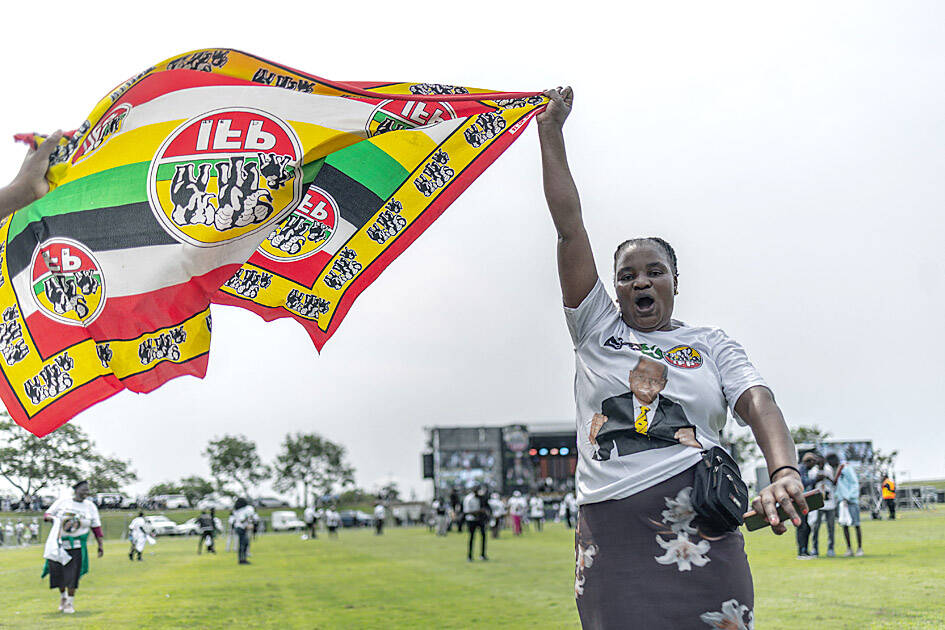
A woman waves an Inkatha Freedom Party flag at an event at Princess Magogo Stadium in Kwamashu, South Africa, on Sept. 20.
Photo: AFP
Mdluli was running as a ward councilor for the veteran Inkatha Freedom Party (IFP) in the Nov. 4 local elections, seen as a test of support for the African National Congress (ANC) after it lost its national parliamentary majority in 2024.
“One of his IFP colleagues, who was speaking at the funeral, said he had alerted them that there were people threatening him in the days leading to his murder,” his brother said.
The day after Mdluli died, another IFP ward council candidate was gunned down after arriving home in the same province, the politically volatile KwaZulu-Natal.
“He was a good man. We are scared,” said a relative of 34-year-old Lucky Sokhela who declined to be identified for fear of reprisals.
The party called a special Political Killings Task Team (PKTT), established in 2018, to investigate.
“The killing of political candidates cannot be treated as ordinary criminality,” it said. “Let the ballot, not the bullet, decide.”
In a new killing this week also referred to the PKTT, four members of the ANC youth division died after a gunman opened fire on them on Tuesday outside Johannesburg.
The motive was unknown and the attacker had turned himself in, police said.
At least 43 people were killed in 45 suspected political attacks in the first nine months of this year, according to the Geneva, Switzerland-based Global Initiative Against Transnational Organized Crime (GI-TOC).
The tally topped the full-year total of 30 for 2021, the year of the previous municipal elections, and 33 in 2024, when the most recent national election was held, the independent civil society group said in a report.
The targets included ward councilors, party officials or traditional leaders — figures with influence over local issues such as the allocation of houses and contracts.
“The focus shifted from ideological divides to contestation over access to resources,” said researcher Crispin Hemson, who documented KwaZulu-Natal’s bloody political wars in the final years of apartheid.
“The market for killing, the networks, the guns, they were already there. Now the ideology is gone and the motive is a tender, a ward, a job,” Hemson told reporters.
The trial of two men sentenced to life imprisonment last month for the 2023 murder of KwaZulu-Natal Democratic Alliance councilor Nhlalayenza Ndlovu heard that the hit was ordered by a traditional chief over disputed land sales and electricity connections.
A ward councilor’s job comes with a salary of more than 25,000 rand (US$1,500) a month before allowances, according to government figures.
The official national unemployment rate is 33 percent and the minimum wage is nearly 6,000 rand.
“The struggle for employment is such that many people see being a councilor as escaping poverty,” said Zakhele Ndlovu, a political analyst and lecturer at the University of KwaZulu-Natal. “Hence there is such competition for councilor posts, with others prepared to kill or be killed in pursuance of this position.”
Most of the attacks (16) recorded by GI-TOC to the end of last month were in KwaZulu-Natal, but there were also 10 in Gauteng, where Johannesburg is.
Of several political movements affected, most of those killed (13) were from the ANC, followed by eight from former South African president Jacob Zuma’s uMkhonto weSizwe Party (MKP), based in KwaZulu-Natal.
“Quite a few of these killings speak to the criminalization of politics, particularly at a local government level, where it’s about contestation for access to power and the money that comes with it,” said Julian Rademeyerthe, author of the GI-TOC report Ballots and bullets.
There is an “intersection between politics and organized crime” that “damages the constitutional democracy that South Africa is,” GI-TOC executive director Mark Shaw told a public hearing last month.
KioskNews shows a cleaned-up reading view extracted from the publisher’s page — the original always lives on their site, not ours.