Singapore’s sole offshore marine lab renamed national station, launches regional network
SINGAPORE – As South-east Asia’s seas get hotter, Singapore’s only offshore marine research facility is establishing a regional network to monitor and study the region’s biologically rich waters.
The South-east Asia Marine Research Stations Network, which brings together five ASEAN countries, comes as marine heatwaves become more frequent and intense, with the next major event forecast to occur in 2027 following what has been touted as one of the strongest El Nino climate events.
Singapore’s National Marine Research Station, formerly known as St John’s Island National Marine Laboratory, announced its leadership of the network at the start of Marine Science Week on Nov 25, an event marking the facility’s 10th anniversary.
The expanded role of the station on St John’s Island was officially launched by President Tharman Shanmugaratnam.
Tharman said: “Climate change, the loss of biodiversity and the health of our oceans are not separate problems but deeply connected... The (new network) will bring together scientists from across South-east Asia to learn from one another and strengthen our collective ability to look after our seas, an effort that will matter even more in the years ahead.”
To date, more than 10 marine research stations from Singapore, Malaysia, Indonesia, Thailand and the Philippines have joined the network.
As part of its new role, the research station will open its doors to researchers across South-east Asia, allowing them to tap its facilities, data and expertise to tackle shared challenges faced by the region’s interconnected seas.
“We want to support collaborative research and capacity sharing and, of course, strengthen institutional links in our region,” said the station’s director, Jani Tanzil.
“The single biggest challenge we have in the region right now is climate change, specifically sea warming.”
By tracking changes in the overall marine environment, the network could help detect early signs of the anticipated fifth global coral bleaching event, expected to occur between April and July 2027, said Tanzil.
Coral bleaching occurs when stressed corals expel the algae that give them their colour. This renders the corals, which act as vital nurseries and natural coastal barriers, much more susceptible to disease and death.
The impending crisis follows previous mass bleaching events in 1998, 2010, 2016 and 2024, with the 2024 event being the most intense on record and affecting reefs across more than 82 countries, territories and economies.
Coordination among institutions in the network will help improve monitoring of the 2027 event’s impact across South-east Asia, as well as the conditions affecting the reefs’ post-bleaching recovery, said Tanzil, a marine biologist who works with corals.
For a start, member stations plan to share basic environmental data such as sea temperatures, which will help track regional marine heatwaves.
Singapore currently has three research buoys that act as sentinels of its waters, monitoring changes in near real time. Information from the marine environment sensing network is available on an online platform.
Beyond climate change, the region is also facing rapid coastal urbanisation driven by population growth, noted Tanzil.
The resulting pressure on coastal ecosystems makes it increasingly difficult to manage ocean spaces without compromising the health of the marine environment and the need to protect it for future generations, she added.
Within the next five years, the research station will upgrade its equipment to aid this research.
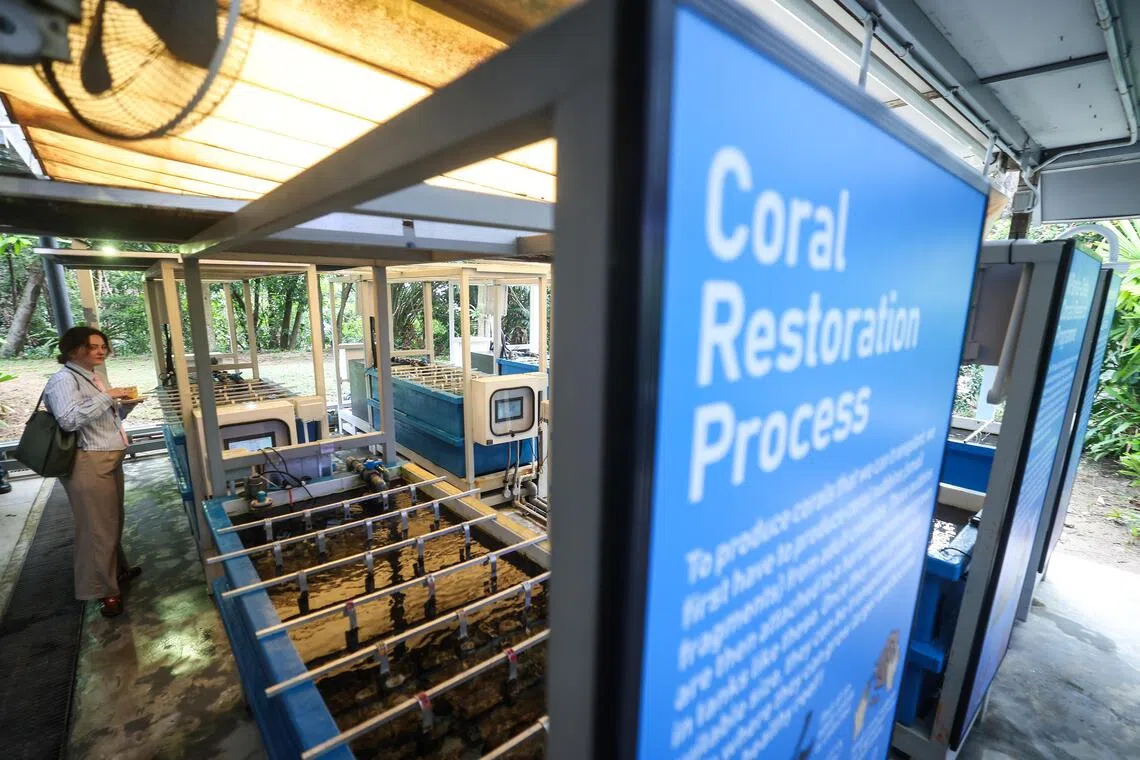
This showcase features Singapore’s largest reef restoration project, the 100K Corals Initiative, led by the National Parks Board in collaboration with the National Marine Research Station.
PHOTO: LIANHE ZAOBAO
This includes purchasing advanced imaging instruments to detect and characterise plankton drifting in Singapore’s waters. These tools will help researchers identify plankton faster and more accurately, allowing them to spot sudden shifts in the marine environment.
Though invisible to the naked eye, plankton are vital to marine ecosystems, performing roles that include producing oxygen, feeding wildlife and recycling nutrients.
These organisms act as bioindicators, often being the first to react to changes in the physical environment. Sudden shifts can lead to events such as harmful algal blooms, which eventually ripple out to harm larger organisms like corals and marine mammals.
A new research vessel to replace the facility’s current 18-year-old ship is also in the pipeline.
The expansion of the facility is supported by the $37 billion Research, Innovation and Enterprise 2030 plan.
At the launch, National Research Foundation chairman Heng Swee Keat said the health of Singapore’s marine environment is closely tied to the liveability of the Republic, noting that the waters support biodiversity, regulate the climate, protect coastlines, and provide food and other resources.
He said: “For a small and highly urbanised country like Singapore, whose waters are among the most intensively used in the world, our marine environment is a precious asset.
“We must understand it well so that we can steward it responsibly and sustainably.”
The network is timely, as Singapore prepares to take on the ASEAN chairmanship in 2027, he added.
He also said: “I hope that (the initiative) will build not just a network of research stations but something more enduring – a regional marine science community, united by a shared responsibility to understand, protect and sustain our seas.”
Pooling resources, protecting seas
Tanzil said that participation in the network will remain voluntary, with the focus on connecting marine stations and research facilities in member countries rather than fostering government-level collaboration.
Plans over the next few years include a mentorship and exchange programme for early-career researchers, students and technical staff, as well as arrangements to share infrastructure and resources.
Zarinah Waheed, the director of Universiti Malaysia Sabah’s Oceanography Research Centre, said the network will help improve access to specialised equipment, noting that no single institution has all the facilities or expertise needed to address the complex challenges faced by marine environments.
She said: “Marine challenges do not stop at national borders, and neither should our research.
“Through (the network), we hope to connect our expertise, facilities and researchers to better understand and protect the marine environments we share.”
Aditya Hikmat, a lecturer at Bintan’s Universitas Maritim Raja Ali Haji, which recently collaborated with Singapore on seagrass and mangrove research, said the pooling of resources could help address gaps faced by Indonesia, which he described as a large country facing fiscal constraints despite its enormous marine resource potential.
“In turn, this brings positive benefits to Indonesia through the research outputs and through a stronger, better-trained generation of marine scientists,” said the marine biologist.
Under the 2025 iteration of Singapore’s Research, Innovation and Enterprise plan, the offshore lab facilitated more than 150 research projects across the areas of manufacturing, trade and connectivity, human health and potential, urban solutions and sustainability, as well as smart nation and digital economy initiatives.
The facility’s coral culture lab also supports the 100k Corals Initiative, a national programme to plant 100,000 corals in Singapore’s waters over the next 10 years and beyond.
Research has shown that less than 40% of the Republic’s original coral reef area, amounting to about 10 sq km, remains today, following extensive coastal development and the effects of climate change.
So far, more than 2,500 corals have been reared as part of the initiative at the research station. By April 2026, about 1,200 corals across 16 species had been transplanted to reefs.
Singapore’s investment in the National Marine Research Station follows the launch of the $60 million National Institute for Marine and Ocean Sciences in September, which aims to strengthen the Republic’s ability to protect and sustainably manage its marine environment.
This research is increasingly critical as Singapore plans and executes a bevy of large-scale coastal developments over the next decade, such as the Long Island reclamation project and the creation of a “western island”.
KioskNews shows a cleaned-up reading view extracted from the publisher’s page — the original always lives on their site, not ours.