Distant space ‘hamburger’ hides a baby gas giant
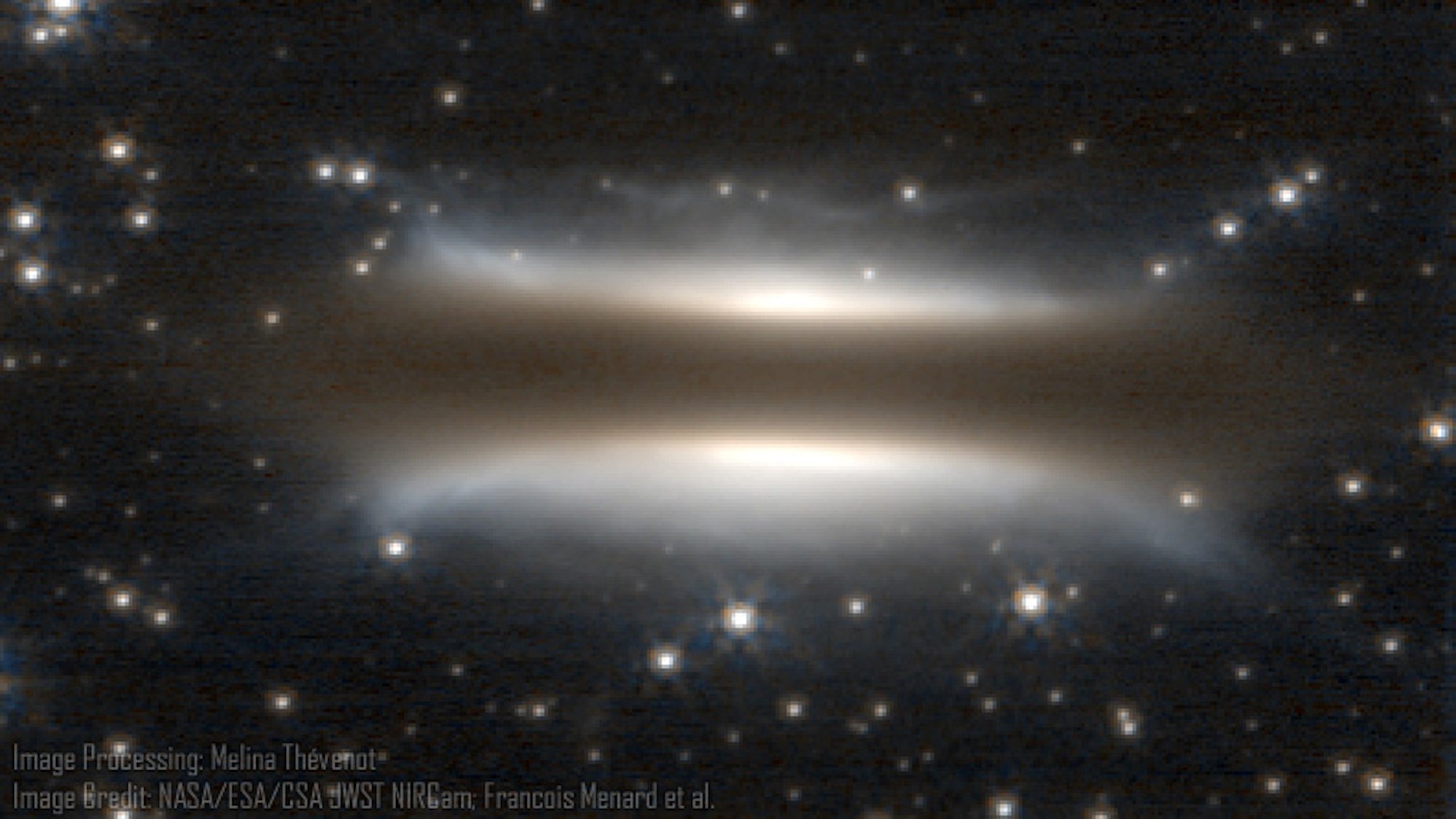
A cosmic Quarter-Pounder is providing us with a near-perfect view of a distant gas giant’s earliest moments. Known as Gomez’s Hamburger (or GoHam for short), the massive protoplanetary disk surrounds a young star located in the Scorpius-Centaurus stellar region of our home galaxy about 453 light-years away from Earth. As researchers explained in a study recently published in The Astrophysical Journal, GoHam’s vantage from Earth is virtually unparalleled for anyone hoping to glimpse the subtle layers of dust and particles that will one day coalesce into a humongous gas giant.
Early observers first spotted GoHam in 1985, but initially pegged it for a planetary nebula as far as 6,500 light-years from Earth. Astronomers have since revised their assessments with data gathered by the Atacama Large Millimeter/submillimeter Array (ALMA) in northern Chile. As its full name implies, ALMA measures millimeter-and-smaller wavelengths, allowing scientists to map the miniscule dust grains and gaseous molecules that compose distant objects. GoHam is a particularly unique subject for ALMA, because its position makes it a new benchmark example for testing models of how planets evolve.
“GoHam gives us a rare and clear view of the vertical and radial structure of a very large, nearly edge‑on disk,” explained study co-author and University of Minnesota astronomer Charles Law.
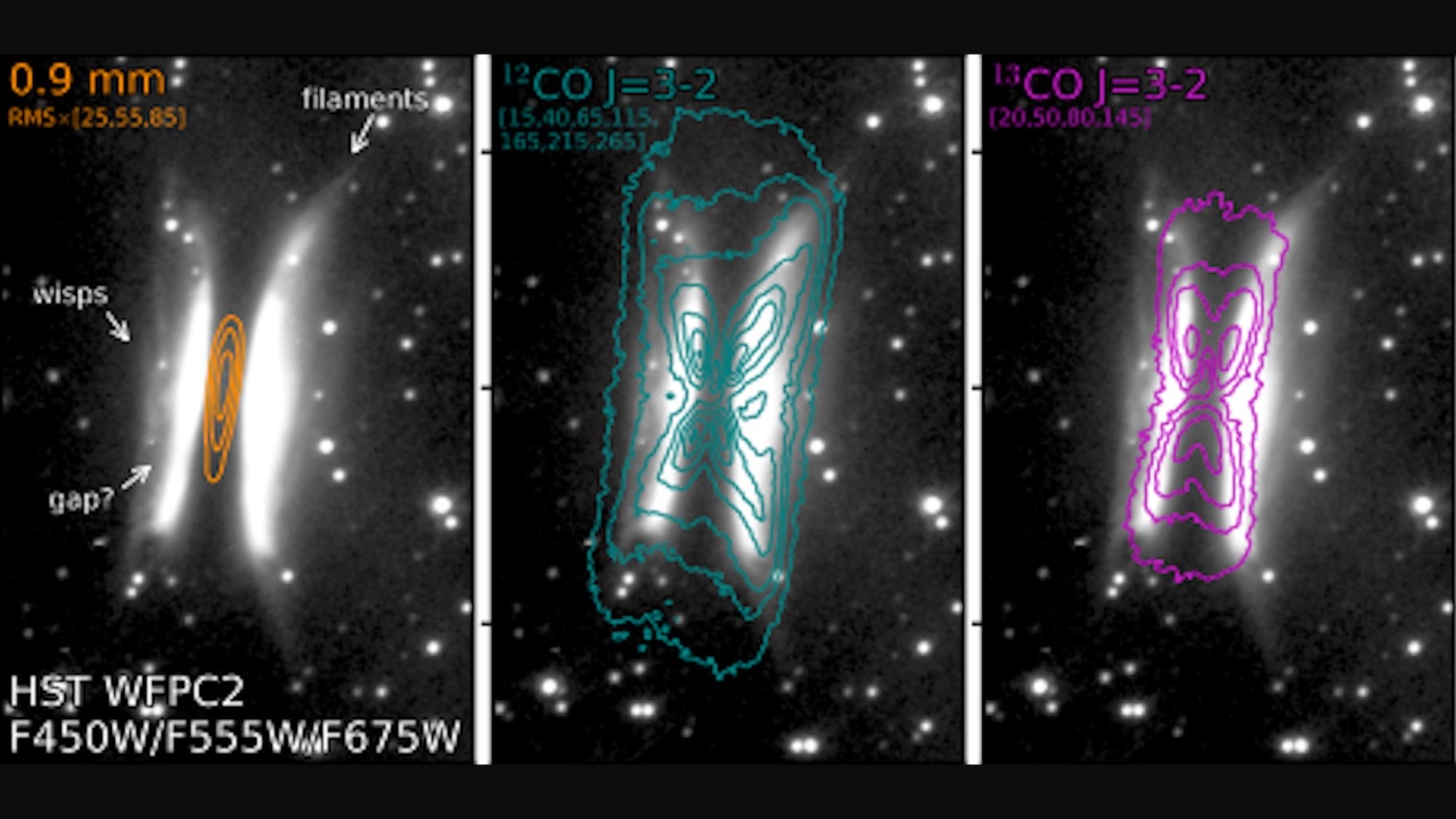
According to Law, its mixture of cosmic winds, large formational asymmetries, massive disk size, as well as the potential for planetary formation makes GoHam a “perfect laboratory.” With ALMA, Law and his colleagues analyzed GoHam’s layers of carbon monoxide, and sulfur-bearing molecules. As predicted, the lightest gas is in the highest layer above the formation’s midplane, while the heavier sulfur components lay beneath it. Meanwhile, a thin but concentrated section of millimeter dust is visible in the midplane itself.
Comparisons to GoHam’s fast food namesake only go so far, however. Its dust clouds lean north–south, with one side containing brighter and wider emissions. This likely stems from a disturbance such as a cosmic vortex, which may capture additional material for planetary formation. Dim, thin carbon monoxide emissions along the disk’s northern section also suggest GoHam’s central star is blowing gases into deep space as what’s known as photoevaporative wind.
Astronomers also noted that GoHam is one of the largest protoplanetary disks ever observed. At nearly 93 billion miles wide and with an exponentially larger dust mass than the typical protoplanet disk, GoHam may ultimately host not just one gas giant, but an entire planetary system.
KioskNews shows a cleaned-up reading view extracted from the publisher’s page — the original always lives on their site, not ours.