China-Pakistan crewed space mission was a decade in the making: minister
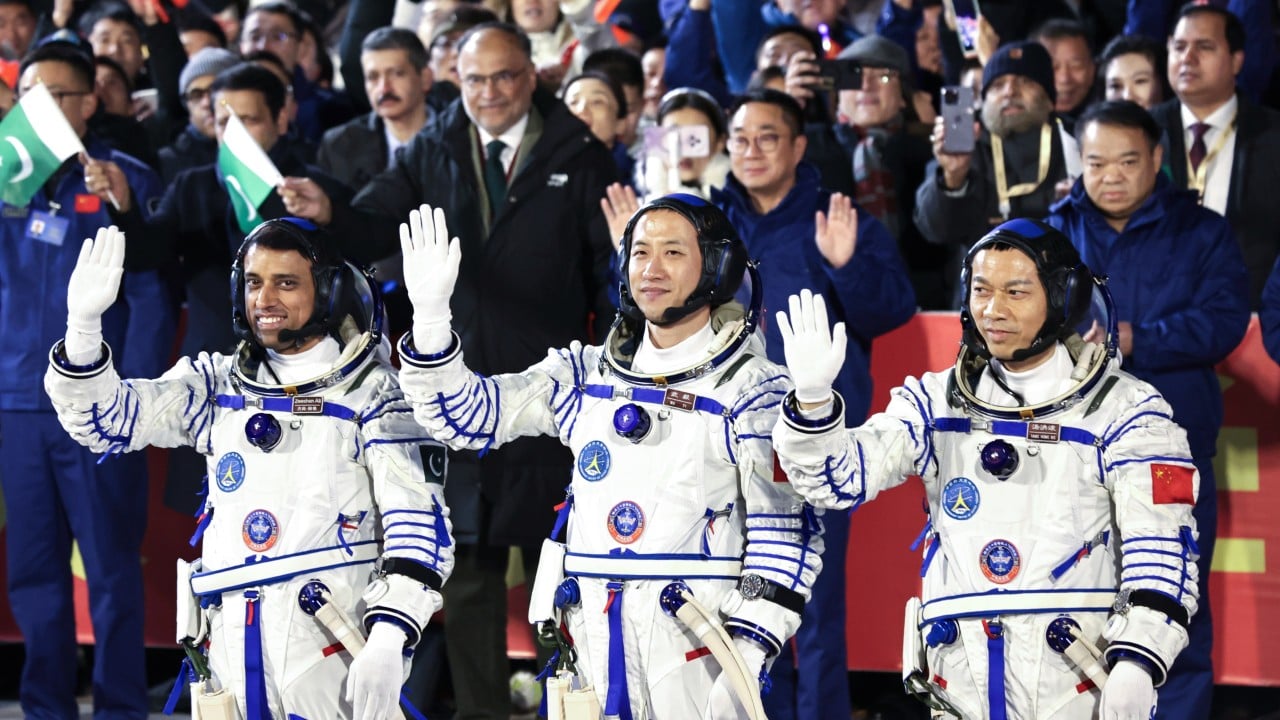
China and Pakistan began discussing collaboration on crewed space missions about a decade ago, a senior Pakistani official said on Wednesday as the South Asian nation’s first astronaut reached the Tiangong space station.
The three-member Shenzhou-24 crew blasted off from northwestern China on Wednesday morning bound for the Chinese space station. Among them was the station’s first foreign visitor, Pakistani payload expert Muhammad Zeeshan Ali.
Speaking to the media ahead of the launch, Ahsan Iqbal, Pakistan’s minister for planning, development and special initiatives, said discussions about expanding bilateral cooperation to include manned space missions began in 2016 or 2017.
“We were discussing at that time a manned space mission to carry a Pakistani astronaut,” Iqbal said. “And what we used to discuss in meeting rooms, today it is a reality.”
He said space technology had become an integral part of a modern economy, noting that satellites could help Pakistan better predict and respond to disasters and climate change.
“This shows the way forward – how developing countries can cooperate to have capability in areas which are very critical for future economic development,” Iqbal said, describing China’s vision of sharing success with developing countries as “truly commendable”.
He said he hoped that one day “our astronauts will be able to step on the moon together, holding Pakistani and Chinese flags”.
Pakistani Prime Minister Shehbaz Sharif said the country was “moving toward new heights in space research and advanced science” and considered space research a top priority, according to a statement posted on social media by his office after Wednesday’s launch.
01:06
China’s Shenzhou-24 spacecraft lifts off with first foreign astronaut on board
The Shenzhou-24 crew, which also includes commander Tang Hongbo and flight engineer Wu Yi, docked with the Tiangong space station on Wednesday, three and a half hours after launch. After completing safety procedures, the crew entered the station’s core module.
After a week in orbit, Ali will return to Earth along with two members of the Shenzhou-23 crew, including Lai Ka-ying, Hong Kong’s first astronaut.
Ali, who underwent seven months of training in China for this mission, is expected to carry out on-board experiments on bacterial photosynthesis and the impact of microgravity and space radiation on quinoa seeds.
The remaining Shenzhou-23 crew member, Zhu Yangzhu, will stay aboard the station with Tang and Wu to complete the first continuous year-long stay in orbit by a Chinese astronaut.
Last year, China and Pakistan signed a cooperation agreement to train Pakistani astronauts for short-term missions to the space station. In April, they announced that Ali and fellow airforce pilot Khurram Daud had been selected to train in China.
Iqbal said Chinese space authorities had set “very rigorous criteria” for the selection process, with Ali and Daud chosen from a shortlist of 60 candidates.
He said the two countries had cooperated in space for many years, with China helping launch multiple Pakistani satellites.
In 1990, China launched Pakistan’s first self-developed experimental satellite, and in 2024, its first lunar exploration orbiter, according to Pakistan’s national space agency, the Space and Upper Atmosphere Research Commission (Suparco).
“This was the next level: to have our astronaut go into orbit and to the space station, [and] our scientists and researchers accessing the opportunity of research in space through this programme,” Iqbal said.
Iqbal said that developing space technology, including satellites, could help Pakistan better manage disaster threats and improve agriculture and logistics.
He noted that climate change necessitated the development of smart agriculture, including climate- or weather-resistant crops.
“They are going to perform on the space station several experiments that will help Pakistan meet its food security target in the wake of the climate risk that we face,” he said.
“We certainly look forward to launching more satellites so that we are in a better position to manage the climate disasters.”
Iqbal said Pakistan was also preparing to send a lunar rover to the moon – a project previously announced as part of China’s Chang’e-8 mission scheduled for 2028.
“That will be a big opportunity for our scientists to test their skills, their knowledge and to see how we can have a rover craft on the moon’s surface,” Iqbal said.
Beijing plans to send its first astronauts to the moon by 2030 and intends to set up a permanent lunar research station at the moon’s south pole by 2035.
Pakistan officially signed on to the International Lunar Research Station project in 2023. Other countries partnering with China on the project include Russia, Belarus, Egypt, Thailand, Kazakhstan, South Africa and Venezuela.
KioskNews shows a cleaned-up reading view extracted from the publisher’s page — the original always lives on their site, not ours.