‘Everyone deserves a name’: How forensic scientists solved the 22-year mystery of ‘Alcove Man’
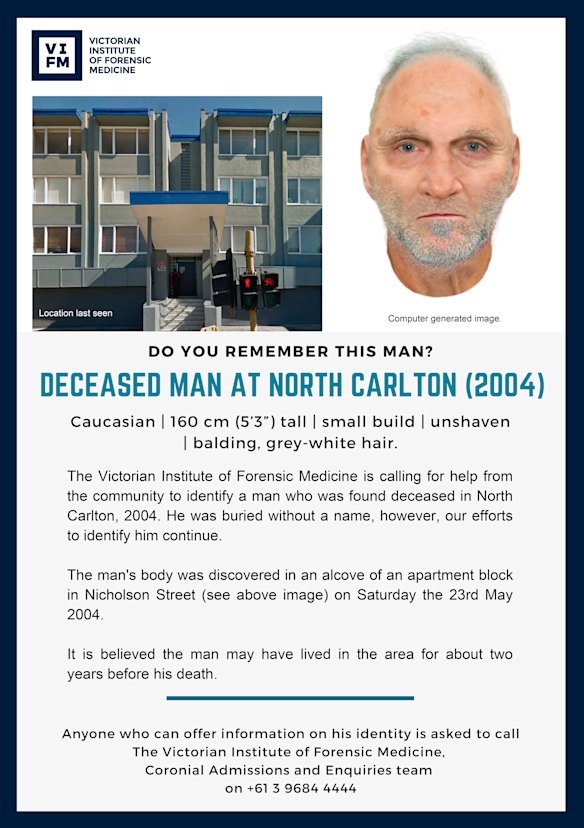
He was polite and well-dressed, the homeless man with a neat, white beard who became a fixture in Nicholson Street, Carlton North. No one remembers when he arrived, but they know when he left.
The man, who for years would sweep the driveway and hang his few possessions on hooks in a small alcove protected from the street, was found dead on May 23, 2004.
The locals who knew him always wondered where he went every day. He would leave the apartment alcove full of purpose at 9am like any other commuter to catch a city-bound tram and return at 6.30pm.
When residents said hello he would not respond. They wondered if he was shy or couldn’t talk.
Professor Trevor Lithgow was working at the microbiology department at the University of Melbourne when he moved into the Nicholson Street apartment block in 2002.
“The mailboxes were in the alcove, and it became apparent someone was living there. There were cardboard boxes and everything was neatly stacked.
“He had a routine, he would pack up his possessions, sweep the driveway, jump on a tram then return and sweep the driveway again.
“He was our neighbour who happened to be homeless.”
The man’s fingerprints were not on record which meant he had no criminal convictions, dental records produced nothing, and the computer-generated image distributed in the media drew a blank. Charity meal stations, hospitals and homeless shelters couldn’t identify him.
He still wore a gold wedding band, which suggested he was not always a loner. Yet, no one had reported him missing.
The Alcove Man was destined to be one of the many mysteries of a big city, remembered only as a curiosity by a handful of strangers, if not for experts at the Victorian Institute of Forensic Medicine, who used cutting-edge DNA technology to embark on a historic journey through seven countries to find the truth.
First the experts used DNA to find the man was of Jewish descent. Yet no one in the close Melbourne Jewish community knew him.
To understand this journey, we need to first understand the technology. DNA is not a stationary science but one that constantly evolves. Which brings us to Forensic Investigative Genetic Genealogy (FIGG).
FIGG is to basic DNA what draughts is to chess. “There have been advances in DNA, but this one is a leap,” says the Victorian institute’s forensic DNA intelligence expert, Dr Runa Daniel.
That leap is breathing life into cold crime cases. Victoria Police don’t want to talk about it, but they are using FIGG in at least a dozen rape and murder mysteries. There have already been breakthroughs. There will be more.
In one case, police have gone back to ancestors in the 1880s to build a family tree of 5500 names involving five generations around the world that they hope will identify a suspect just around the corner from a crime scene.
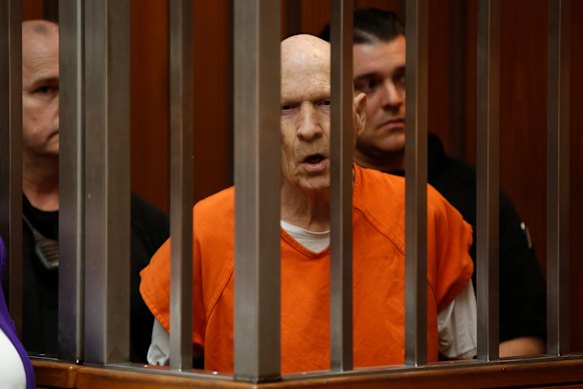
The most celebrated case was California’s Golden State Killer, former US cop Joseph DeAngelo, who pleaded guilty to 13 murders and about 50 rapes after he was identified using FIGG.
Law enforcement agencies and forensic teams upload DNA samples into genealogy databases, GEDmatch Pro and FamilyTreeDNA, looking for any matches, then try to build a family tree back to their person of interest.
Before anyone screams civil liberties, the samples are only checked against people who have opted in to co-operate on the two databases.
It was back in 2019 when the forensic medicine institute, the Australia Federal Police and NSW Police conducted a study on the viability of FIGG. They liked what they saw.
In 2020, with no leads on the Alcove Man’s identity, the institute began using FIGG to manufacture one, slowly building his family tree from the furthest leaf – a first cousin, once removed, living in America.
This meant they shared one grandparent. It was a start but only that.
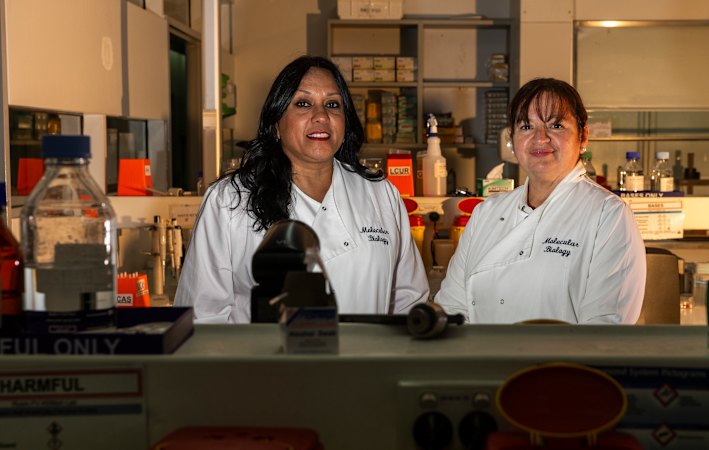
Through emails and international conversations, the forensic institute’s team of Daniel, chief molecular biologist Dr Dadna Hartman and Dr Colleen Fitzpatrick, an expert genealogical researcher, began to piece together the story that began in Warsaw, Poland, months before the end of World War I.
“It began a journey of discovery for all of us,” Hartman says.
The experts found leads, bumped into dead ends and looked for evidence in Poland, the US, Israel, Greece, Germany, Italy and Australia.
Polish couple Yakov Kwiat and Jente Pomerancz had five children. Three boys, Yitzhak, Izrael and Chemia, and two girls. Fitzpatrick concluded there was a 69 per cent probability that one of the brothers was the man in the alcove.
As the institute’s team began to build the family tree, they found the sisters, Esther and Kahna, died in the Holocaust.
Izrael and Yitzhak migrated to Israel, while Chemia, by now a professional tailor, proved himself to be resilient, resourceful and lucky to survive World War II.
He was 21 when the Nazis invaded Poland, and lived for three years in a ghetto before being part of a 1942 mass deportation of Polish Jews to Germany for extermination.
Somehow he survived the Holocaust, massive aerial bombardments and invasions by the Soviets and the Allies. The Nazis killed 6 million Jews, of which 3 million were from Poland. Of the 3.3 million Polish Jews, only 300,000 survived.
Chemia lived a further two years in post-war Germany before moving to Italy in 1947 and finding his way to the overcrowded Bagnoli refugee camp in Naples that housed 10,000 people trying to flee to the US, Australia, Canada, Argentina and Israel.
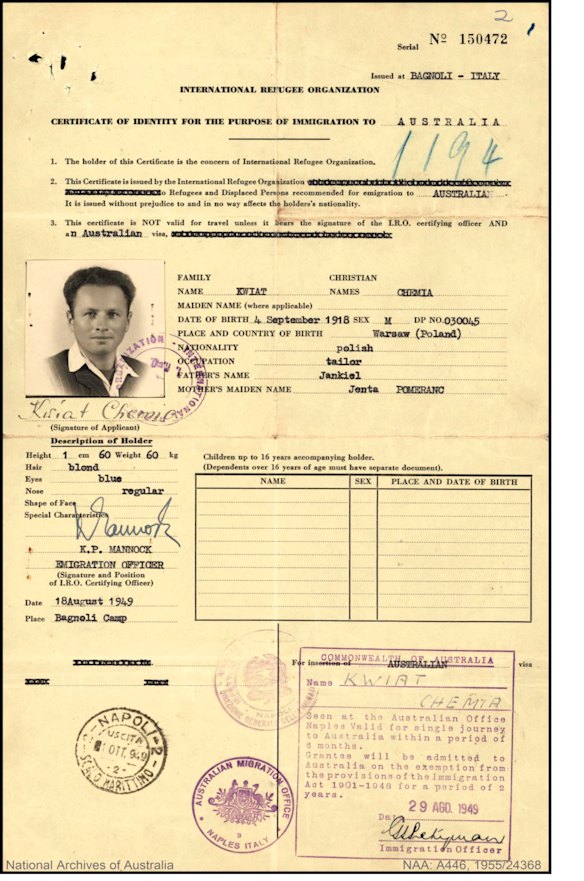
He was issued passport No.150472 in Bagnoli, on August 18, 1949. His photo showed a neat, well-dressed man, with a slightly receding hairline and an optimistic smile.
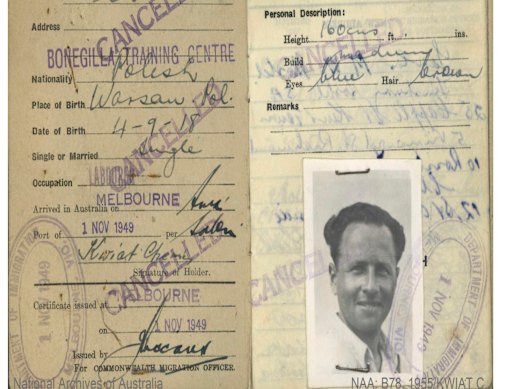
He sailed to Australia in October 1949 on the Anna Salen, a refugee transport ship that was a pre-war cargo vessel later converted to the Royal Navy aircraft carrier escort HMS Archer.
It made six trips to Australia, bringing thousands of migrants. This voyage was its third. On this journey, many disembarked in Fremantle due to illness brought with them from the camp. Some died on board.
Chemia continued to Melbourne. “We found it was a long, tough journey for Mr Kwiat to get to Australia,” Daniel says.
It took him 10 years and he travelled 2225 kilometres by land and 30,000 kilometres by sea to reach his new home.
He arrived in Melbourne on Tuesday, November 1, 1949. An overcast day that cleared for the running of the Melbourne Cup in front of a crowd estimated at 110,000. Foxzami, a 16-1 chance, won the race from a field of 31 and won $25,000 in prizemoney.
As an International Refugee Association “displaced person”, Chemia Kwiat owed the Commonwealth government two years of compulsory labour and was sent to migrant camps in South Australia, where he spent months living in army Nissen huts, before returning to Melbourne. He was released from compulsory work on Wednesday, November 7, 1951, the day after Delta won the Melbourne Cup.
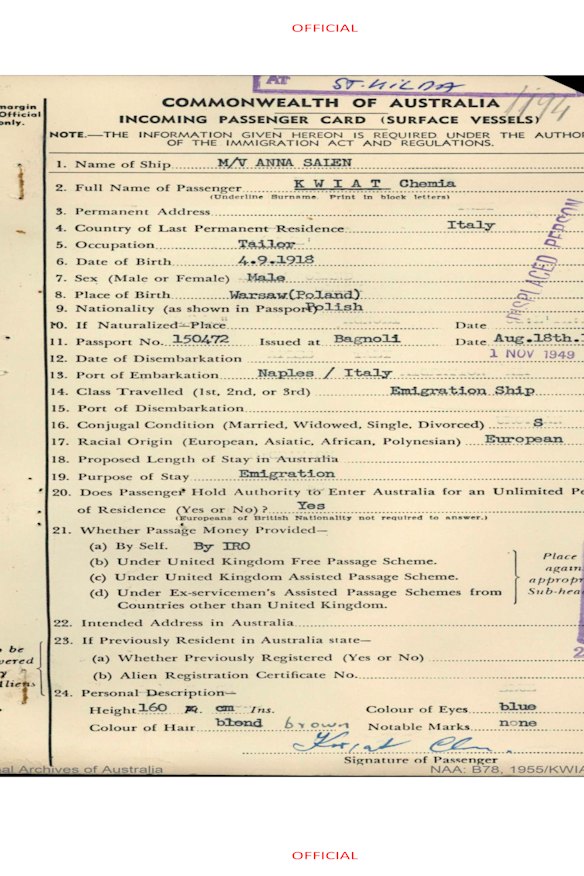
Kwiat applied for citizenship in 1954, was approved the following year, and settled in the suburb of Balaclava. He was no longer a tailor but a storeman working in Little Bourke Street.
On August 30, 1959, he married a woman of Greek Orthodox faith and, according to the forensic institute team, stopped practising as a Jew. They had one child.
“This is why we found no leads from the Jewish community here because he was not known,” Daniel says.
The trail became narrower when the forensic team discovered Kwiat’s brothers, Izrael and Yitzhak, had died in Israel.
Yitzhak had wanted to maintain links, writing to the Jewish organisations in Melbourne wanting to find his brother. Yitzhak’s relatives said they corresponded for years until Chemia stopped responding to letters.
Daniel says they conducted many “wild goose chases” but scouring public records helped find individuals to build the family tree. One lead came through an ad in Israel promoting a man selling tomatoes.
The 1972 and 1977 Australian electoral rolls, showed Kwiat and his wife lived together in Carlton North. In 1980, their child was recorded on the same roll.
Then there is a blank. Disengaged from his relatives overseas and no longer seeing his wife and child, Kwiat re-emerged in Nicholson Street. His child said they had lost contact 25 years earlier.
Was he there because he was familiar with the area or to be close to the wife he no longer saw? His alcove was 350 metres away, a four-minute walk from what had been his home when he lived another life.
“We thought there must be a reason why he was living there,” Hartman says.
The neighbour, Trevor Lithgow says, “I always felt he felt this was his place.”
For the Victorian Institute of Forensic Medicine team the years of international effort were justified when a coroner was satisfied the unidentified man was Chemia Kwiat. “We lived and breathed the case,” Daniel says. “The neighbours were grateful that he wasn’t forgotten.”
“Everyone deserves a name,” says Hartman. “It was nice to see a [passport] photo where he had a smile on his face.”
The institute team found that Kwiat’s wife died on May 12, 2004, and was laid to rest at the Melbourne Cemetery just up the road.
Eleven days later, Kwiat was found dead in his alcove. The autopsy showed the cause of death was pneumonia, but was it a broken heart?
John Silvester lifts the lid on Australia’s criminal underworld. Subscribers can sign up to receive his Naked City newsletter every Thursday.
KioskNews shows a cleaned-up reading view extracted from the publisher’s page — the original always lives on their site, not ours.