UK economic outlook brighter as new government measures will boost growth, says OECD – business live

The outlook for the UK economy has brightened, according to the Paris-based OECD, with inflation lower than expected while new government support measures are likely to boost growth.
The think tank has significantly cut its inflation forecast for this year, from 3.7% to 3.1%, after prices rose less dramatically than expected.
Economic growth for the UK is forecast at 1.1% for 2026, up from the 0.9% it had forecast in June and 0.7% in March, “with consumption expected to be supported by newly announced government support measures”.
In response, the chief secretary to the Treasury, Emma Reynolds, said:
Despite unprecedented pressures and conflict in both the Middle East and in Europe, the UK economy is showing strong resilience.
We will face these challenges together and we are already giving families space to breathe. We had the fastest growth in the G7 in the first half of the year and we are starting the big, long-term changes needed to create good jobs and growth in every postcode.
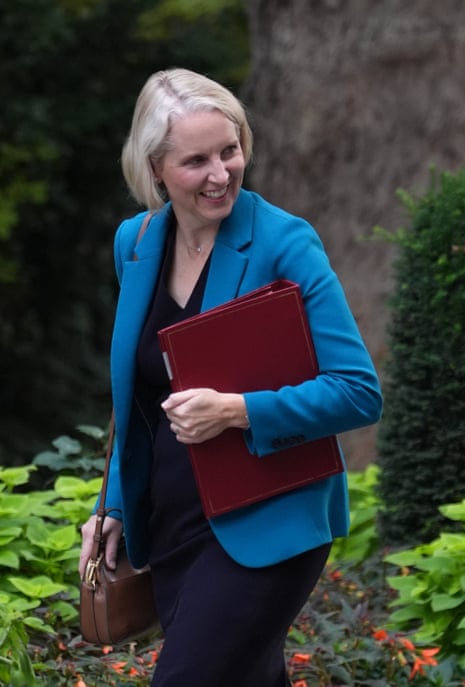
Andy Burnham, who became the UK prime minister on 20 July, announced a cut in VAT on electricity bills as one of his first policy measures on coming to power in July, and has suggested there may be more measures to give consumers “breathing space” in next month’s budget.
Burnham and his chancellor, John Healey, have seen UK borrowing costs rise sharply amid turmoil in global bond markets as ongoing conflicts have disrupted the oil supplies, driving up inflation.
The world’s advanced economies have been warned they need to take action to reduce their borrowing and bring down debt levels, at a time of surging government borrowing costs, according to the head of the International Monetary Fund.
Kristalina Georgieva told the BBC that global economic shocks had been “pushing debt levels up like a staircase not to heaven” despite governments taking “no action to contain that service cost. [It’s] time to take that action,” Georgieva said, adding that courage was needed by politicians to take the necessary steps.
Key events
UK private sector growth eases in September, inflationary pressures pick up – PMI
UK economic outlook brighter as new government measures will boost growth, says OECD
OECD: global economy has been more resilient to Iran war than expected
Eurozone private sector growth hits 3 1/2 year high, helped by AI and defence spending
German businesses record 'solid and accelerated increase' in output of goods and services – PMI
French private sector activity rebounds in September
IMF chief issues call to action to governments, with global shocks 'pushing debt levels up like a staircase to heaven'
Introduction: Oil prices fall in longest losing streak in a year on hopes of progress in US-Iran talks
Meanwhile, the latest PMI survey shows business activity in the UK eased this month, while inflationary pressures picked up.
The flash UK composite output index fell to 51.7 in September from 52.5 in August, a three-month low. There was a loss of momentum in both the services and manufacturing sectors.
The rate of input price inflation accelerated for the second month running to its highest since June. Companies pointed to increased energy, fuel and raw material costs.
Service providers noted that subdued domestic economic conditions and ongoing geopolitical uncertainty were factors that held back business activity growth in September, although some firms again cited a boost in demand for technology services.
AI investment and greater defence spending were highlighted as factors supporting manufacturing production, while weak consumer demand acted as a constraint.
Total new work across the private sector fell slightly in September, which contrasted with marginal growth during July and August. This mostly reflected a renewed downturn in new business volumes at service sector companies. They talked of weak business and consumer confidence, in part due to pressures on discretionary spending amid the ongoing cost of living crisis.
Chris Williamson, chief business economist at S&P Global Market Intelligence, said:
September is seeing a worrying combination of disappointingly sluggish economic growth and intensifying inflationary pressures, with subdued business confidence and high costs meanwhile continuing to discourage hiring.
Output growth across the manufacturing and services PMI surveys has slowed to a pace consistent with the economy growing at a mere 0.1% quarterly rate.
Growth, business confidence and employment are all being hamstrung by high energy prices, elevated business costs, geopolitical worries, higher market borrowing costs and uncertainty over government policy at home in the run up to the autumn Budget.
While the upturn in the survey’s price gauges suggest the Bank of England looks likely to keep a hawkish bias, the worryingly lacklustre pace of business growth underscores the risk to the economy from higher borrowing costs.
The outlook for the UK economy has brightened, according to the Paris-based OECD, with inflation lower than expected while new government support measures are likely to boost growth.
The think tank has significantly cut its inflation forecast for this year, from 3.7% to 3.1%, after prices rose less dramatically than expected.
Economic growth for the UK is forecast at 1.1% for 2026, up from the 0.9% it had forecast in June and 0.7% in March, “with consumption expected to be supported by newly announced government support measures”.
In response, the chief secretary to the Treasury, Emma Reynolds, said:
Despite unprecedented pressures and conflict in both the Middle East and in Europe, the UK economy is showing strong resilience.
We will face these challenges together and we are already giving families space to breathe. We had the fastest growth in the G7 in the first half of the year and we are starting the big, long-term changes needed to create good jobs and growth in every postcode.
Andy Burnham, who became the UK prime minister on 20 July, announced a cut in VAT on electricity bills as one of his first policy measures on coming to power in July, and has suggested there may be more measures to give consumers “breathing space” in next month’s budget.
Burnham and his chancellor, John Healey, have seen UK borrowing costs rise sharply amid turmoil in global bond markets as ongoing conflicts have disrupted the oil supplies, driving up inflation.
The world’s advanced economies have been warned they need to take action to reduce their borrowing and bring down debt levels, at a time of surging government borrowing costs, according to the head of the International Monetary Fund.
Kristalina Georgieva told the BBC that global economic shocks had been “pushing debt levels up like a staircase not to heaven” despite governments taking “no action to contain that service cost. [It’s] time to take that action,” Georgieva said, adding that courage was needed by politicians to take the necessary steps.
The global economy has withstood the strains of the Iran war better than first feared but its outlook is “heavily dependent” on a lasting resolution to the conflict, the Organisation for Economic Co-operation and Development (OECD) has warned.
In its interim economic outlook, the Paris-based body suggested global growth had been more resilient than expected when the US-Israeli war on Iran began in late February.
The OECD on Wednesday pointed to the release of global oil stockpiles, a sharp decline in energy imports by China and the switch to other fuels including coal as factors helping to cushion the economic impact of limited Gulf oil supplies.
However, it warned that the recent resurgence in oil and gas prices posed risks for the coming months.
Global economic prospects remain heavily dependent on whether a durable resolution to the Middle East conflict is achieved.
In its quarterly forecast update, the OECD said it expects global economic growth to be 2.9% this year – a modest 0.1 percentage point upgrade from the 2.8% it forecast in June. At the same time it has trimmed the outlook for next year slightly, from 3.1%, to 3%.
Oil prices fell back below $100 a barrel on Tuesday amid hopes of a potential agreement between the US and Iran, but the continued standoff between the two sides has sent energy costs soaring in recent weeks.
The OECD warned that while more oil supplies were expected to resume as hostilities eased, “renewed or more persistent disruptions could result in both higher inflation and weaker growth”.
The Paris-based organisation also identified the record-breaking El Niño weather system – expected to be the strongest in 1,000 years – as a “significant downside risk” to the global economy, warning that it could hit agricultural production and push up food prices.
Other such risks include a further increase in the yields, or interest rates, on government bonds, which have risen in response to fears of higher inflation, and a loss of market confidence in the value of AI companies.
The OECD said AI investment has helped to offset wider economic weakness, especially in the US economy.
In the United States, countervailing forces are at work, with strong underlying momentum and further expansion of AI investment, but consumer spending that is increasingly constrained by declining purchasing power, softer labour force growth and depleted household savings.
In the eurozone as a whole, private sector output growth hit a three-and-a-half year high in September, helped by the ramp-up in AI and defence spending, according to the latest PMI survey.
The flash reading from S&P Global showed output rose at the fastest pace since April 2023 amid solid expansions in both the series and manufacturing sectors, reflecting high new orders.
The composite output index rose to 53.1 in September from 52 in August, indicating faster growth. Any reading above 50 points to expansion. The services index jumped to 53 from 51.6, marking a 10-month high, while the manufacturing index edged up to 53.4 from 53.3, a four-and-a-half-year high.
However, the rate of job creation remained muted as confidence in the year-ahead outlook eased to a three-month low. Rates of input cost and output price inflation were the strongest since May.
Chris Williamson, chief business economist at S&P Global Market Intelligence, said:
It’s no surprise to see inflationary pressures on the rise again in September, given the increase in energy prices emanating from the ongoing conflict in the Middle East, but more encouraging is the resilience of economic growth being reported. Accelerating business growth means the flash PMI survey is indicative of GDP rising at a quarterly rate of 0.4%, with order book growth picking up further momentum across both manufacturing and services in September to hint at sustained momentum heading into the fourth quarter.
Manufacturing, spearheaded by Germany, is enjoying its best growth spell for over four years, spurred by rising AI and defence spending, but service sector growth is also perking up to signal a broad-based improvement in the economic growth story.
The rate of job creation remains subdued as business confidence continues to be dampened by caution over geopolitics, notably the ongoing impact on energy prices and the cost of living. However, employment has edged higher again in September, up for a second month, to suggest more companies are returning to the jobs market.
The resilience of economic growth amid the headwinds of geopolitical issues and rising prices will likely embolden the European Central Bank to hike interest rates again before the end of the year, adding to the case for rates to rise sooner rather than later to put an October hike very much on the table.
The picture also brightened in Germany, Europe’s largest economy.
Businesses in Germany recorded a “solid and accelerated increase” in output of goods and services at the end of the third quarter, according to the latest PMI survey from S&P Global.
This was despite firms reporting increased inflationary pressures, which they linked in large part to the rising price of fuel.
The flash composite output index for September rose 53.8 from 51.8 in August, an 11-month high.
The services business activity index increased to 52.9 from 49.7, a seven-month high and above the 50 mark that separates expansion from contraction.
The manufacturing output index eased to 55.9 from 56.6, a two-month low, but stayed well above the 50 mark.

Phil Smith, economics associate director at S&P Global Market Intelligence, said:
German businesses reported further signs of resilience in September, with output growth picking up speed, expectations towards the outlook holding steady and employment rising for a second month running, all despite renewed pressure on the inflation front.
The flash data pointed to the strongest rise in business activity for almost a year, with the service sector finally rejoining manufacturing in growth territory after a quieter period that followed the outbreak of the Middle East war.
Rising inflows of new work were starting to put pressure on business capacity, however, as underlined by the accumulation of backlogged orders, which in turn helped strengthen labour market conditions. So far, recent job creation has been confined to the service sector, but factory employment continued to show signs of stabilising as goods producers reported rising levels of work-in-hand and greater optimism towards future output.
In France, private sector activity bounced back in September, and rose at the fastest pace in more than two years.
The first of the flash purchasing managers’ index (PMI) reports from S&P Global for September showed a strengthening of the eurozone’s second-biggest economy at the end of the third quarter as activity growth returned.
The composite output index, measuring service and manufacturing activity, rose to 51.2 from 48.5 in August. Any reading above 50 points to expansion. This was driven by the services sector, where the business activity index jumped to 51.4 from 48, a 10-month high. The manufacturing PMI dipped to 50.3 from 51.1.
Demand improved, reflecting rising sales activity in the service sector, although employment continued to decline and business optimism weakened further.

Joe Hayes, senior principal economist at S&P Global Market Intelligence, said
The French economy displayed surprising resilience in September, although the durability of this expansion is questionable given new orders barely rose and firms’ own expectations for activity deteriorated. There may also be some payback driving the uplift after the extreme heat seen in August disrupted some business activities, particularly in the service sector.
Nevertheless, these data reinforce the narrative that European economies are weathering the war-induced inflation shock well. The pick-up in the PMI price measures seen in September should however be watched closely, particularly as we approach the winter months, as the risk of energy price inflation spreading to other areas of the economy undoubtedly rises.
Input and output prices both rose at quicker rates for the first time since May as rising cost pressures were passed on to clients, the survey showed.
The world’s advanced economies have been warned they need to “take action” to reduce their borrowing and bring down debt levels, at a time of surging government borrowing costs, according to the head of the International Monetary Fund (IMF).
Kristalina Georgieva told the BBC that global economic shocks have been “pushing debt levels up like a staircase not to heaven”, and that governments have been taking “no action to contain that service cost”.

“[It’s] time to take that action,” Georgieva said, adding that “courage” was needed by politicians to take the necessary steps.
Her comments come at a time governments, including the UK and US, have seen their borrowing costs soar as ongoing global conflicts have disrupted the oil supply, driving up inflation.
Good morning, and welcome to our rolling coverage of business, the financial markets and the world economy.
Oil prices have fallen for a sixth session, dropping further below $100 a barrel on reports of increased supply from the Middle East, and amid hopes of progress in talks between the US and Iran.
Several Asian stock markets have risen for a sixth session with the exception of Chinese indices, riding high on the artificial intelligence wave.
Brent crude is down about $1 at $98.32 a barrel, after closing below $100 a barrel yesterday for the first time in more than two weeks. If the downward move is sustained over the day, the six-day declines would be the longest losing run for oil since August 2025, according to Bloomberg.
Reuters reported, citing sources, that Saudi Arabia has restarted operations at its east-west pipeline and may have already resumed exports from the Red Sea port of Yanbu.
Donald Trump talked of progress in talks with Iran in New York, but also threatened to “annihilate” the country if there was no deal.
Iranian president Masoud Pezeshkian addresses the UN general assembly later today and according to reports may meet with the US president.
Chinese president Xi Jinping arrives in Washington later today for talks with Trump, with speculation a trade truce between the US and China will be extended, and hopes that they can agree a cooperation deal over AI. Trump commented on AI in his speech at the UN yesterday, calling it “super intelligence” and rejecting any attempts to control it. He said:
I’m not going to stifle growth of something that will be bigger than the Industrial Revolution.
The buzz around AI has lifted technology stocks and helped South Korea’s Kospi gain nearly 0.7% while the Taiwan stock market rose 0.75%. Japanese markets are closed for the silver holiday. China’s CSI 300 fell 0.5%. European and US stock futures are pointing to a higher open.
There has been strong uptake of Meta’s new personal Muse agent, which has sat at the top of US app download charts since its launch a fortnight ago.
The dollar has climbed to a two-month high on expectations of interest rate hikes soon. Sterling dipped 0.2% to $1.3316 while the euro eased to its weakest level since July, falling 0.2% to $1.1423.
The Agenda
-
9am BST: Eurozone S&P Global flash manufacturing PMI for September
-
9.30am BST: UK S&P Global flash manufacturing PMI for September
-
2.45pm BST: US S&P Global flash manufacturing PMI for September
KioskNews shows a cleaned-up reading view extracted from the publisher’s page — the original always lives on their site, not ours.