Incinerated novels and destroyed warehouses: Russia’s war on Ukrainian books

On a Saturday morning in August, Viktor Kruglov, the co-founder and chief executive of the publisher Ranok, was at his headquarters in Kharkiv – the eastern Ukrainian city that, along with Kyiv, is the centre of the country’s publishing and printing industry. Built 15 years ago on the site of a former bread factory, the footprint of the premises is about 10,000 sq metres (107,640ft). Books were stacked 12 metres high on rank after rank of shelves.
Kruglov, along with five senior colleagues, were on the warehouse floor to discuss the approaching school year. The warehouse was holding 628,000 new schoolbooks. “It was the high season of distribution,” he said, “so we were checking all our processes: how to do it more successfully, how to do it in time.”
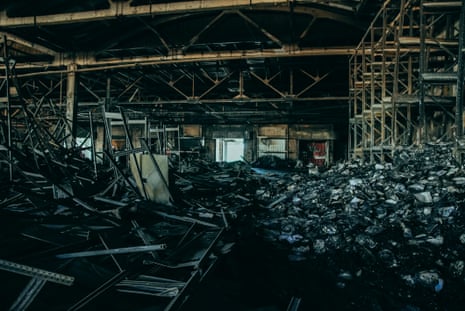
The meeting was scheduled for 11am. But a couple of moments after it began, there came “the sound of an explosion, and almost simultaneously I saw a huge fire”, said Kruglov. The impact was about 30 metres from where the staff were gathered, and, as colleagues set about trying to put out the flames, “there came a second strike and I understood that there could be a third, and a fourth, so we started to evacuate”.
The munitions used in the attack were jet-powered Shaheds, a recent and insidious escalation of Russian drone technology, faster and harder to intercept than their predecessors. These are the weapons that have been lately terrorising Kyiv during daylight hours, ploughing into the National Academy of Sciences and a working medical clinic in the past week.
“Fifty people were on shift that day,” said Kruglov of the warehouse strike, “and I don’t know how to explain how nobody was injured.”
The combination of an explosion, jet fuel and a warehouse full of paper was catastrophic. None of the books could be salvaged and 8m were destroyed. It took firefighters a week to bring the flames under control.
Several weeks on, smoke still rose from parts of the warehouse. The roof seemed on the verge of collapse, metal beams listing alarmingly, twisted out of shape by the heat.
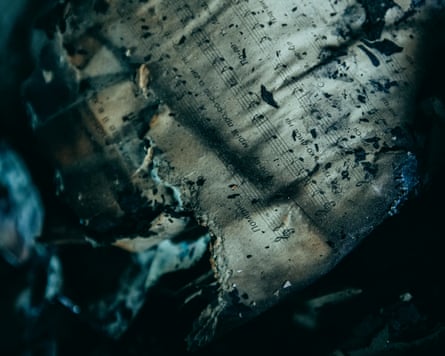
Shafts of sunlight slanted through the damaged roof, illuminating the catastrophe. The smell was terrible, clinging to clothes and hair. As far as the eye could see, the wreckage of books lay in mounds.
In some places, engulfed by the firefighters’ water, they had dissolved into a thick, stinking, mud-like slurry. In others, they were charred at the edges but recognisable as what they once were: children’s picturebooks illustrated with animals and flowers, geography textbooks, young-adult fiction. Others were nothing but swollen millefeuilles of blackened pages that flaked away to the touch.
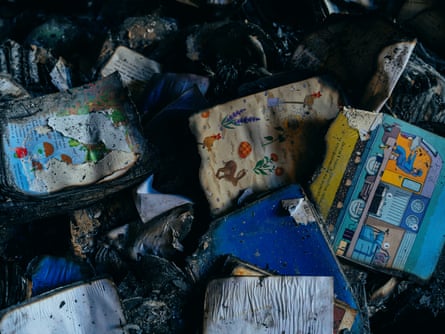
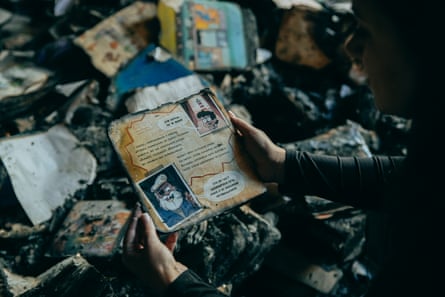
A couple of editorial staff, visiting the wreckage for the first time since the attack, looked shaken as they recognised fragments of books they had written or edited. “When you see what was produced with your brain, with your hands, with your imagination, spoiled by Russia, it’s an awful feeling,” said Kruglov, a trim, bald, blue-eyed man in his early 60s.
Those 8m books represented more than 85% of Ranok’s total stock, he said. In the main branch of Ranok’s own Knyholand bookstore in Kyiv, the display still looked cheerful and dense in late September – but, predicted Kruglov, there will be shortages this autumn when the books instore run low and there is nothing to replace them.
In total, this summer, 13m Ukrainian books have been destroyed by Russian missiles or drones – a third, estimates the government, of all books printed in Ukraine this year.
Books, literature, culture and language are not peripheral to Russia’s war on Ukraine – they are bound up in it. The full-scale invasion in February 2022 was prompted, at least in part, by Vladimir Putin’s conviction that Ukraine and Russia have no true separate cultural identity.
Kruglov said he was sure his warehouse full of Ukrainian-language, Ukraine-produced books had been deliberately targeted. “It is nowhere near any military facilities and everyone knows it is a book warehouse,” he said.
Bohdana Laiuk, a Ukrainian deputy minister for culture, who works on literature and publishing, takes a slightly different view: the recent attacks on books should not be seen in isolation, but as part of the invaders’ recent campaign of attacking warehouses, depots and fulfilment centres of any kind. “They cannot occupy Kyiv,” she said. “So they target warehouses around Kyiv to take the possibility of everyday life from us – and books are part of everyday life.”
But books are also part of language, and language is part of identity and, often, nationhood. Books are, said Laiuk, certainly considered important by the Russians invaders. “When the Russians occupy, the first thing they do – and we know this from the areas that were occupied and then liberated in 2022 in the Kherson and Kharkiv regions – is to go to the libraries, take the Ukrainian language books out, and destroy them,” she said.
Until 2022, about 70% of the Ukrainian book market was Russian-language titles – most imported from Russia, some published in Ukraine.
The dominance of Russian publishing had a long history. Its seeds lay in 19th-century decrees under the tsars against publishing in Ukrainian and continued through the Soviets’ promotion of Russian as the language of aspiration, education and culture. Ukrainian writers were purged and Ukrainian literature left in the shadows, shut out from a canon that lionised the Russian novel.
After Ukraine’s independence in 1991, the idea of a commercially successful Ukrainian-language novel that tackled modern social issues was so unthinkable that publishers initially suggested to Oksana Zabuzhko that her 1996 novel Fieldwork in Ukrainian Sex be published in Russian translation. She insisted it was published in the language it was written. It became a bestseller, paving the road for waves of contemporary Ukrainian literature.
Laiuk characterised the dominance of Russian book imports as a kind of colonialism. “It should be compared to how Russians invested in Ukrainian media outlets, Ukrainian TV channels, Ukrainian newspapers and magazines.” It was a conscious policy, she argued. “This is how Russians think: when they arrive on tanks, everything will be ready for them because they already have this information space.”
But in 2022, Ukrainian booksellers abruptly stopped selling Russian imports, in line with the rupture of all commercial ties between the countries. At the same time, swathes of the Ukrainian population switched their day-to-day language from Russian to Ukrainian.
They switched reading matter, too, and Ukraine’s publishers fed the appetite with new editions of classic Ukrainian literature from the 1920s, poetry, translations, and new Ukrainian writing. The country’s publishers may publish Russian-language books, as long as at least half their titles are in Ukrainian; in practice the social barriers to doing so, at the moment, would be prohibitive. (Death and the Penguin author Andrey Kurkov, for example, writes his novels in Russian, but they are published only in Ukrainian translation; he writes nonfiction and children’s books in Ukrainian.)
“People began to understand that the Russians came here to kill people simply because they were Ukrainian,” Laiuk told me in 2023. “So people are asking: what does it actually mean to be Ukrainian? Literary culture gives us the place to understand who we are.”
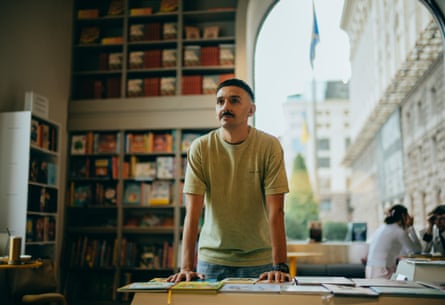
Oleksiy Erinchak opened the first of his chain of Ukrainian-only bookstores, Sens, in 2021. In 2024, while the city was under fire, he opened a second, in a huge building on Khreshchatyk, Kyiv’s grandest boulevard, to which he has recently added a third floor, with an expansive events space. He has another branch in the western city of Ivano-Frankivsk and he has just opened a fourth, in a former cinema in Lviv.
“When you go to a bookstore like Sens,” said Laiuk, “you feel that you have dignity. You have the right to buy a new book and to choose which one you like. And when you have drones above your head, it gives so much space, inner space in your heart and soul, and in your mind.”
The rapid expansion of Sens is a symptom of something unlikely: a Ukrainian publishing boom amid a full-scale invasion of the country. And now, that boom is threatened by the force and frequency of Russian attacks.
Kateryna and Artem Sova started their imprint in 2023, in the thick of the new Ukrainian publishing boom. By then Artem had been in the army for nearly a year and Kateryna was several months pregnant, living in her hometown of Kremenchuk, on the River Dnipro in central Ukraine. It was their dream: they had both worked in bookstores and at arts festivals for years. Part of the point for Artem was to keep some chink of his old self alive. “I realised,” he said, speaking in Zaporizhzhia during a break from his military duties, “that I was detached from everything I love.”
They began with Lonely City, a nonfiction work about art and the experience of urban isolation, by the British author Olivia Laing. They had loved it since they read it a decade ago, and were bemused it was not already translated. They wrote to Laing’s agent asking whether they could acquire the rights.
“We tried to explain why this book is important for Ukrainians now, and to me personally,” Artem said, recalling. “This experience of being lonely is kind of universal, but it has been multiplied because a lot of people went into the army, and there are so many displaced people in Ukraine: separated couples, destroyed lives.”
Laing, to their surprise, agreed: only then did they actually go through the legal process of setting up the company. They called it Krapky – Ukrainian for “ellipsis”, the three dots being their favourite punctuation mark, signifying, said Kateryna, as she sipped coffee in an independent bookshop in Kremenchuk, that they wanted reading their books “to be an ongoing conversation. Something that doesn’t stop when you close the book.” Their aim was for every book they published to be expertly translated and wonderfully illustrated.
In 2025, they finally went to Kyiv Book Arsenal – the great annual gathering for publishers, writers and readers in the capital – with a beautifully designed edition of Lonely City. By this year’s Book Arsenal they had several titles already out, and translations of Laing’s To the River and Karen Blixen’s classic, Out of Africa, in the pipeline. In preparation were also works by Flannery O’Connor, among others. “We wanted to get to a position where we were publishing eight to 10 titles a year,” said Kateryna.
Recently, they had signed a contract with Nova Poshta, the Ukrainian postal service, to handle fulfilment – so that Kateryna was not sending out the books herself to customers and bookstores. She was driving her sister to university on the morning of 28 August when Artem rang. The warehouse where their books were held, on the periphery of Kyiv, had been attacked. Kateryna had to pull off the road in her distress. At the Lviv BookForum, a fortnight later, their stand was empty but for a QR code so visitors could preorder their forthcoming titles. They had nothing physical to sell. All of their books had been destroyed.
Ranok is now rushing to reprint textbooks and bestsellers, hoping to get precious teaching materials into schools – and plug the shortfall in cashflow with sales of popular titles. Vivat, a large Kharkiv-based publisher, which lost 16m Ukrainian hryvnia (about £270,000) worth of books in a hit on one of its warehouses this summer, is doing the same. “We’ll definitely continue publishing Ukrainian authors, and the schedule for 2027 is already finalised,” said Vivat’s spokesperson, Kateryna Ilchuk, between events at Lviv BookForum. “But probably yes, it will mean going with more mainstream titles.”
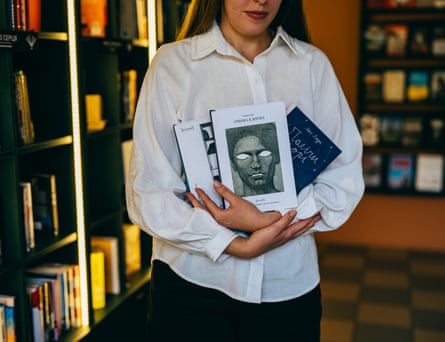
Small literary publishers such as Krapky are the most vulnerable in the current crisis. Another small independent press, Who is That?, recently announced a pause in its operations until the end of the war, after the destruction of all of their stock this summer in two separate airstrikes.
For debut authors, or writers of less commercial or more experimental titles, this is a bleak moment. Even before the summer drone hits, there had been delays in some books’ publication owing to attacks on printing infrastructure. Ksenia Shpak’s debut young-adult novel – an urban fantasy about a girl internally displaced from eastern Ukraine to the Carpathian mountains – was originally due out in February 2025. It was finally published, by the imprint Zhorzh, in November.
But half the print run was in the Ranok warehouse in Kharkiv when it was attacked. “I must say that it’s sad because it was my first published book,” said Shpak, “and now my publisher will focus on their bestsellers, and only after that if they get enough money will they reprint my book.” She mentioned other factors that had lately cooled the Ukrainian publishing boom: a levelling out of demand; the rise in the cost of living. “It feels like there is a snowballing of bad things for our publishing industry,” Shpak added.
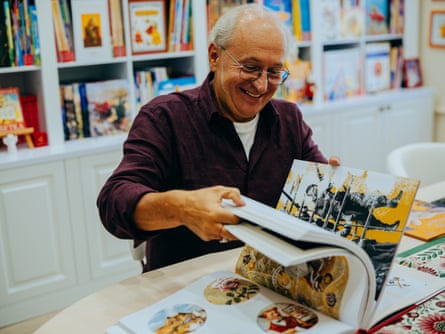
“It’s shaky,” said veteran poetry editor, poet and children’s publisher Ivan Malkovych. His premises – in central Kyiv, shared with a male-voice choir, the sound of whose rehearsal wafted through the editorial offices as he spoke – presented an absolute contrast to the desolation of the Ranok warehouse. In one room, a wall of shelves displayed ranks of exquisitely illustrated children’s titles, and handsome volumes of poetry. He began his company amid the economic chaos of the early 1990s, starting with a Ukrainian alphabet book, printed on board a supplier let him have on the vague promise he’d pay for it in six months (the book was a success, and he did). The alphabet began, “A is for Angel”, and the angel has been the publishing house’s good luck charm ever since.
Malkovych has published many children’s books, but none in such quantity as Harry Potter. His editions hit the shelves faster, and were better translated, than the Russian versions (“We Ukrainianised a lot of children that way,” he said.) He lost 40,000 books in the same Nova Poshta warehouse attack that destroyed Krapky’s stock – about $500,000 (£377,800) of losses. “We were always proud of our delivery service – you could order a book at 4am and it would arrive by midday. Now we face big delays,” he said. He was particularly worried about the next Harry Potter release, on 6 October. There had been a lot of pre-orders and he wanted delivery to be synchronised with the rest of the world, despite the full-scale invasion.
For publishers like Malkovych – whose staff have elected not to leave Kyiv, despite the oncoming winter and the new Russian jet-powered drones – the task now is to adapt: they will now spread stocks of book in smaller warehouses across the country, at the expense of super-fast delivery times. There is hope for Krapky too: Nova Poshta may reimburse it for some of their lost stock; there has been an outflowing of support from readers who have preordered forthcoming titles; and it has received a grant from an NGO towards reprinting costs.
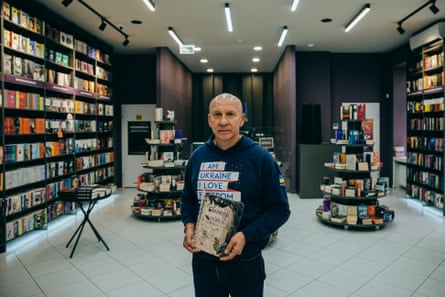
When Laiuk visits Frankfurt book fair this October, she will be promoting a Kyiv School of Economics fundraiser for small Ukrainian publishers like Krapky. But she will also urge global publishers to translate Ukrainian titles. “It’s important to see that the industry is suffering and to see the devastating pictures of burned books. But that is not the whole story. The whole story is that Ukrainian literature is rich and diverse as never before. The best way is to see that is to translate, and to bring new voices to the discourse in your country.”
As for Kruglov, despite the devastating loss of 8m books, he was, somehow, optimistic. Surveying the absolute ruin of his Kharkiv premises, he said, “I think that we will rebuild everything. And I even know how to do it better.”
KioskNews shows a cleaned-up reading view extracted from the publisher’s page — the original always lives on their site, not ours.