Koome reports 2.5pc drop in case backlog, says more cases cleared than filed
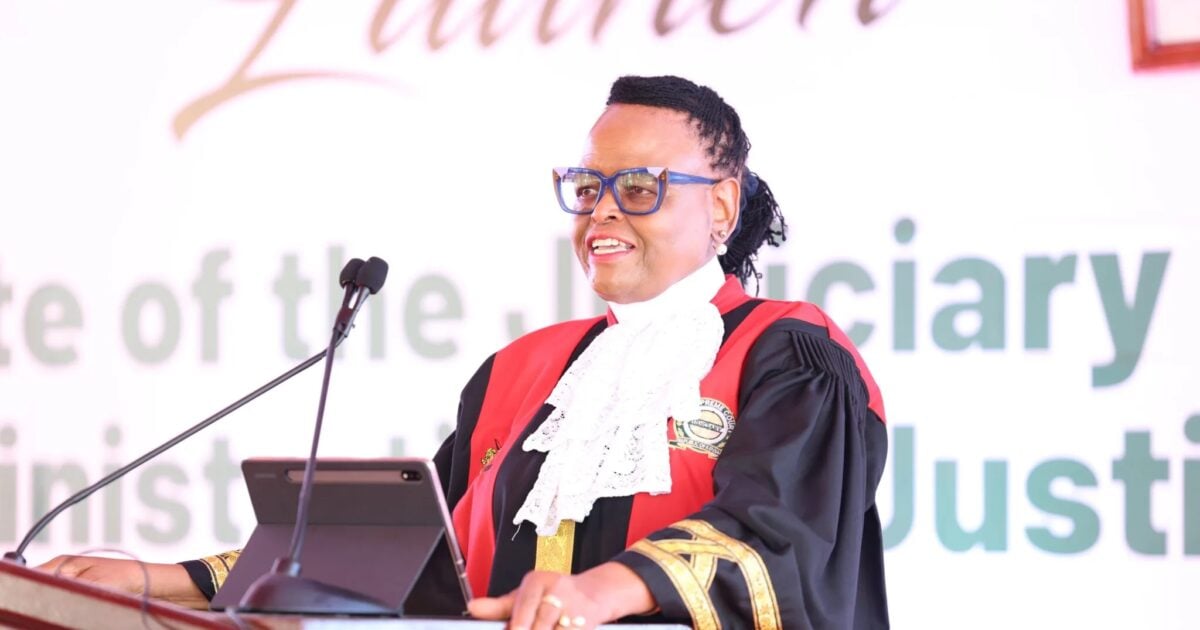
NAIROBI, Kenya, Nov 20 — The Judiciary resolved more cases than were filed for the second consecutive financial year, reducing the overall pending caseload by 2.5 per cent, Chief Justice Martha Koome has announced.
The courts resolved 576,702 cases against 561,580 filed during the 2025/2026 financial year, achieving a Case Clearance Rate (CCR) of 103 per cent, according to the 2026 State of the Judiciary and Administration of Justice Annual Report (SOJAR).
Presenting the report on Friday, Koome attributed the improved performance to sustained efforts to enhance court efficiency, strengthen institutional systems and expand access to justice despite resource and staffing constraints.
The pending caseload fell from 595,076 cases at the beginning of the reporting period to 579,954 by June 30, 2026, while the backlog of cases pending for more than one year declined by 15.8 per cent.
However, Koome warned that 341,412 cases, representing approximately 59 per cent of the total pending caseload, had remained unresolved for more than a year, highlighting the pressure facing courts and the need to address judicial staffing shortages.
Expansion of court services
The Judiciary expanded its geographical reach during the year, establishing two new Court of Appeal stations in Kakamega and Meru, operationalising the Eldoret Court of Appeal station and opening an Embu sub-registry.
Five additional Magistrates’ Courts became operational, bringing their total to 148, while 15 new Small Claims Courts increased the national footprint to 55 stations.
Despite the expansion, 101 constituencies still lacked Magistrates’ Courts, with Koome identifying geographical access to judicial services as a continuing priority.
Alternative dispute resolution also recorded progress, with Court-Annexed Mediation reaching all 47 counties through an expanded network of 128 registries.
Of disputes valued at approximately Sh20.88 billion referred to mediation, settlements worth Sh13.05 billion were achieved without full trials.
Alternative Justice Systems were operational in 29 court stations, while 14 counties had developed county action plans to support their implementation.
Digital justice and staffing challenges
The Judiciary also reported progress in digital service delivery, with electronic filing and the Case Tracking System operational across all courts and tribunals.
A further 192,633 case files were digitised during the year, bringing the cumulative number to 749,522.
The Judiciary Contact Centre resolved 13,574 enquiries, while the pilot implementation of Mahakama AI, a legal research tool, commenced.
On staffing, the Judiciary made 1,280 appointments, including 53 Judges and 100 Resident Magistrates.
However, the institution had 8,017 employees against an approved establishment of 12,079 positions, representing a staffing level of approximately 66 per cent.
Koome said the staffing deficit continued to constrain the Judiciary’s capacity to improve case resolution timelines and expand services.
Judiciary calls for increased funding
The Judiciary’s budget increased by 19 per cent to Sh27.15 billion during the 2025/2026 financial year but remained below its operational requirements, leaving a funding gap of Sh12.95 billion.
Koome called for adequate, predictable and sustainable financing to support recruitment, infrastructure development, technological modernisation and access to justice in underserved communities.
She also highlighted the need for legislative reforms, including enactment of the Tribunals Bill and Kenya Judiciary Academy Bill, as well as reviews of the Kadhis’ Courts Act and Small Claims Court Act.
On accountability, the Chief Justice reaffirmed the Judiciary’s commitment to integrity and public trust, saying corruption, bribery, favouritism and misconduct had no place in the administration of justice.
The Office of the Judiciary Ombudsman resolved 1,111 of the 1,243 complaints received during the reporting period, representing an 89 per cent resolution rate.
Kindiki pledges government support
Deputy President Kithure Kindiki reaffirmed the government’s commitment to supporting an independent and adequately resourced Judiciary through budgetary, legislative and institutional interventions.
Kindiki said the Judiciary’s budget had increased by 19 per cent to Sh27.15 billion in the 2025/2026 financial year and would rise further to approximately Sh30.4 billion in the 2026/2027 financial year.
He cited the appointment of 53 additional Judges, enactment of the Judges’ Retirement Benefits Act, 2026, and Cabinet approval of the proposed Sh26 billion Judicial Performance Improvement Project Phase II, in partnership with the World Bank, as key interventions.
The project is intended to modernise judicial infrastructure and strengthen institutional capacity.
Kindiki also pledged government support for legislative reforms, including the Tribunals Bill and Kenya Judiciary Academy Bill, alongside a review of the Small Claims Court Act.
He said cooperation between the arms of government was necessary to ensure increased investment translated into shorter case resolution timelines, more accessible courts and greater public confidence in the administration of justice.
Lands Cabinet Secretary Alice Wahome and National Assembly Justice and Legal Affairs Committee Chairperson George Murugara, who represented Speaker Moses Wetangula, also addressed the gathering.
KioskNews shows a cleaned-up reading view extracted from the publisher’s page — the original always lives on their site, not ours.