Six prototypes later, SIA adds doors to business class
SINGAPORE – At least six prototypes were produced before Singapore Airlines (SIA) settled on the final design for its brand-new business-class seats.
The seats will also feature sliding doors – a first for the airline in business class.
Mark Hiller, chief executive of seat manufacturer Recaro, said the team had to “push boundaries” to ensure that the seats were as wide as possible, with very thin doors that still provide privacy.
Recaro also produces automotive seats for high-end car brands, including Aston Martin and Porsche.
Recaro Aircraft Seating chief brand and design officer Hartmut Schurg added that the team had to strike a balance between offering passengers privacy and allowing cabin crew to serve passengers easily.
The team did so by optimising the height of the doors in relation to the new seats. This allows shorter cabin crew members to peer over the door when standing, while giving taller passengers privacy in the seats without making them feel claustrophobic.
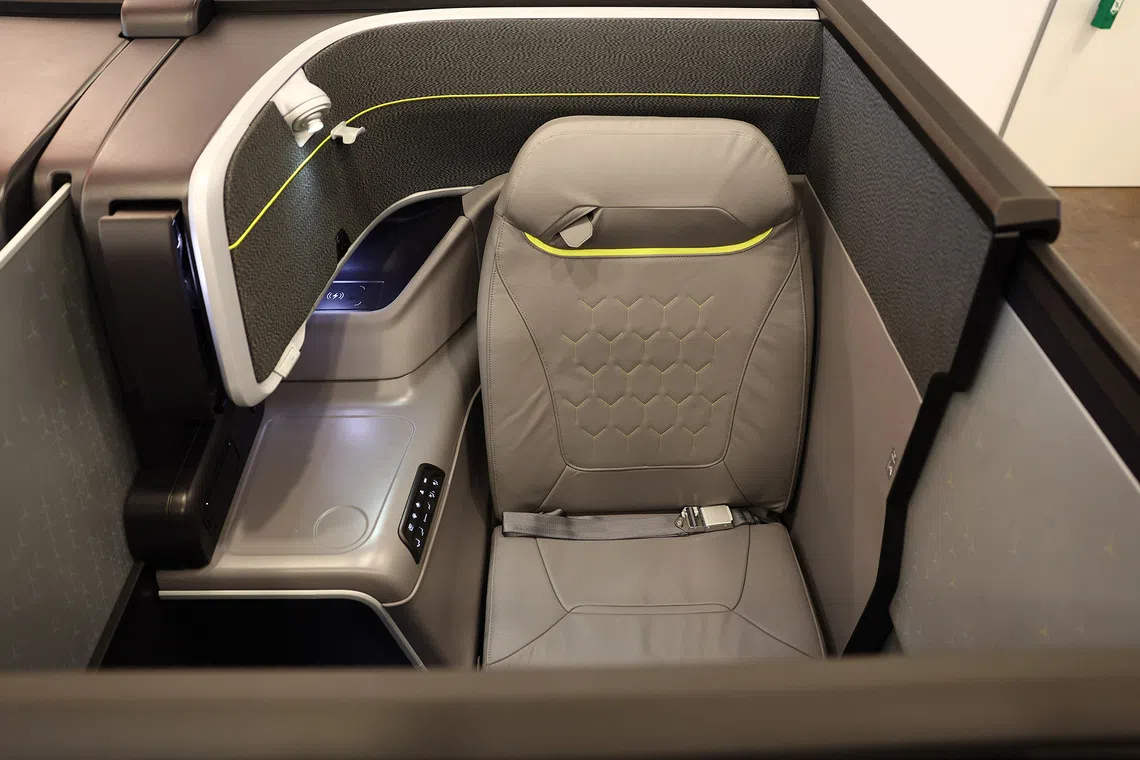
A first for the airline in business class – sliding doors.
ST PHOTO: BENJAMIN SEETOR
SIA’s 34 Airbus A350-900 long-haul aircraft will be retrofitted to include 42 new business-class seats, while its seven A350-900 ultra-long-range jets will be upgraded to fit 70 of these seats – three more than the current arrangement.
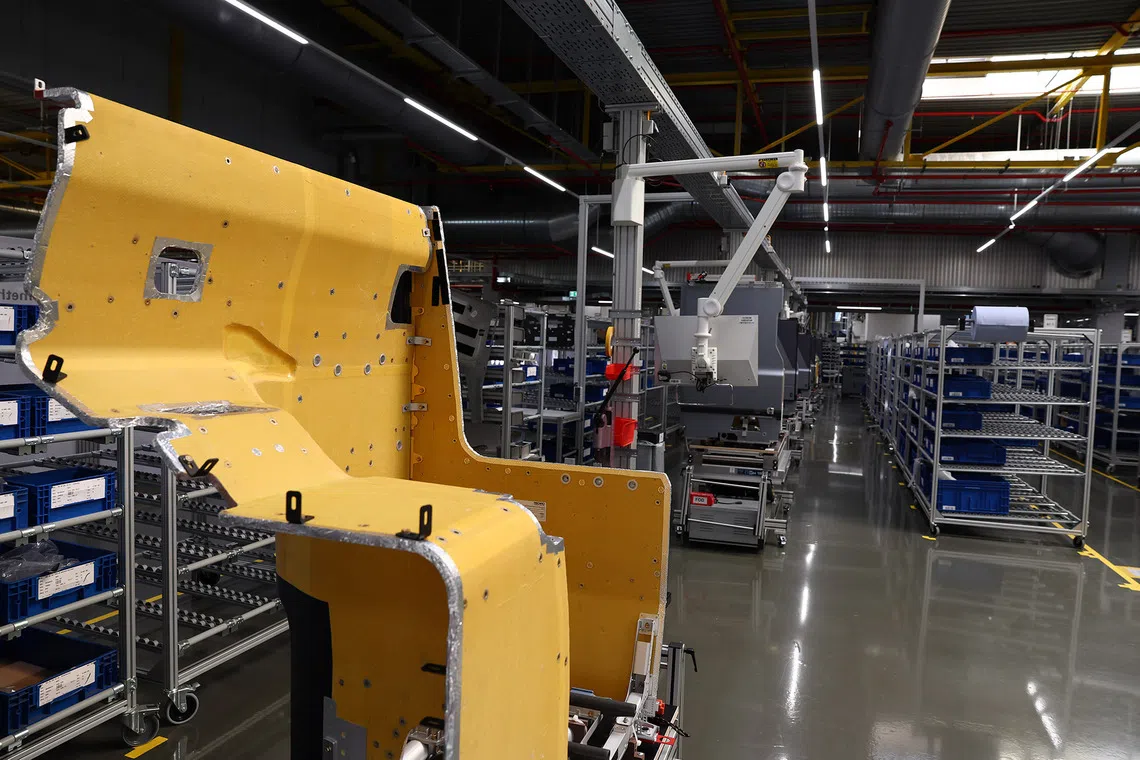
The shell or outer structural layer of the new business-class seat on display as part of the production line for the new seats at Recaro’s manufacturing facilities in Schwabisch Hall, Germany.
ST PHOTO: BENJAMIN SEETOR
It took SIA more than seven years to find the right balance between weight, premium quality, comfort and reliability for the new seats.
This involved running tests on 3D seat prototypes with potential users to assess whether they could see and reach control buttons easily, while feeling comfortable in the seats.
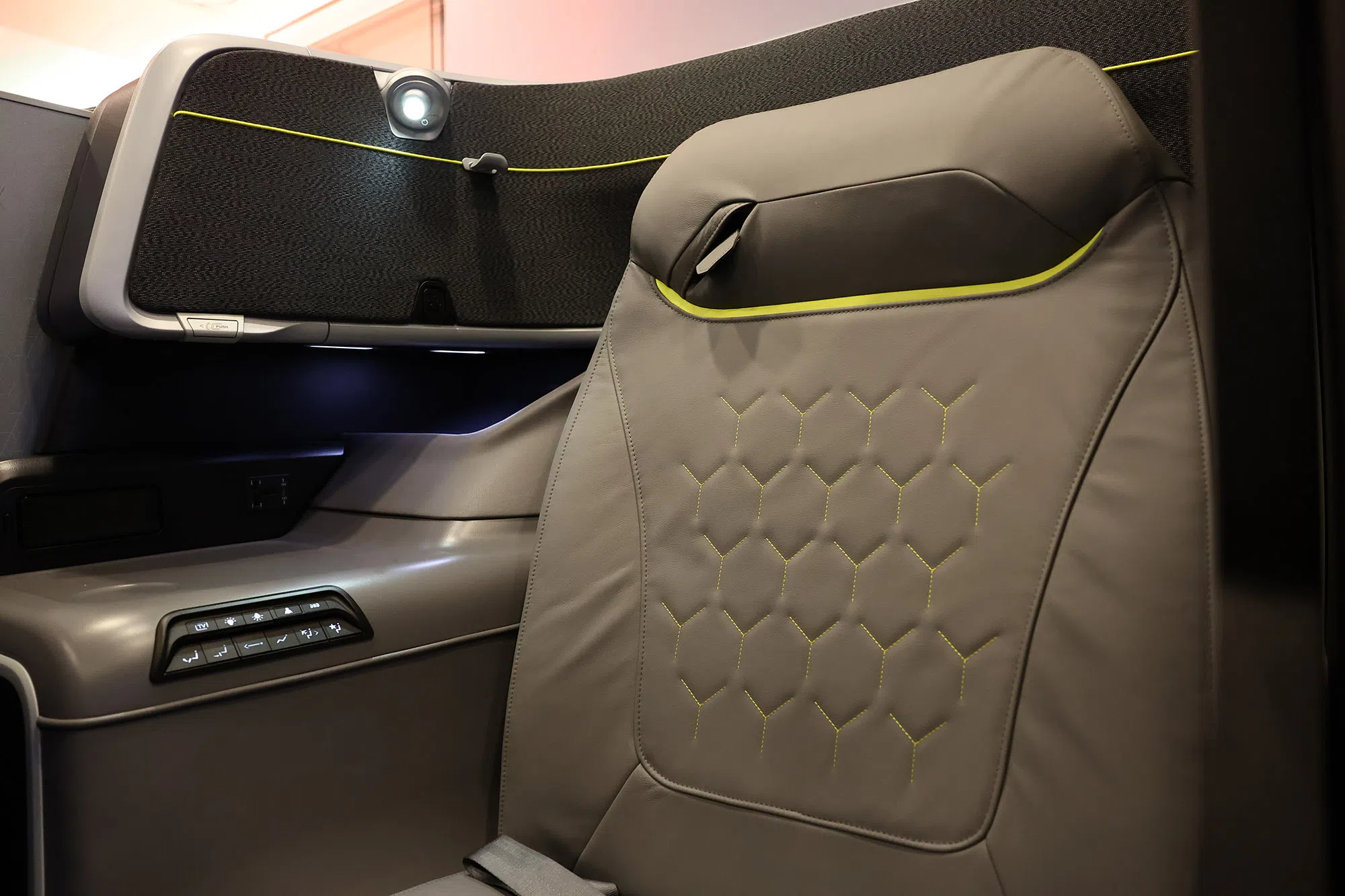
Electronic controls at the side of each seat allow passengers to adjust the position of the seat’s leg rest and lumbar support.
ST PHOTO: BENJAMIN SEETOR
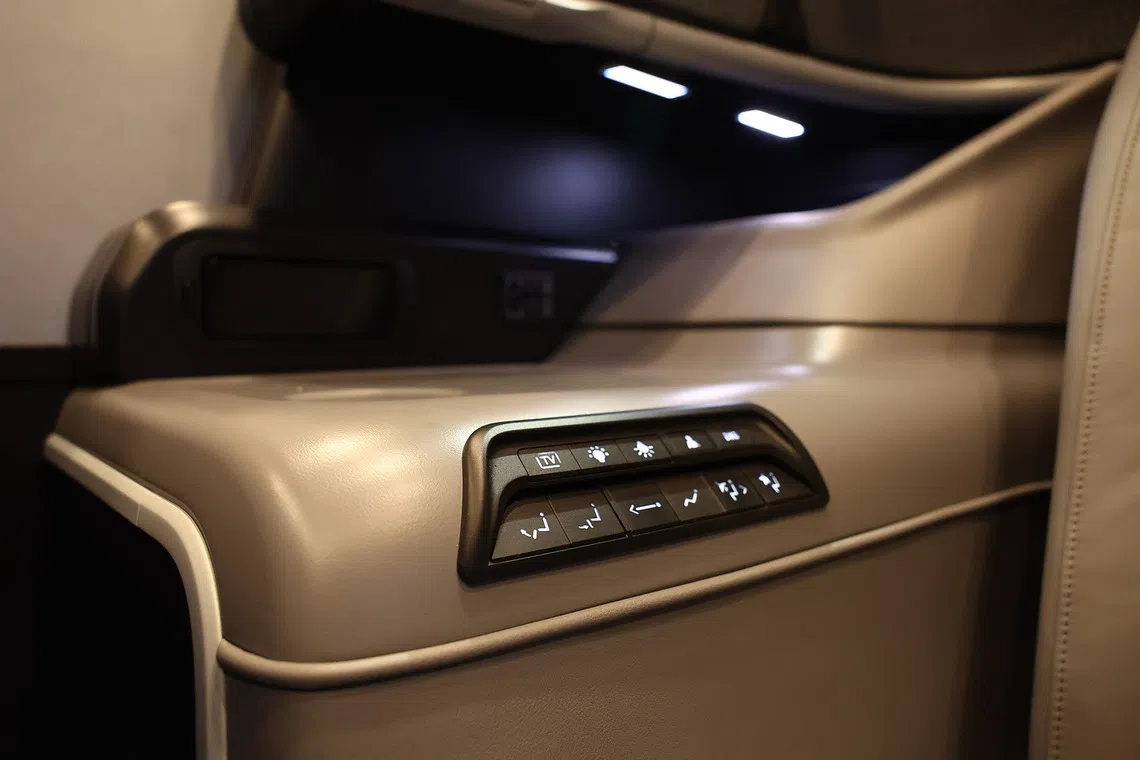
Tests were carried out on potential users to assess whether control buttons could be seen and accessed easily from the seat.
ST PHOTOS: BENJAMIN SEETOR
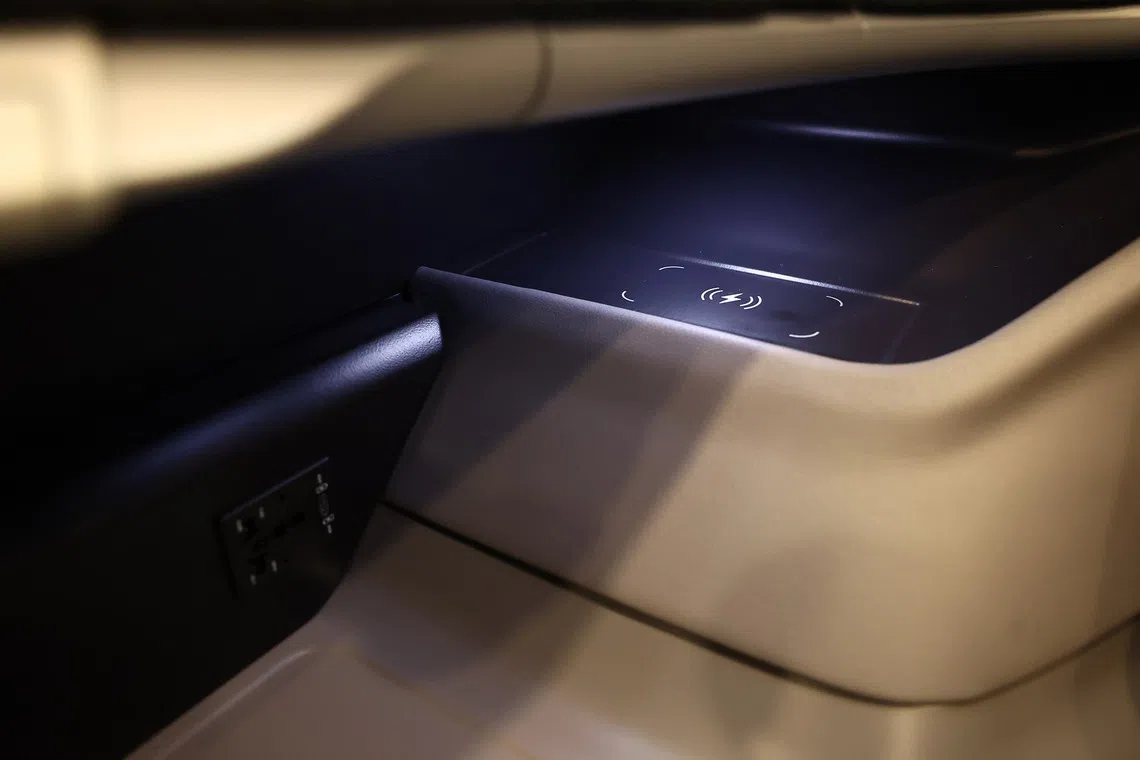
Each seat comes with wireless charging capabilities.
Schurg said the most important part of the design process was building seat mock-ups “again and again” for tests.
Hiller said the new seats need to be reliable, given that they will be in use for more than 20 hours daily over more than a decade.
They also need to be comfortable and lightweight without compromising on the standards for aircraft seat certification.
Recaro had to carry out vigorous crash tests on the seats at its headquarters in Schwabisch Hall – a historic town 2½ hours from Frankfurt Airport.
It ran simulations of hard landings with different load cases or gravitational forces (G-forces), including 16G towards the front and 40G downwards to simulate a plane’s hard landing impact.
G-forces measure rapid acceleration or deceleration relative to the normal pull of gravity on earth, which is considered plus 1G. At plus 16G, for instance, a person would feel like they are 16 times their body weight.
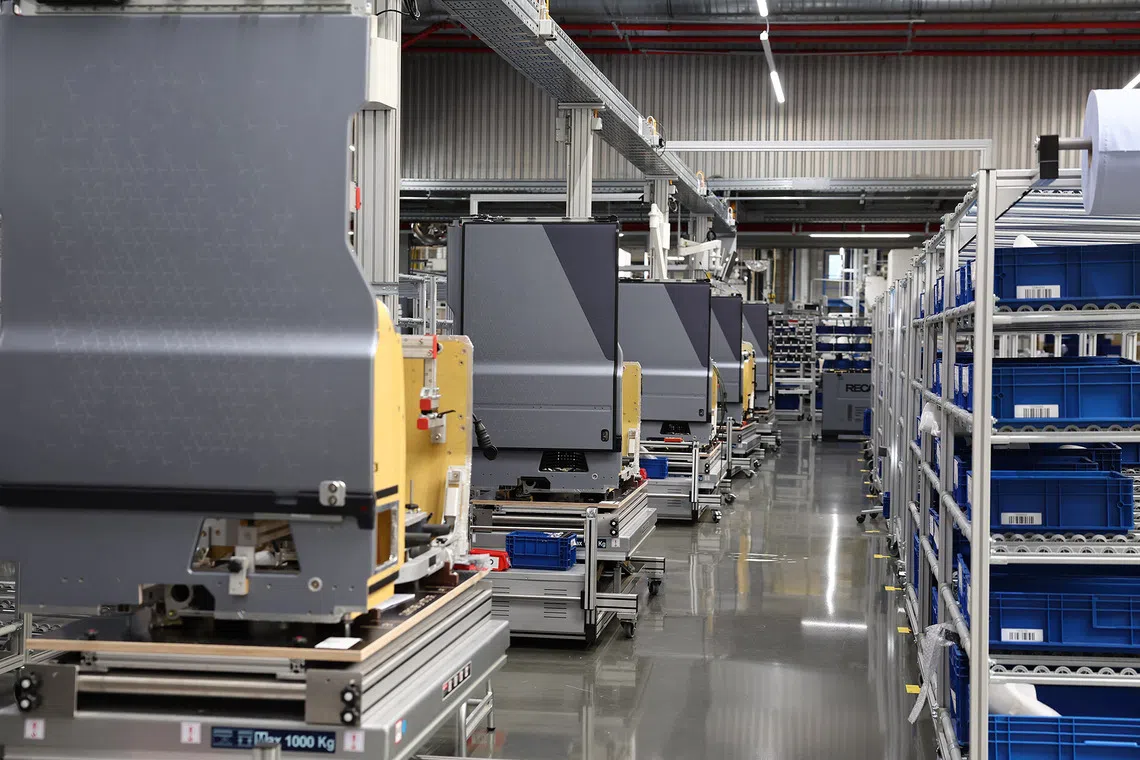
Each new business-class seat takes up to 34 hours to be completed at Recaro’s seat manufacturing facility.
ST PHOTO: BENJAMIN SEETOR
Each new business-class seat is 24 inches wide on the Boeing 777-9s and 22 inches wide on the A350-900 long-haul aircraft and A350-900 ultra-long-range aircraft.
On the difference in widths, the airline said the new seats have been designed to accommodate the different cabin dimensions and configurations of the Boeing 777-9 and A350-900 aircraft. The interior of the Boeing jet is wider than that of the A350-900 plane.
The seat can recline into a 79-inch-long full-flat bed at the touch of a button, allowing passengers to sleep stretched out straight.
This will be an upgrade from some existing business-class seats on SIA’s A350s and Boeing 777-300ERs, which often require cabin crew to help passengers manually flip the seats forward into beds.
Passengers previously needed to sleep diagonally, putting their feet into a narrow footwell.
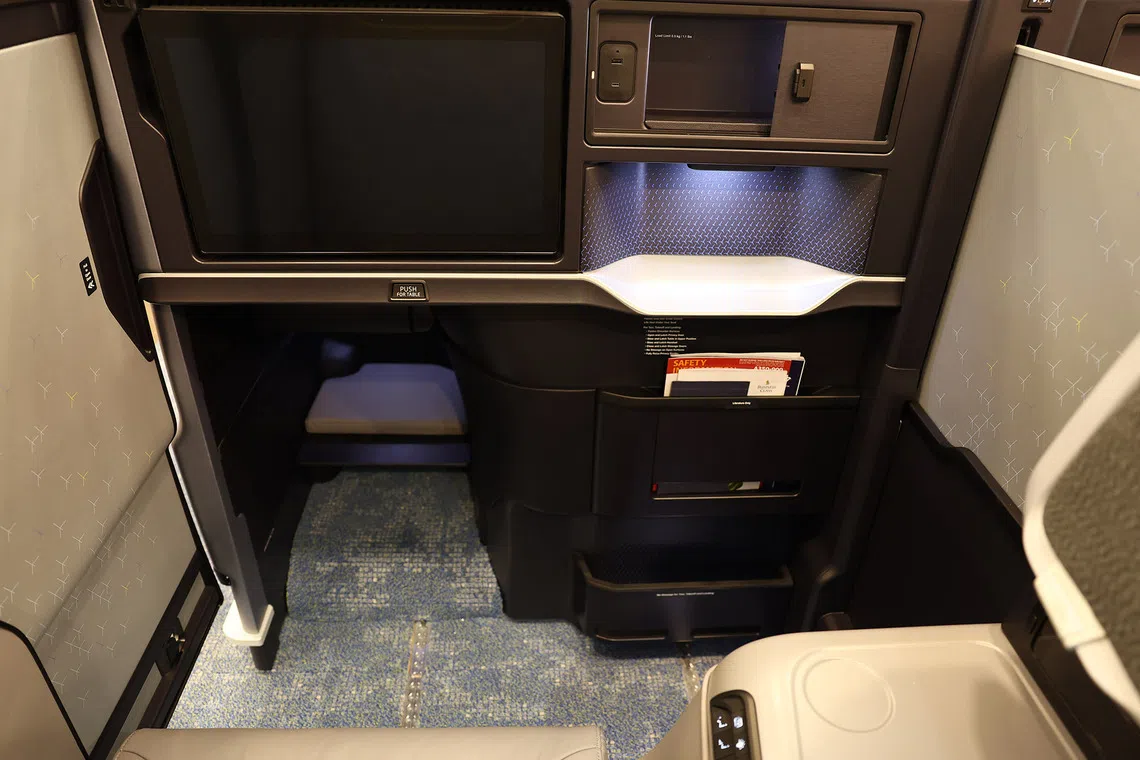
The footwell space is generous enough to accommodate a new method of stowing the foldable table under the in-flight entertainment screen.
ST PHOTO: BENJAMIN SEETOR
The new seat has a pitch – the distance between a seat and the one directly in front – of 50 inches, down from at least 55 inches on SIA’s existing aircraft.
Regarding the pitch difference, SIA said: “Seat pitch is one of several measurements that contribute to the overall seating experience, and does not necessarily reflect the usable space or comfort available to customers.”
At 22 to 24 inches, the width of the new seat is also narrower than that of existing ones, which measure between 25 and 30 inches.
But the footwell space is generous enough to accommodate a new method of stowing the foldable table under the in-flight entertainment screen, said Julia de Bono, chief executive officer of creative design firm Designworks.
The firm was responsible for coming up with the design of the new business-class seats and cabin interior.
Noting that the design of the new table is more intuitive, she said it is an improvement from the existing pop-up table located at the side of each seat. That is because the current table can be quite cumbersome for passengers to pull out and they may require cabin crew’s help.
De Bono added that the team considered how passengers would interact with the seats differently and designed the space to allow flexibility for them to do various tasks in their preferred sequences.
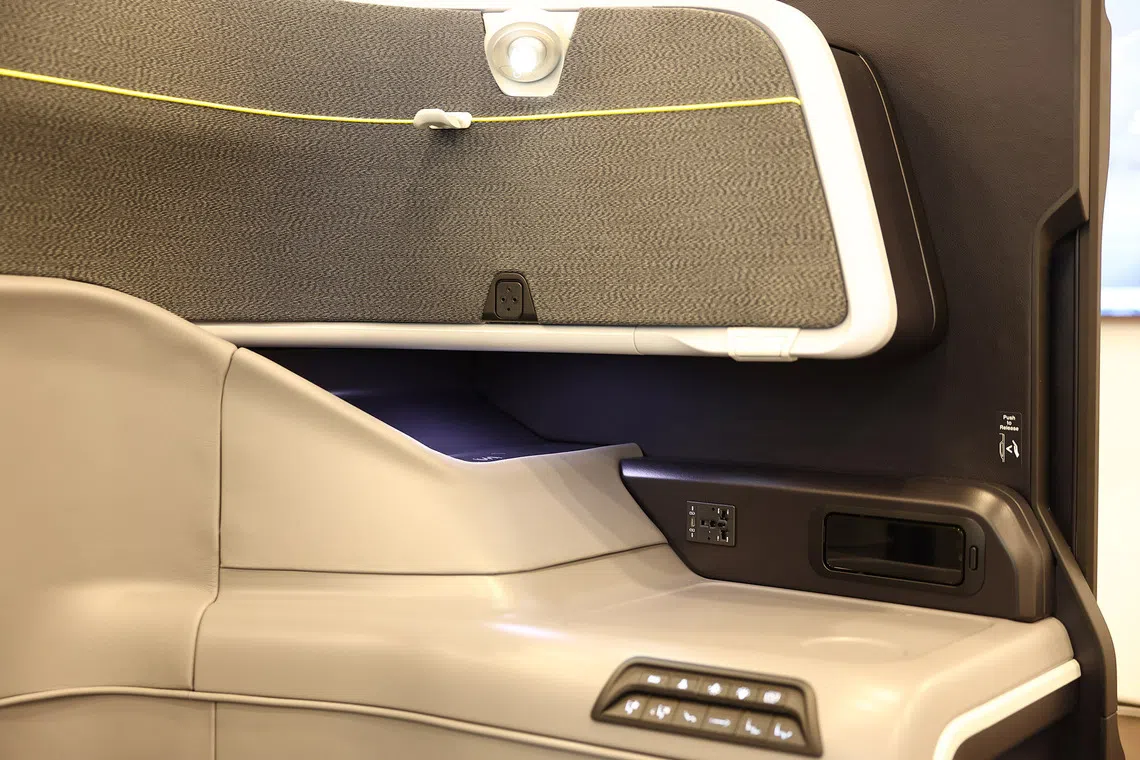
Every seat is equipped with a large side console for passengers to store their laptops while they eat their meals, and another platform to place their phones.
ST PHOTO: BENJAMIN SEETOR
For example, there is a large side console for passengers to store their laptops while they eat their meals, and another platform to place their phones.
On the biggest challenge during the design process, she said it was making the space intuitive and easy to use.
At Recaro’s facility, the largest premium seat manufacturing space in Germany, each business-class seat takes up to 34 hours to build.
Every seat passes through a U-shaped production line measuring 14m by 41m. The unique layout gives workers more flexibility to switch between tasks as multiple seat components are manufactured simultaneously.
Ong Wah Li, vice-president for product experience at SIA, said the airline reached out to more than 1,000 frequent SIA business travellers in the United States, United Kingdom, Australia, China, Japan and Singapore to find out what they look for in a business-class seat and how they prefer to transition between sitting, working, eating, resting and sleeping.
Passengers said they wanted better lumbar support and to be able to seamlessly recline their seat.
They also valued comfortable sleep and greater convenience, including easy-to-use controls and memory functions that store their preferred seat settings.
On how SIA’s new business-class seats can stand out in the airline industry, Ong said the national carrier was responding to passengers’ desire for increased privacy and a personalised space they could control.
She added that the teams had worked to ensure that passengers can sleep well, with the spacious footwell allowing them to stretch out fully.
Asked how the new seats compare with those of SIA’s rivals, Ong declined comment, saying that SIA has a lot of respect for its competitors and is confident that the new business-class seats will “redefine luxury business travel in the sky”.
Hong Kong carrier Cathay Pacific progressively introduced doors to its business-class product, known as the Aria Suite, from late 2024, while Qatar Airways launched its Qsuite business-class seats with doors in 2017.
SIA chief commercial officer Lee Lik Hsin said substantial planning went into the seat design, pointing to the larger footwell and storage spaces.
These “little aspects of care”, he noted, are what set SIA’s business-class seats apart from its rivals.
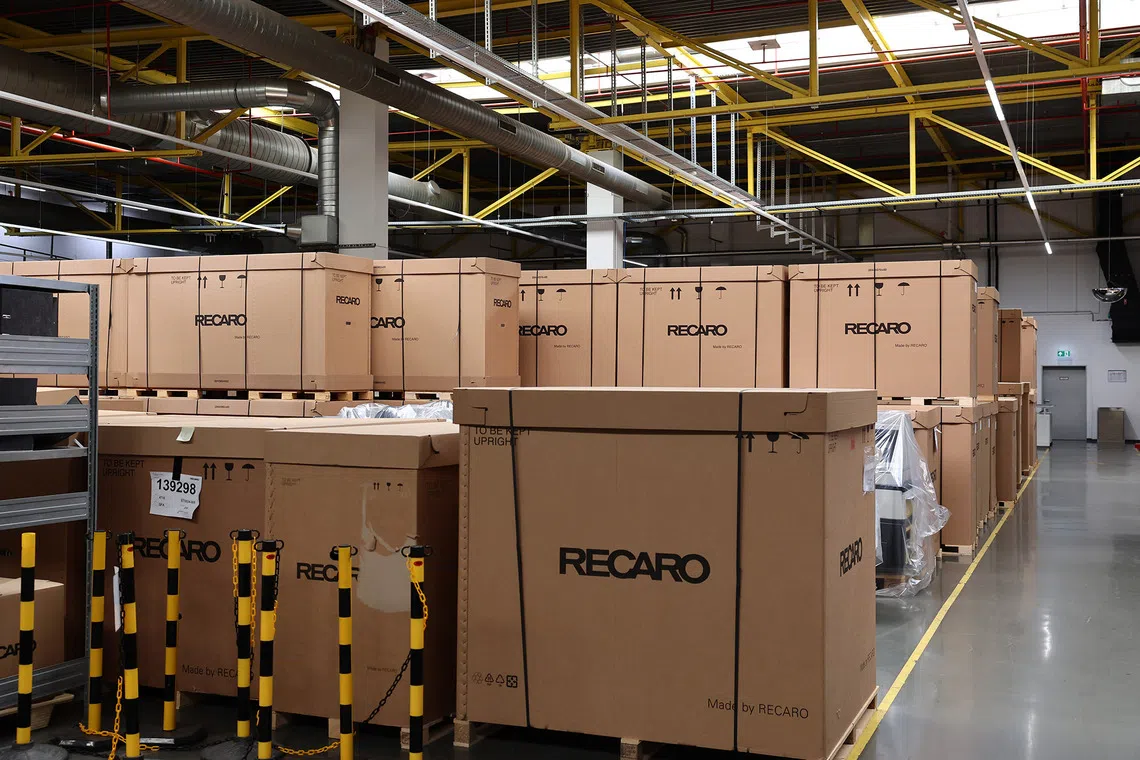
The completed seats are packed carefully into crates before being assembled on the planes.
ST PHOTO: BENJAMIN SEETOR
KioskNews shows a cleaned-up reading view extracted from the publisher’s page — the original always lives on their site, not ours.