Delhi's smog came from farm fires lit after NASA's satellite passed
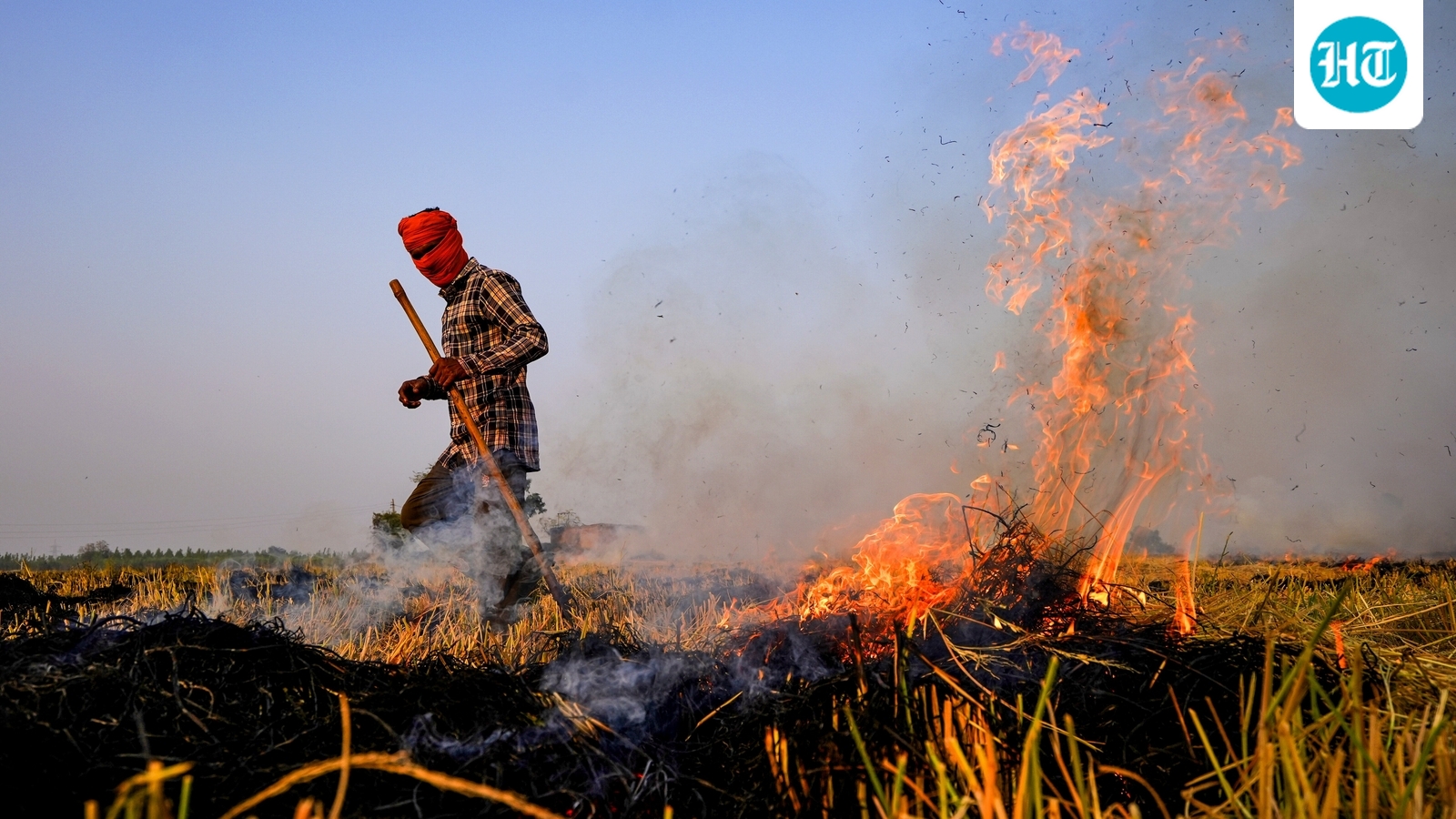
On two Oct nights with the same weather, Delhi's air was far cleaner. India's weather satellite shows surge in evening crop burning in the 4 days before Nov 1.

 Prefer HTon Google

Smoke from farm fires in Punjab and Haryana drove the sharp rise in Delhi's pollution on Sunday, which pushed the air into the "very poor" range on Monday, an HT analysis of air-quality, weather and satellite data has found. Most of the fires were lit in the evening, after the NASA satellite whose count is the standard measure of stubble burning had passed over the region.
Delhi's air quality index, which runs from 0 to 500, rose from 117 on Saturday to 261 on Sunday. By Monday morning the Central Pollution Control Board's (CPCB) hourly reading had crossed 300, the threshold for "very poor" air. Monday's 4pm bulletin put the index at 324, the season's first very poor reading. The last very poor reading this year was on February 11.
ALSO READ: GRAP-II pollution curbs imposed in Delhi-NCR as air quality dips further
The weather in the run-up was poor, with little wind and a still night. But Delhi had the same weather on October 18 and 28, and the air on those nights was far cleaner. The clearest measure is PM2.5, the fine particles that do the most harm because they reach deep into the lungs. India's limit for PM2.5, averaged over a day, is 60 micrograms per cubic metre of air. On the night of November 1, from 10pm to 6am on Monday, it averaged 194, more than three times that limit. On the October nights it averaged 68 and 127.
Same weather, dirtier air
HT compared November 1 with every night this season on three measures from the India Meteorological Department's weather balloon and the Safdarjung airfield: how well the afternoon wind cleared the air, how strong the dawn inversion was, and how still the night was. The inversion is a lid of warm air that stops air near the ground from mixing upwards.
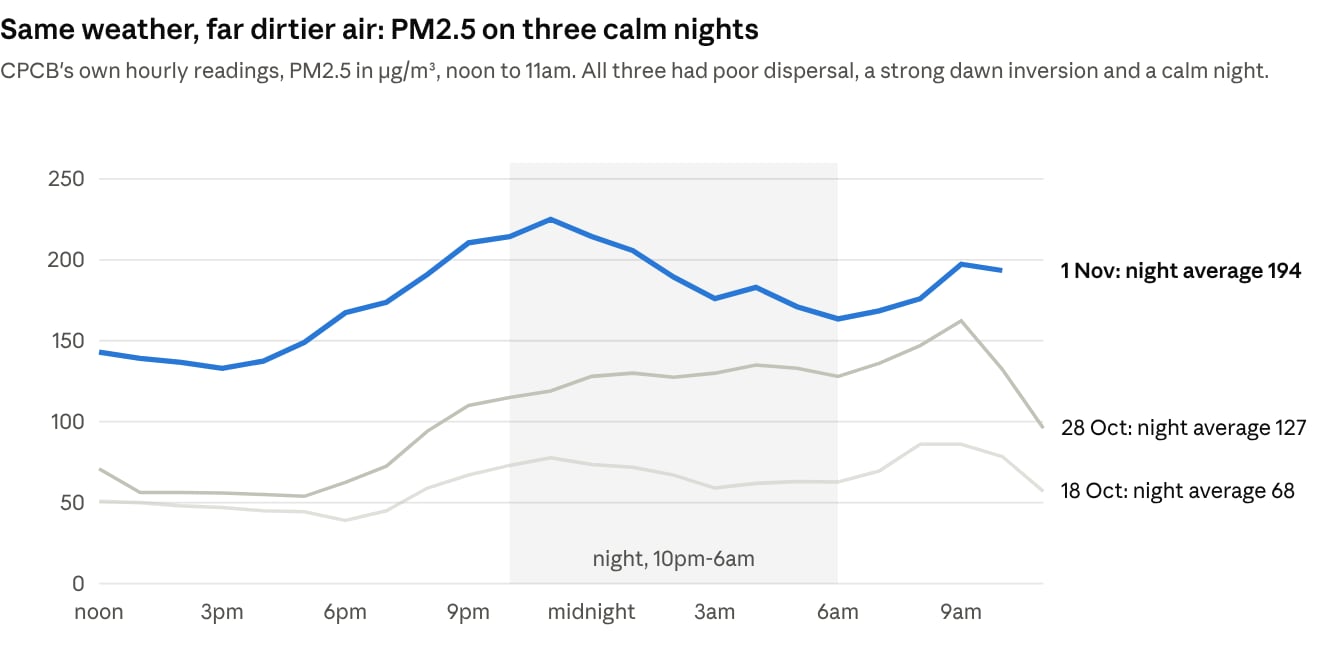
On October 18 and 28, all three were as bad as on November 1, or worse. Both nights were fully calm, and the lid was at least as strong. Yet the air on the night of November 1 held nearly three times as much PM2.5 as on October 18, and about half as much again as on October 28.
Not a rebound from the rain
Rain on October 29 and 30 washed the air, and the index fell to 60 on Friday. The index is an average of the past 24 hours, so as those clean hours dropped out of it, the index would have risen anyway.
The hourly readings, however, show that by the morning of November 1 the air was about as dirty as on the morning of October 28. The two days diverged after that.
The pollution came in by day
On a bad morning in Delhi, pollution trapped overnight hangs low over the city. As the sun warms the ground, the air starts to churn, the pollution spreads upward, and readings at street level fall. Pollution from the city's own traffic, trapped overnight, thins out this way. On October 28, PM2.5 fell by nearly two-thirds by mid-afternoon. On October 18, it fell by more than half. On November 1, it did not fall at all: it was slightly higher in the afternoon than in the morning.
Readings hold steady only when the air higher up is as dirty as the air at street level, or when dirty air is blowing in. Either way, the extra pollution on November 1 came from outside Delhi.
It had begun to show a day earlier. Around midday on October 31, PM2.5 nearly doubled in three hours, the sharpest midday rise this season. It stayed high into Monday morning.
The extra pollution was also made up of the finest particles. On the night of November 1, they made up nearly six-tenths of all the particulate matter in the air by weight, against just over four-tenths on the October nights. Smoke is mostly fine; road and construction dust is coarse.
The fires NASA's count misses
The count most often quoted for stubble burning comes from a NASA satellite that passes over Punjab once a day, at about 1.30pm. Farmers no longer burn at that hour. More than 90% of large fires in Punjab in 2024 and 2025 were lit after 3pm, against 3% in 2021, according to the Stubble Burning Status Report 2025 by iFOREST, a New Delhi research group.
HT checked this against geostationary satellites, which stay over the same spot and scan the region through the day. They see in coarser detail than NASA's satellite and pick up only large or intense fires, but they show when the burning happens. Last season, 99% of the fires India's INSAT-3DS satellite spotted in Punjab and Haryana were burning after 3pm.
This season, INSAT-3DS saw almost no evening fires from October 15 to 28. Then the count climbed day after day, from 17 on October 29 to 90 on November 1. Because it sees only the bigger fires, far more fields burned than it counted.
NASA's count also rose, to 171 on November 1, the season's highest. But through October it did not rise and fall with Delhi's air. On October 18 and 28 it recorded more than 100 fires each day, yet Delhi's afternoons on both days were cleaner than usual for the season. The difference lay in the wind.
The air had crossed the fires
The winds that carry pollution over long distances, a few hundred metres to a kilometre or two up and known as transport-level winds, blew from the north-west on the afternoons of October 31 and November 1, according to the Safdarjung balloon readings. That is the direction of the fire belt. On October 28 they blew from the south.
HT also used wind data from two global weather models to trace where the air reaching Delhi had been over the previous three days. On November 1, it had spent most of that time over Punjab and Haryana, passing over dozens of fires that the satellites had spotted in the day before. On October 28, it came in from the east, away from the fire belt, and passed few fires. On October 18, it crossed Punjab, but before the evening burning had begun, and the city stayed comparatively clean.
What the data cannot show
HT's analysis cannot measure how much of the November 1 pollution was smoke. The damp air left behind by the rain may also have played a part, because humid air helps some gases turn into fine particles. Humidity was above 90% on the nights of October 31 and November 1, against 76% on October 28. But it was just as humid on October 31 as on November 1, and the afternoon air on November 1 was far dirtier.
NASA's count for the season so far is about a quarter lower than last year's for the same dates. Most burning now happens after its satellite has gone, so the lower count says little about whether fewer fields burned. INSAT's count of evening fires was still rising on November 1.

Binayak Dasgupta is a senior editor at Hindustan Times, New Delhi, where he has worked since 2013. He heads the paper's Page 1 team and is part of the editorial leadership overseeing daily news operations. He has previously led the national news desk. His work sits at the intersection of specialist depth and emerging public consequence — stories where complexity and nuance are in themselves the journalistic challenge. He shapes Hindustan Times's coverage and editorial positions on technology and artificial intelligence, information security, environment, health and science — steering these subjects from the commissioning of reporting to editing and the framing of the paper’s institutional view. His work spans analysis, commentary and reportage and in the past has led the paper's coverage of Covid-19 pandemic science. His interviews and hosted sessions include Nobel laureates, technology leaders, economists and climate justice scholars. In recent months, Binayak has overseen the coverage of the Air India Flight 171 crash and its investigation, India's energy exposure during the West Asia conflict, the trade dispute with the US, Delhi's air quality emergency and the evolving conversations around AI, including the IndiaAI Summit.Read More

KioskNews shows a cleaned-up reading view extracted from the publisher’s page — the original always lives on their site, not ours.