Swift passage of supplementary budget urged to keep energy prices in check
By Crystal Hsu / Staff reporter


State-owned CPC Corp, Taiwan (CPC, 台灣中油) and Taiwan Power Co (Taipower, 台電) could struggle to keep domestic energy prices in check if a supplementary budget to cover rising energy costs fails to pass the Legislative Yuan, Directorate-General of Budget, Accounting and Statistics (DGBAS) Minister Chen Shu-tzu (陳淑姿) said yesterday.
Without additional government funding, CPC’s cumulative losses could reach NT$127.6 billion (US$3.93 billion) by the end of this year, Chen said at a meeting of the legislature’s Finance Committee in Taipei.
Taipower’s accumulated losses have totaled NT$371.2 billion since 2020, the Ministry of Economic Affairs’ data showed.
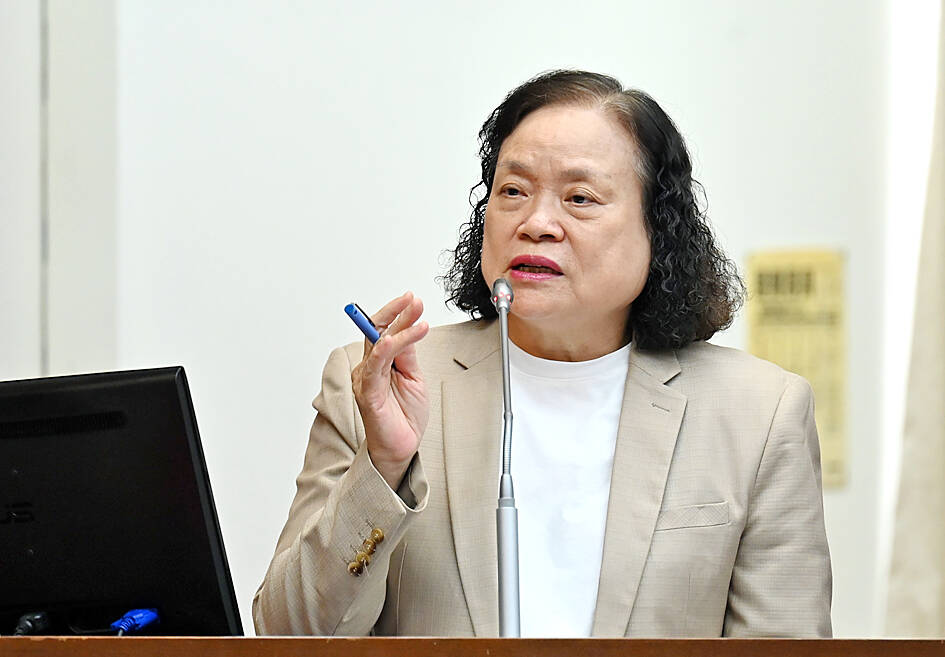
Directorate-General of Budget, Accounting and Statistics Minister Chen Shu-tzu speaks at a meeting of the legislature’s Finance Committee in Taipei yesterday.
Photo: Liu Hsin-de, Taipei Times
Both CPC and Taipower have been absorbing higher international oil and natural gas costs to help stabilize domestic energy prices, putting mounting pressure on their finances, Chen said.
The Cabinet proposed a supplementary budget of NT$607.6 billion that includes subsidies for the two companies. The proposal would lapse if lawmakers do not pass it by the end of this year.
However, subsidies alone would not be enough to offset CPC’s accumulated losses, making a planned capital injection of NT$233.8 billion into the company necessary, Chen said.
The company has a paid-in capital of about NT$130.1 billion. Without additional funding, CPC’s projected losses would nearly wipe out that amount, potentially undermining its ability to maintain the current pricing policy and making it more difficult to secure bank financing, she said.
Deterioration in CPC’s financial position could also weaken its creditworthiness and disrupt crude oil procurement, threatening domestic energy supplies and adding to inflationary pressures, Chen warned.
Lawmakers also questioned whether the proposed capital increase would help fund CPC’s planned investment in a liquefied natural gas (LNG)project in Alaska.
CPC is negotiating a deal to purchase 6 million tonnes of LNG annually from the project, with the investment potentially reaching US$4.4 billion, the ministry said last week.
Deliveries could start as early as 2032 if the project develops on schedule, though purchase and investment details are still being negotiated, the ministry said.
Chen said the proposed capital injection includes funding for urgent, necessary natural gas infrastructure projects.
However, CPC’s planned investment in the LNG project in Alaska remains under negotiation and has not been finalized, she said.
Whether funding would come through the annual budget or a special budget depends on CPC’s financial structure, she added.
Opposition parties, which hold a majority in the Legislative Yuan, have been reluctant to provide additional funding for CPC and Taipower because they object to the Democratic Progressive Party’s energy policy since it took power in 2016.
The policy stressed phasing out nuclear power while supporting renewable energy development, while relying heavily on fossil fuels, especially LNG.
Fossil fuels accounted for over 85 percent of Taiwan’s electricity generation in the first eight months of this year, according to Energy Administration figures.
KioskNews shows a cleaned-up reading view extracted from the publisher’s page — the original always lives on their site, not ours.