Joseph Quesnel: High-speed rail should not come at the expense of property rights
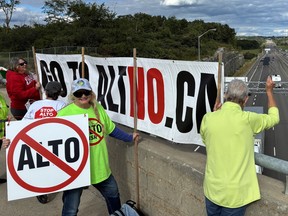
A government that can take your land before buying it is not merely building a railway. It’s testing the limits of property rights.
Sign In or Create an Account
In 2025, the federal government announced plans for a new high-speed rail line, called Alto, to connect Toronto, Ottawa, Montreal and Quebec City. Funded primarily by taxpayers, cost estimates range between $60 billion and $90 billion.
To clear the path, in 2022, the government created a Crown corporation to oversee the Alto project and later designated it a “transformative project” to expedite regulatory and environmental reviews. Those developments create political momentum. They do not establish necessity.

Columnist Jesse Kline keeps you up to date with what’s happening in Israel and the effects of antisemitism on life here in Canada. Friday mornings.
By signing up you consent to receive the above newsletter from Postmedia Network Inc.
A welcome email is on its way. If you don't see it, please check your junk folder.
The next issue of Channel Israel will soon be in your inbox.
We encountered an issue signing you up. Please try again
Under the framework, which was enshrined in law with the passage of the High-Speed Rail Act earlier this year, Alto could potentially expropriate private property along the proposed route without first trying to purchase it from owners. That should concern anyone who believes ownership means more than holding land until the government finds another use for it.
Expropriation is sometimes necessary. A government cannot allow every landowner to veto a hospital, bridge, utility line or highway. But there are reasonable limits. And a government’s declaration that a project serves the “public interest” is not proof that it does.
High-speed rail is not an emergency service. It is a transportation choice for commuters and travellers, and on the government’s part, it is a policy choice of where to invest in infrastructure. That does not make Alto illegitimate, but it does mean the burden of justification should be higher before the state compels someone to surrender a home, farm or business.
The relevant question is whether the benefits are sufficiently clear, broad and substantial to justify taking Canadians’ land. That requires evidence, not just assertions.
The government should publish its estimates of ridership, economic growth, environmental gains and operating costs. It should explain who benefits — frequent travellers, urban centres, developers near the stations, the public — and who bears the costs — taxpayers, rural communities that won’t use the service and property owners whose land falls within the corridor.
The benefits of Alto may be widely advertised, but the burdens will be personal. One family could lose land. Another could see a rail corridor divide fields, undermine drainage or obstruct farm equipment. A business could lose a location. A homeowner may retain part of a property but lose privacy, access, value and peace of mind.
Market-value compensation matters. Full compensation for relocation, business losses and damage to remaining land matters even more. But a cheque does not make an involuntary transaction voluntary. A farm is not merely a number of acres. A home is more than its square metres. For their owners, they may bear intangibles that money cannot buy.
Moreover, property rights provide security: the confidence that one may invest, build and plan without the government casually changing the rules. That is why Alto must meet a property-rights test.
First, it should demonstrate a substantial public need — not a government preference. Second, it should show that the benefits are broadly shared and sufficiently certain to justify compulsory acquisition. Third, it should compare less intrusive alternatives, including upgrades to existing rail lines and alternative routes.
Most importantly, Alto must prove not only that a railway is useful, but that the route is necessary. The project is planned to eventually span roughly 1,000 kilometres. Yet the route has not been finalized, land rights have not been secured and environmental and impact assessments remain incomplete. Active development does not mean every parcel within a prospective corridor is destined for public use.
If several routes can substantially serve the same purpose, the government should not automatically select the cheapest option while imposing the greatest burden on private landowners. The cost of disrupting hundreds of homes, farms and businesses is a real project cost. It cannot be dismissed after the route is chosen.
Negotiated acquisition should be the rule. Expropriation should be the true last resort. Making compulsory acquisition easy creates the wrong incentives and encourages planners to treat private land as an available input rather than a right deserving respect. It weakens the incentive to negotiate, redesign routes and avoid harm. This approach is neither fair nor wise and can generate the resistance, distrust and litigation that delays infrastructure.
Canada does not need to choose between building major infrastructure and respecting property rights. In fact, it will build better infrastructure if it respects them. Alto may deserve to be built. But before it takes anyone’s land, the government should establish more than desirability. It should establish necessity, broad public benefit, proportionality and the absence of less intrusive alternatives.
A railway can connect cities. It must not sever the principle that citizens own what is theirs.
National Post
Joseph Quesnel is a senior fellow with the Aristotle Foundation for Public Policy.
Join the Conversation
This website uses cookies to personalize your content (including ads), and allows us to analyze our traffic. Read more about cookies here. By continuing to use our site, you agree to our Terms of Use and Privacy Policy.
KioskNews shows a cleaned-up reading view extracted from the publisher’s page — the original always lives on their site, not ours.