From garbage dump to urban oasis: Inside the community garden at Jerusalem’s Nature Museum
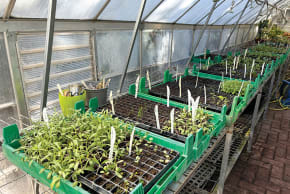
"This is the mother ship,” declared Susan Elster with a smile, her fingers digging in the soil of a starter pot of tiny sage seedlings in the community garden adjacent to Jerusalem’s Natural History Museum.
This mostly volunteer-staffed green space in the German Colony, spread over some 0.45 hectares (1.1 acres), is indeed the mother ship for residents who work the land at about 50 community gardens citywide.
“They all come here on a weekly basis to collect plants, tools, compost, wood chips, and whatever else they need, and to get advice on planting and irrigation,” said Avinoam Kahn, a municipal agricultural coordinator working part-time in the Community Garden at the Nature Museum.
“People also come to get inspiration for what to do in their own private gardens.”
This quiet urban oasis not only produces vegetables, flowers, herbs, and fruit raised through a variety of methods. It is also a culture and leisure hub where visitors of all ages enjoy lectures, classes, festivals, craft workshops, musical and theatrical performances, and much more, in a bucolic setting.
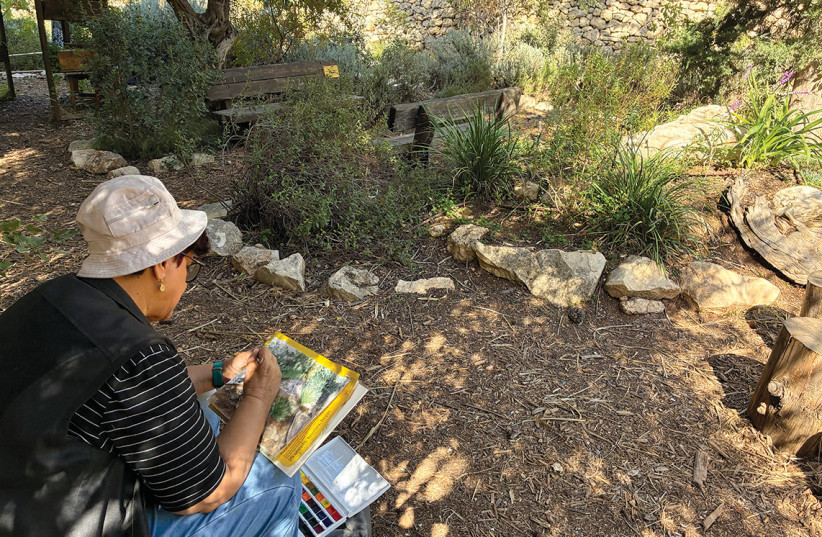
Replete with shaded sitting areas, the grounds include restored historic ornamental pools teeming with goldfish; lending libraries for books, gardening, and carpentry equipment; meeting rooms; a children’s play area; a woodworking shop; a rehab nursery and plant shop; and a studio where Naomi Lachish, one of the volunteers, creates artworks displayed across the space.
Steering this active mother ship are professionals and volunteers, including two personalities central to community gardening in Jerusalem and to this garden in particular: Dena Maltinsky and Amnon Herzig.
On a recent Wednesday morning, I found Maltinsky, a Montreal native and retired coordinator of environmental programs for Jerusalem, collecting dried zinnias. She explained that she will shake out the seeds and package them for distribution to other community gardens.
More than 20 years ago, she told me, a consortium including the Joint Distribution Committee, the SPNI, the municipality, and governmental ministries allocated a four-year grant toward community gardens for senior citizens.
“We established 10 or 12 of these little senior gardens within larger community gardens, and it really took off. After the four years were over, the municipality got a larger budget for community gardens in general, and I took over the project for the city.”
More than 70 community gardens were established, mostly on neglected parcels of land. It’s hard to imagine that the gorgeous garden she and I are standing in was unkempt until two decades ago.
“It was originally part of a beautiful estate, but it had turned into a garbage dump,” Maltinsky said.
The estate, encompassing the museum (now under renovation), was built by 19th-century Armenian opium dealer Lazarus Paul Margharian, according to the book Treasure in Plain Sight: Growing Community through a Garden in Jerusalem, by Vera Schwarcz.
In 2005, retired banker Amnon Herzig partnered with another German Colony neighbor, the late Ora Ron, to prevent real-estate developers from snatching this prize piece of public property. With a group of like-minded residents, they began transforming the dump into a showcase garden, drawing nature enthusiasts from across the city.
Schwarcz is one of those enthusiasts. A retired professor of East Asian history, she made aliyah eight years ago from Connecticut and discovered to her delight that she lived right next door to the Community Garden at the Nature Museum.
“Discovering the garden was one thing; discovering Amnon was another,” she said. “Here is a former banker who, with a group of local volunteers, started an extraordinary garden.
“To sequester this amount of land in the heart of one of the best neighborhoods in Jerusalem took a tremendous amount of skill and conniving.
“He teaches all of us who come into his presence a great deal about what it takes to nurture soil and people alike.”
She volunteers each Thursday afternoon and frequently brings homemade Szechuan tofu to share with the other volunteers.
The Wednesday group concludes their morning labor with a shared fruit salad in summer and soup in winter, prepared on-site with contributed vegetables.
“The volunteers range from 20-something students at Pardes [Institute of Jewish Studies] to a woman in her 80s. Amnon, who is 81 now, finds jobs for all of them,” said Schwarcz.
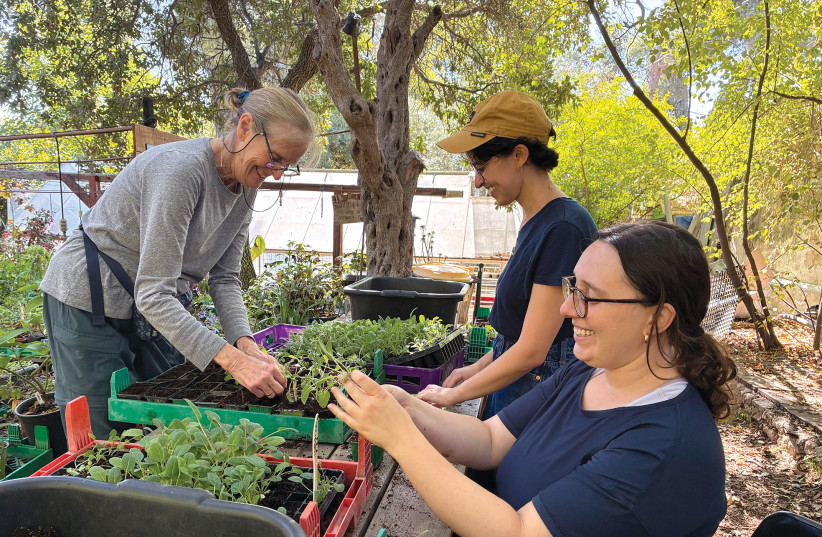
“Everyone who comes here finds a niche. My niche is transplanting,” agreed volunteer Sarah Rose, herself a recent transplant from California. “But we all work together. Last week, all of us prepared wildflower beds, and now we are weeding them.”
'We’re doing a good thing here'
WHAT DOES she get out of it? “A community. I love the people I volunteer with, and I love gardening. I make sure to keep my Wednesday mornings free because this is valuable to me. We’re doing a good thing here.”
Maltinsky noted that because many community gardens are rooted in the hands-on help of seniors, the number of active gardens has declined over the past decade.
“It takes a garden to make a community, and a community to make a garden. It’s not a one-person job; it needs a conglomerate of people and organizations working together to allow it to really work well,” she said.
“The work of committed, crazy optimists to enhance and save our environs is a true blessing. Some of the ‘crazies’ I started with 20 years ago are no longer able to do everything needed to keep the gardens going. We need younger ‘crazies’ who have time to commit. And we need to engage neighborhood schools to help tend the gardens.”
Kahn acknowledged the labor shortfall. “All the community gardens I go to say they need more volunteers, more working hands. The more people participate, the more beautiful the gardens become, and the more green lungs we have in the city.”
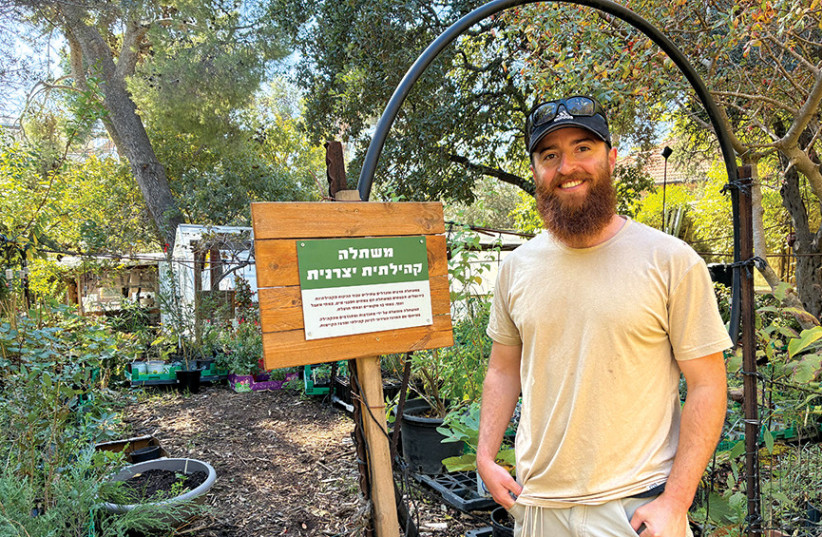
Kahn, 31, whose family made aliyah from Minnesota when he was 14, pointed proudly to a fruit tree nursery propagated from cuttings of varieties carefully chosen for hardiness and flavor. Hundreds of these saplings will be distributed for planting in other community gardens.
“This is like the base camp,” said Gadi Warszawski, head agriculture coordinator for the municipality’s Community Gardens and Social Sustainability Unit. “To bring nature into the communities, to the people, is an amazing thing to do inside a city that is growing fast.”
Warszawski watched approvingly as Kahn supervised volunteers preparing sage seedlings that will germinate in the greenhouse.
“The sage we’re planting today used to be plentiful in the Jerusalem mountains, and now it’s on the brink of extinction,” Warszawski said.
For this and many other reasons, Schwarcz’s book describes the Community Garden at the Nature Museum as infused with “the scent of hope.” She sees it as “a unique laboratory where each person can become a better human being, a more caring fellow to those in need.”
A respite from the noise and bustle of the city
Currently, the garden is nearly hidden from view, surrounded by construction projects. It can be reached on foot through a gate in the parking lot opposite 6 Hamagid Street.
Once museum renovations are completed, a new coffee shop on the grounds will provide ready access to the garden, potentially exposing its charms to many more patrons.
Entering the garden provides an immediate calming sense of respite from the noise and bustle of the fast-evolving German Colony.
Schwarcz put it this way: “An invisible smile flutters over these grounds, revived by neighbors who wanted to maintain ancient pathways filled with new growth and purpose.”
The garden’s website (www.ginateva.com) is updated weekly to inform the public of planned events. For information on volunteering, email amnon.herzig@gmail.com
KioskNews shows a cleaned-up reading view extracted from the publisher’s page — the original always lives on their site, not ours.