Hitler’s Eagle’s Nest retreat was torched in an arson attack. Should it be rebuilt?
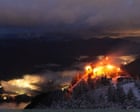
One of the last structural relics of Adolf Hitler’s dictatorship was conceived to project indomitable power. Last month it was destroyed in a suspected arson attack. Will it, and should it, be rebuilt?
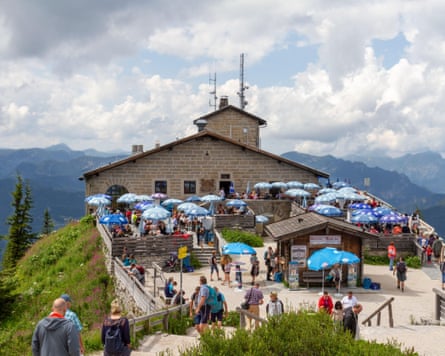
The historic Nazi mountaintop retreat known as the Eagle’s Nest is perched on an Alpine peak at an altitude of 1,834 metres (6,000ft), with stunning views over southern Germany and Austria. In German, its design is known as Überwältigungsarchitektur, intended to overwhelm and intimidate.
Now, despite the efforts of 200 firefighters battling through the night, only charred ruins remain of the former guest lodge, tourist magnet and remembrance site destroyed in the blaze which started on 23 October. It is closed indefinitely.
“Even if a British air force bomb had struck the building on 25 April 1945, as it did most of the other structures in what was then the ‘Führer’s no-go zone’ on the Obersalzberg near Berchtesgaden, Hitler’s former tea house … could scarcely have been more severely damaged than it was by the fire,” Munich’s Süddeutsche newspaper said.
The fire has triggered a debate about whether, and how, to rebuild at the toxic site for the next generation of visitors, while mitigating the never-quite-banished risk of creating a shrine for neo-Nazis.
While the places associated with Hitler’s victims, including the former concentration camps, are preserved in perpetuity, the question of how to treat the perpetrators’ artefacts remains fraught, particularly given the resurgence of the far right in Germany and in Europe more broadly.
Local authorities believe the fire was deliberately started by a 33-year-old suspect with a history of mental illness. The site, which is owned by the German state of Bavaria, attracts more than 300,000 people each year but was closed to visitors that day. No one was injured.
Bavarian state culture minister Markus Blume has said a commission of experts in heritage conservation, construction and Germany’s culture of Holocaust remembrance would be enlisted to help determine the future of the Eagle’s Nest.
Given the building’s inextricable links to the Nazi regime and its crimes, Blume said, “any reconstruction must do justice to this historical responsibility”.
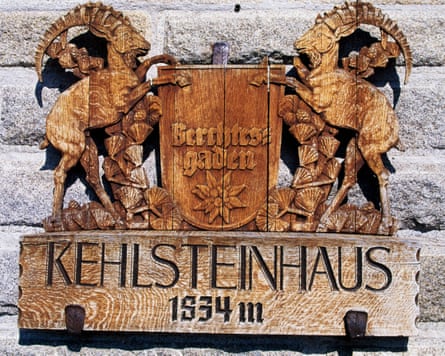
The marvel of Alpine engineering, which took 3,800 workers just over a year to build, is known more prosaically in German as the Kehlsteinhaus, for the mountain it rests on.
After a coach ride on serpentine roads through five tunnels, visitors rode a brass-plated lift, built into the rock, for 41 seconds to reach its portal.
“The prestige project and the road leading to it cost about 30 million Reichsmarks, equivalent to about 130 million British pounds today,” said Nazi-era historian Felix Bohr, author of Before the Downfall: Hitler’s Years in the Wolf’s Lair, which is being published in the UK in November.
“Hitler loved architecture that made other people look small. He insisted on being involved in the planning and construction of propaganda buildings.”
The lodge was completed in 1938, and mainly used to welcome and impress state guests, diplomats and select foreign journalists.
Just a short distance down the mountain at the Obersalzberg complex was Hitler’s own residence, the Berghof, where he spent about a quarter of his 12 years in office.
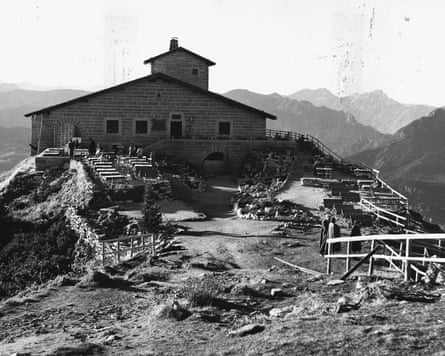
“Important decisions about prosecution and crime, about war and genocide were taken there,” said Sven Keller, director of the Obersalzberg Documentation Centre, an educational facility at the site.
“The surrounding mountain scenery was used as a backdrop for the construction of Hitler’s ‘Führer’ image. It offered spectacular, awe-inspiring views, and demonstrated technical prowess to subjugate even this rough natural environment.”
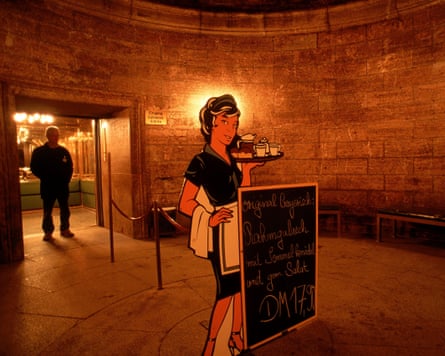
Inside, it had many of the trappings of Nazi bling, including Untersberg marble donated by Mussolini, Venetian mirrors and plump green leather armchairs recalling an English country manor house.
Hitler is known to have visited the Eagle’s Nest only 14 times until 1939 and then never again due to the second world war’s outbreak, when the tea house no longer matched the warrior-statesman image he wished to project, Bohr said. Close associates including his companion Eva Braun still used it regularly, however.
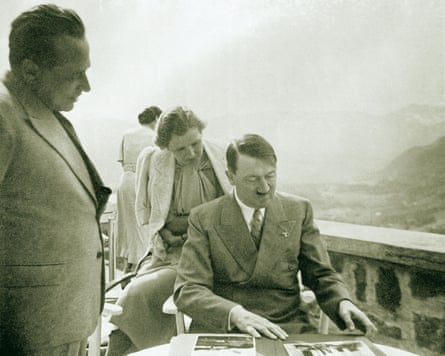
After the war, Obersalzberg became a recreation centre for occupying US troops, but the last vestiges of the Berghof were torn down and hundreds of trees were planted in its place – a fateful decision that has served as a cautionary tale.
“The Americans and the Bavarian state tried to prevent it from becoming a pilgrimage site for old Nazis and Hitler admirers. It didn’t work. If anything, a hidden site in the woods is even more interesting and mysterious,” Keller said. Nazi swastikas were often found carved into the tree bark.
He said a 180-degree pivot toward clearly marking the site and exposing its history, including how it fit into the Nazi power apparatus, proved the healthier approach.
“Public accessibility creates transparency whereas barriers or fences encourage rumours and legends,” Keller said. “Today, a popular public trail crosses the site, and mundane activities such as hiking keep it from becoming a sacred space (for neo-Nazis).”
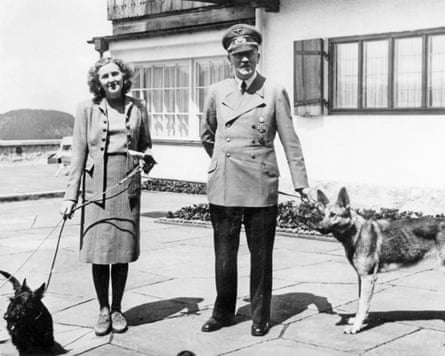
Keller said transparency should be the watchword going forward.
“I cannot imagine that those responsible would opt for [a] simple reproduction of Nazi architecture, but it also can’t be left as a ruin – those tend to be even more fascinating,” he said.
“Instead, we should find ways to integrate the material remains and new information and education, showing the temporal layers, including the use as a tourist destination since the 1950s. The fire added a new layer to the history to Obersalzberg, and this should be visible too.”
New political realities in Germany and Austria, where the far-right Alternative für Deutschland (AfD) and Freedom Party lead the respective national polls, will have to be taken into account as well, he said.
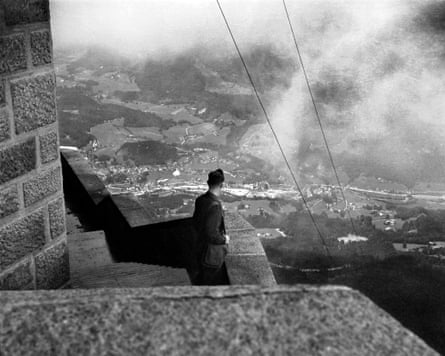
Bohr said that troubling context led him to oppose any reconstruction of the Eagle’s Nest. “Hitler’s megalomania should remain a ruin. My suggestion would be to secure the remaining structure as far as possible and to use it to convey the history of the site,” he said.
“Particularly in view of the strength of the AfD and the rise of right-wing extremism in Germany, the focus should be on coming to terms with Nazi ideology, not on restoring its stage sets.”
KioskNews shows a cleaned-up reading view extracted from the publisher’s page — the original always lives on their site, not ours.