Jorge Taiana: 'It will be difficult for Cristina Fernández de Kirchner to stand as a candidate in 2027'
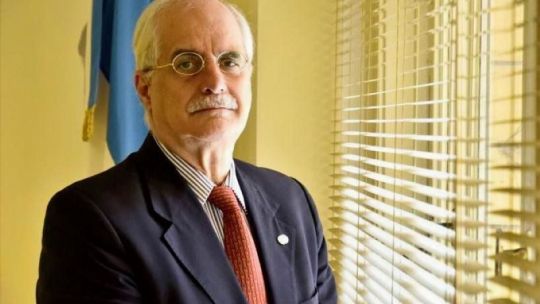
In an interview with Modo Fontevecchia, broadcast on the +Perfil television channel and Radio Perfil (AM 1190), former foreign minister Jorge Taiana explained the status of ex-president Cristina Fernández de Kirchner’s submission to the United Nations challenging her lifetime ban from holding public office, though he acknowledges that the judicial timetable could make it difficult for her to stand in the 2027 election.
Taiana is a sociologist and political figure who currently serves as a national deputy for Buenos Aires Province. During his career, he has held several senior top government positions, including serving as defence minister from 2021 to 2023 under then-president Alberto Fernández, and as a national senator for Buenos Aires Province from 2019 to 2021.
He also served as foreign minister from 2005 to 2010, under the administrations of Néstor Kirchner and Cristina Fernández de Kirchner. In addition, he was executive secretary of the Organisation of American States' Inter-American Commission on Human Rights (IACHR) from 1996 to 2001 and Argentina's ambassador to Guatemala from 1992 to 1996.
Good morning, Jorge. It’s a pleasure to speak to you. We’re here in Buenos Aires and you’re over there; I’m told you’ve already left Washington and are now in New York.
You took part, alongside national deputy Vanesa Siley, in a programme of meetings in Washington with organisations such as the Washington Office on Latin America (WOLA).
Tell us a little about what you saw there, and how you view US relations with Argentina following [Donald] Trump's defeat, while you were there in Washington.
Well, I would say this is almost a post-shock moment, because the Democrats' electoral victory [in the US midterms] was bigger than expected. Not only do they have majorities in both chambers, but there have also been Republican defeats that are very difficult to understand. For example, Vice-President JD Vance, who is one of the possible contenders to succeed Trump, lost in his district and also lost with his Senate candidate; he has been dealt a blow.
Likewise, in Kansas, a Democratic senator was elected for the first time since 1930. And, obviously, the Republicans' defeat in Texas, where they had governed since the Reagan era, more than 40 years ago, has been a major shock.
In other words, this was essentially a rejection of Trump's policies: Trump is the big loser, and the Republican Party is suffering as a result. On the Democratic side, there have also been a series of changes: the emergence of a new generation of leaders, whose best-known faction is what is called the “democratic socialists.”
But, more broadly, there is a wider movement known as progressive Democrats – or sometimes populists – who have visions of change. There is a generational shift taking place within the party that has yet to run its course ...
Yesterday we had a very good meeting with two members of the Progressive Caucus: one was a very important congresswoman, Pramila Jayapal, who is of Indian origin and won more than 70 percent of the vote in her district in Washington state, on the Pacific coast; and the other was Jesús 'Chuy' García, a congressman from Chicago – which, as he pointed out to me, is the Pope's home city.
We spoke, of course, about Pope Leo XIV, who was in Argentina, where the huge scale of the public gatherings also made an impression.
Jorge, you mentioned US Vice-President JD Vance. Yesterday it was announced that he had cancelled his visit to Argentina, which had been scheduled for some time. How do you interpret this cancellation and what effect do you think Trump's defeat will have on relations with Argentina?
Well, it seems to me that the privileged relationship Milei secured – which led to them sending him the currency swap and buying pesos, in what was an unprecedented move – prompted a reaction from Democrats in Congress at the time, and that reaction has continued. In other words, from the standpoint of US economic policy abroad, and particularly towards Argentina, there is growing criticism and mistrust of the policies pursued by Bessent. So Argentina's position is not an easy one, and the idea that 'they'll give me money whenever I need it' and all the rest is now being cast into doubt by Trump's defeat ...
It seems to me that the narrative, as people call it nowadays, is running out for Milei's camp, and it is beginning to run into trouble. And Caputo is coming under increasing criticism, no longer just from the opposition, but also from prominent economists who had been very close to the government and had firmly supported it.
Jorge, you were also involved in an issue concerning former president Cristina Fernández de Kirchner and her petition to the United Nations, which was ultimately not considered and was postponed until the autumn in our hemisphere. I think this rules out any possibility of her being a candidate.
I would like to hear your thoughts on the progress of the legal appeal before the United Nations, which seeks to restore the former president's political rights and allow her to stand as a candidate.
Well, there are two aspects to this. We have also come here to raise the broader issue of the deterioration of the situation, not only the authoritarianism of the Executive and how it manages, in a way, to secure support through favours in the Legislature, building a majority that is not ideological but based on financial support for particular or general purposes – there is clearly a majority in Congress that has been constructed quite artificially with money and is largely subordinate – but also the growing deterioration of the Judiciary.
Cristina is in prison and has been deprived of her political rights for life, while the President is deemed to have had nothing to do with [the] '$LIBRA' [cryptocurrency scandal], and the matter is then closed. And in the case of [former Cabinet chief Manuel] Adorni, they say it cannot be proved that he obtained that money while in office, when in fact we all know that in cases of illicit enrichment the burden of proof is reversed: it is the person under investigation who must demonstrate the legitimate origin of their money or assets. And that is obviously what has not happened in Adorni's case.
When you look at all of this, at Cristina's case and the issues that have arisen during the judicial proceedings, it becomes clear that there is political persecution of Cristina, and that has been evident at every level. If you look at the 'Vialidad' trial, it is a trial with a great many irregularities, both in terms of the National Constitution and the United Nations International Covenant on Civil and Political Rights.
That is why Cristina's legal team decided to submit a complaint to the Human Rights Committee, which has three components. One concerns her disqualification from holding public office, an issue that is of interest in the international human rights community. We held an important private meeting with legal experts from American University, we met with WOLA – a longstanding human rights organisation in Washington – and we will be meeting with organisations here in New York.
There is interest in examining the case because the Human Rights Committee has issued few rulings on situations involving this particular issue: when an additional penalty is greater than the principal sentence. In other words, Cristina was sentenced to six years in prison but also given a lifetime ban from holding public office. Lifetime disqualification exists under Argentine law, but the Committee has said many times that it should not exist – not specifically in Argentina, but in general. It opposes lifetime disqualification as a principle and recommends that it be abolished. That is one of the issues.
The second concerns all the violations of due process, and the third relates to the conditions of detention. The due-process violations concern several matters, above all the inability to present evidence: everything she submitted was rejected, and ultimately the Supreme Court did not consider the matter, applying Article 280 and effectively dismissing the appeal.
So the case goes to the Committee. What for? So that, through a favourable ruling – which is why precautionary measures were requested – the Committee can pave the way for a review of the sentence. That is what the Committee should recommend.
As for violations by the Argentine Judiciary of rights enshrined in the Covenant, it is clear that Cristina will win that case. The problem is that these proceedings at the United Nations, before the Committee – as would have been the case before the Inter-American Commission – take a long time: at least a couple of years.
So what matters most here is the request for precautionary measures to allow a review. Why? Because Article 366, subsection (f), of the Federal Code of Criminal Procedure allows a case to be reviewed following rulings by international bodies – for example, the Inter-American Court, the International Criminal Court, the International Court of Justice, or treaty bodies established under agreements signed by the country.
Indeed, a review under Article 366 can be requested even without an international ruling or a recommendation such as one from the Committee. It can, for example, be requested if there is new evidence, and Cristina's lawyers say there is new evidence in another case that forms part of the evidence Cristina was unable to present.
I was personally very doubtful that the Committee would issue a ruling so quickly. We have to remember that this was submitted at the end of July or in September, when the holidays begin in Europe and the northern hemisphere, and this is the Committee's first meeting since that break.
So they have received the case but have not ruled either on the precautionary measures or on the admissibility of the case. I think that was the most likely outcome. Some people were more optimistic and believed a decision might be made now. I did not think so. I believe they will study it further. Moreover, precautionary measures are generally granted in more limited circumstances, such as cases involving a threat to life, and so on ...
A decision by the United Nations Human Rights Committee would provide significant political and legal reinforcement for Cristina's claim that she did not receive a fair trial – a claim for which there are many grounds to challenge the proceedings.
More specifically, as you yourself said, you were not as optimistic as some others – whose optimism was contrary to reason – about the possibility of obtaining a ruling within a timeframe that would allow Cristina to stand as a candidate in the next elections. She will not be able to stand in the next elections.
Well, we'll have to see. A review can be requested through the domestic courts, and there could be a decision in March...
Let's say I'm not ruling it out. I think it will be difficult, but it is not something we can consider 100 percent settled.
KioskNews shows a cleaned-up reading view extracted from the publisher’s page — the original always lives on their site, not ours.