Nagas pay homage to 39 ancestral remains repatriated from UK after a century
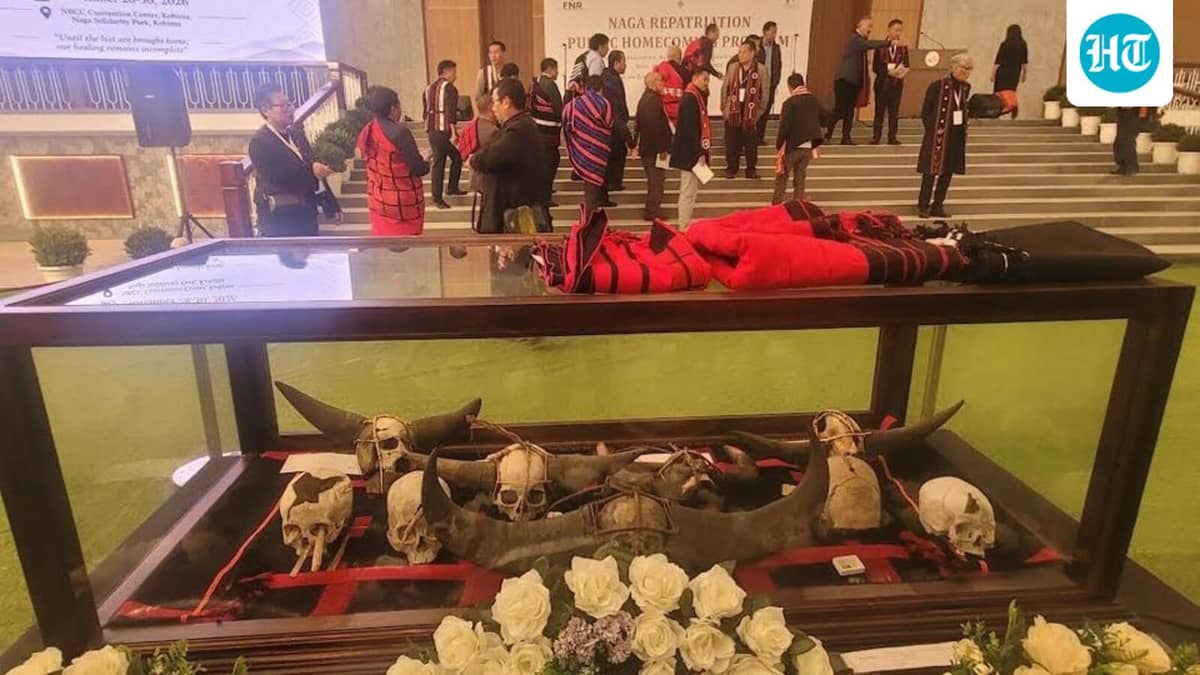
Hundreds of people gathered at the NBCC Convention Centre in Nagaland’s capital Kohima on Saturday to pay their last respects to the 39 Naga ancestral human remains repatriated from the United Kingdom after being housed at the Pitt Rivers Museum for more than a century. The remains arrived in Nagaland on Friday, marking the culmination of a six-year effort by the Forum for Naga Reconciliation (FNR) and Naga tribal bodies to bring them home for a dignified burial.
“Today is a deeply significant and historic moment for the Naga people. The homecoming of 39 ancestral human remains from the United Kingdom is not merely the return of historical remains, it is the restoration of a part of our identity, our history, and our collective memory,” Chief Minister Neiphiu Rio said.
Addressing a solemn public homecoming programme on Saturday, Rio said the journey of the ancestral remains away from their homeland was a painful reminder of a chapter in their history marked by colonial encounters. He thanked the FNR and its research team from Recover, Restore and Decolonise (RRaD), Naga tribes and community leaders for their efforts. He also acknowledged the cooperation and understanding extended by the Pitt Rivers Museum and the University of Oxford in facilitating the process.
“This reflects the importance of dialogue, mutual respect, and shared responsibility in acknowledging and addressing the historical legacy of indigenous communities… Our ancestors are not relics of a distant past, they are an inseparable part of our collective identity as a people and history. The state government recognizes the cultural, historical, and emotional significance of this homecoming,” the chief minister stated.
Pointing out that the repatriation was a complex process involving sustained engagement with several Central ministries and departments at various stages to obtain clearances, Rio expressed appreciation to the Ministry of External Affairs, Department of Customs under the Ministry of Finance, Directorate General of Foreign Trade, Ministry of Environment, Forest and Climate Change, Ministry of Health and Family Welfare, Ministry of Civil Aviation, and the Ministry of Culture, along with the Archaeological Survey of India, for playing a crucial role in facilitating the necessary clearances under the Antiquities and Art Treasures Act, 1972.
The Nagaland government provided both administrative and financial support to facilitate the historic repatriation.
“I, on behalf of the state government, join the Naga community in welcoming our ancestral human remains home. May they now be laid to rest in their final resting place, in their homeland, with the peace, dignity, and reverence they rightfully deserve,” Rio stated.
FNR convener Rev. Dr Wati Aier described the homecoming as more than the return of human remains, calling it a restoration of dignity and a recognition that every human life bears an identity.
“The return (of the ancestral remains) reminds us that while history may scatter us, our common humanity ultimately calls us back to one another,” he said.
Aier also said the repatriation would help heal the brokenness of the land, ease the burden of unresolved grief and liberate the Naga spirit from the lingering trauma of the past. “Healing does not erase history, but it allows us to face the history truthfully and move forward with hope,” he added.
According to the FNR, British anthropologists and collectors have donated Naga artefacts, including ancestral human remains, to the Pitt Rivers Museum since its establishment in 1884.
The 39 human remains, believed to belong to members of eight Naga tribes — Phom, Konyak, Yimkhiung, Khiamniungan, Sümi, Pochury, Chang and Tangkhul — will be given a dignified burial on November 30 at the Naga Solidarity Park in Kohima.
KioskNews shows a cleaned-up reading view extracted from the publisher’s page — the original always lives on their site, not ours.