FINANCE WELLNESS COACH: Weighing up owning a rental property against investing in a balanced fund

I am considering making an offer on a two-bedroom apartment in Johannesburg. The asking price is R700,000 and the monthly levies are R3,000. From the research I have done, I believe I could rent the apartment out for R12,000 per month.
Would you recommend buying the apartment as an investment, or would I be better off investing the money in shares?
Answer
The apartment you are considering certainly looks attractive on paper, but before you make an offer, I would suggest we compare the after-tax returns with those from a diversified balanced investment fund.
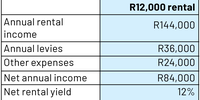
If you manage to rent the apartment out for R12,000 a month, you will receive R144,000 a year. On a purchase price of R700,000, this represents a gross rental yield of 20%. Unfortunately, this is not what you will actually earn – there are costs and when they are considered, the yield drops to 12%, as can be seen below.
Let’s compare what could happen if you invested R700,000 in either the apartment or a diversified balanced investment fund over 15 years. For this comparison, I will assume that the property increases in value by 5% a year and that the balanced fund earns an average annual return of 10%.
The apartment generates R144,000 in annual rental income. After deducting levies of R36,000 and other expenses of R24,000, you are left with R84,000. However, we must also account for income tax.
Your rental profit is added to your other taxable income and taxed at your marginal income tax rate. Assuming an illustrative tax rate of 40%, your R84,000 rental profit would be reduced to R50,400 after tax.
Let’s assume that you reinvest this R50,400 each year in a balanced fund earning 10%, rather than spending it. To see how the two investments could compare, look at the table below. At first glance, the property comes out slightly ahead. However, there are some important differences.
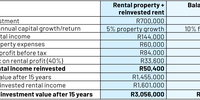
With the property, you would own an apartment worth about R1.46-million and have an additional R1.6-million invested in a balanced fund from the rental income you reinvested over the years.
With the balanced fund option, your entire R700,000 investment would have benefited from compound growth over the full 15 years, without the responsibilities of owning a rental property.
The property investment also carries additional risks. You may struggle to find tenants, have tenants who fail to pay rent, or face repairs and unexpected special levies.
Rental profits are taxed at your marginal income tax rate, whereas only 40% of the capital growth in the balanced fund is subject to income tax. For example, if your marginal tax rate is 40%, your effective capital gains tax (CGT) rate would be just 16%.
With a balanced fund, CGT can generally be deferred until you sell units, giving your investment more opportunity to grow. Interest and dividends may still attract tax.
The increase in your property’s value is also subject to CGT when you sell, and you may have to pay estate agent commission and other selling costs.
Before deciding, consider these factors:
Which investment offers better long-term growth potential?
Will you consistently find tenants and be able to increase the rent?
How much of your return will you keep after tax, maintenance and other costs?
Can you afford periods without rental income or tenants who fail to pay?
Would you prefer investing in one property or spreading your money across different investments?
A balanced fund allows you to withdraw part of your investment without having to sell everything.
Ultimately, the best investment is not necessarily the one offering the highest return, but the one that provides the right balance between after-tax returns, risk, flexibility and peace of mind. DM
Kenny Meiring is an independent financial adviser. Contact him on 082 856 0348 or at financialwellnesscoach.co.za. Send your questions to kenny.meiring@sfpadvice.co.za
This story first appeared in our weekly DM168 newspaper, available countrywide for R39. The e-edition of Daily Maverick’s weekly newspaper, DM168, is now free for readers who are signed into their Daily Maverick account. Click here to access the latest e-edition.
KioskNews shows a cleaned-up reading view extracted from the publisher’s page — the original always lives on their site, not ours.