Rajnath’s Sikkim visit shines spotlight on soldier who stands guard long after death
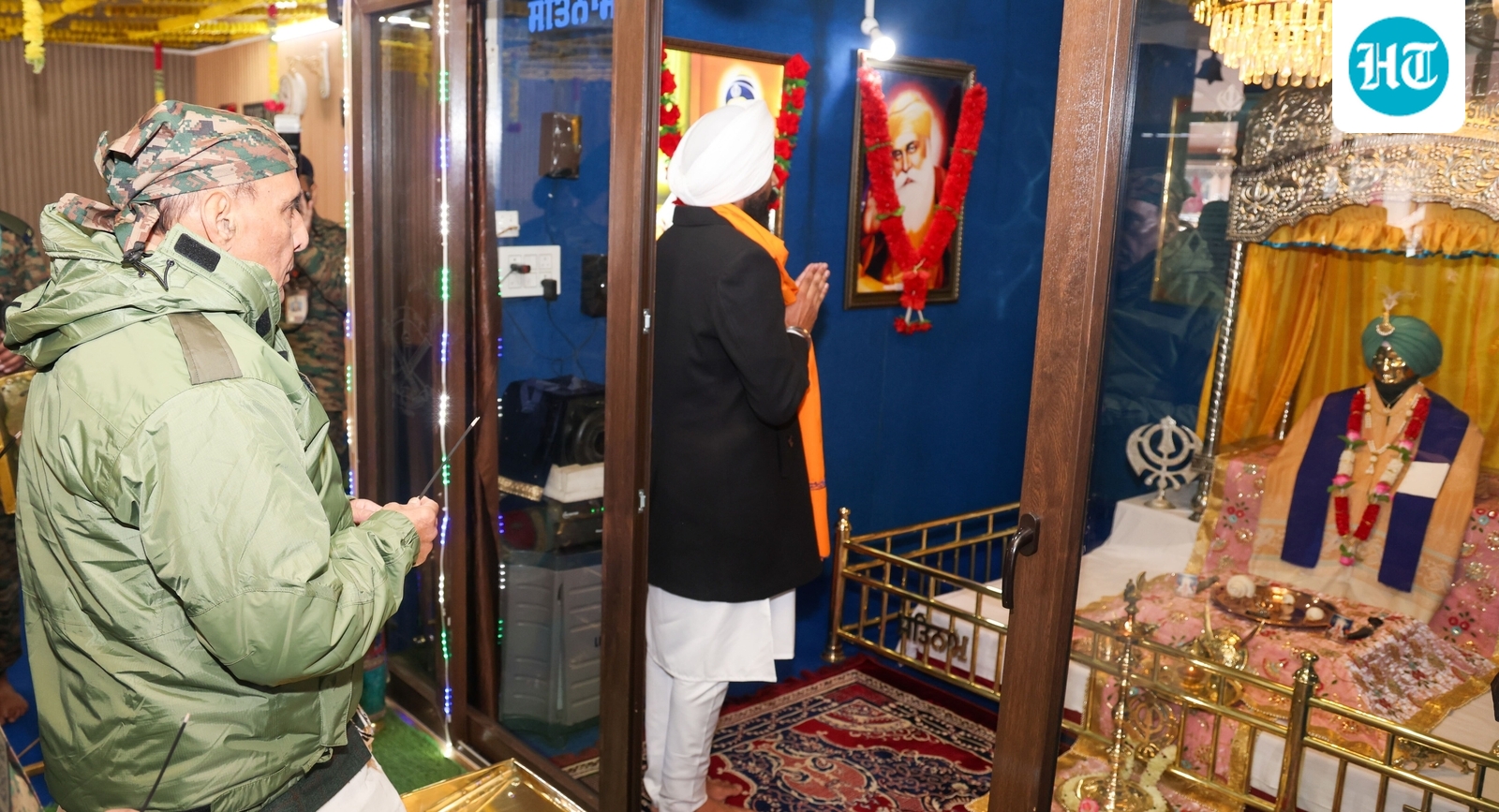
Defence minister Rajnath Singh’s Diwali visit to the forward areas of Sikkim has revived the legend of a soldier believed to be standing guard long after death, officials said on Monday. Baba Harbhajan Singh’s enduring presence is woven into military folklore; soldiers believe he watches over those deployed along the mountain frontier with China.
Harbhajan Singh, 22, drowned in October 1968 after slipping into a stream while escorting a mule convoy near Nathu La, one of two Himalayan passes where Indian and Chinese troops clashed the previous year.
Soldiers and generals alike believe his vigil along the frontier continues, the officials added.
Also Read | Defence minister Rajnath Singh reviews battle readiness, infra push along LAC in Sikkim
“Rajnath Singh visited the Baba Harbhajan Singh memorial, paying his respects to the revered soldier whose legacy continues to hold a special place in the military-civil traditions of the region,” the defence ministry said. He earlier visited the Sherathang war memorial nearby and paid tribute to Indian soldiers killed in the 1967 Nathu La and Cho La clashes with China. The battles ended in an Indian victory, with one account putting Indian casualties at 88, against 340 on the Chinese side.
Army chief General Dhiraj Seth, Eastern Army commander Lieutenant General VMB Krishnan, and 33 Corps commander Lieutenant General Man Raj Singh Mann accompanied him.
Former army chief General Manoj Mukund Naravane chronicled the legend of Baba Harbhajan Singh in a chapter of his book "The Curious and the Classified: Unearthing Military Myths and Mysteries," published in April 2026.
“His body was recovered days later after drowning, but the legend was only beginning. A fellow soldier claimed that Harbhajan appeared in a dream, guiding him to the exact location of the body. This uncanny experience sparked a wave of belief that Harbhajan had not truly departed. Stories began to circulate of soldiers receiving warnings from him in dreams—alerts about impending attacks, terrain hazards and enemy movements. These predictions were often eerily accurate. In some instances, sentries about to doze off on dark wintry nights claimed to have been rudely slapped awake,” Naravane wrote in the chapter titled “Saintly Sentinels: Legacy in Legend.”
Harbhajan Singh was from the 23rd Battalion of the Punjab Regiment, and posted to east Sikkim. His memorial stands at an altitude of 13,123 feet, along the road connecting Nathu La and Jelep La.
A shrine was built by the army near Chhokya Chho, where Sepoy Harbhajan Singh was stationed during his final posting, and it evolved into a pilgrimage site over time, wrote Naravane who served as army chief from December 2019 to April 2022.
Also Read | 'First Diwali when India is free from Naxalism': PM Modi marks festival in Bastar
“Reaching the shrine involved climbing about fifty steps which, in the rarefied atmosphere, made it difficult for tourists to access. Accordingly, a new shrine (New Baba Mandir) was constructed at the junction of the Kupup-Gnathang Road and the track toward Menmecho Lake, where all who pass make it a point to stop and seek the Baba’s blessings,” he wrote.
Naravane himself sought the Baba’s blessings when he visited the original shrine during his first posting to Sikkim in 1980.
He provides a vivid description of the shrine.
“The main attraction (in the area) is the shrine itself where soldiers treat Baba Harbhajan as a living presence. His quarters are maintained with military precision: uniform ironed, boots polished, bed made. In the mornings, sheets are reportedly found crumpled, boots muddy—signs, perhaps, of nightly patrols.”
The soldier was granted a series of posthumous promotions until he became an Honorary Captain, the highest rank someone from the non-officer cadre can reach.
“Until his symbolic retirement, he was granted annual leave, during which his belongings were ceremoniously transported to his hometown in Punjab. A seat was reserved for him on the train, accompanied by soldiers—a gesture that made ritual and reality almost inseparable,” Naravane wrote.
The legend seems to have cross-border appeal.
“During flag meetings between Indian and Chinese troops at Nathu La, Chinese soldiers reportedly leave a chair vacant for him—a silent acknowledgement of his enduring presence. Such gestures reflect a shared respect that transcends politics and conflict. His shrine continues to draw visitors—soldiers, civilians and tourists alike—who come seeking blessings, protection or simply to pay homage to a man who, in death, became a guardian,” the former army chief wrote.
KioskNews shows a cleaned-up reading view extracted from the publisher’s page — the original always lives on their site, not ours.