After 60 Years, Star Trek Has Officially Found Its Perfect Crossover With Brand-New Release

Hannah covers horror, sci-fi, and games at Collider, where she writes news and features, reviews new releases, and interviews the people who make them. She’s helping build out Collider’s gaming coverage, with Pokémon as one of her specialties. If she isn’t writing about a monster, she’s probably watching one on a tape from her VHS collection.
Sign in to your Collider account
"Could diplomacy win the game?" That was one of the questions the designers behind Star Trek’s latest crossover asked early in development. They talked through what it might mean to negotiate or trade with another player, looking for ways to bring the decisions that drive a Star Trek episode to the table. Giving fans the Enterprise was an easy sell, but giving them a reason to open a channel took more work.
At the U.S.S. Gathering launch party in Los Angeles on November 6, set design lead Gavin Verhey explained how the team made room for those decisions. Players can assemble a crew to get a spacecraft running, explore new worlds, and face dilemmas that reward them for choosing how to respond. “They take time to get rolling,” Verhey said of those mechanics. For anyone still arguing about Sisko’s decision in “In the Pale Moonlight,” there’s something appealing about being the one who has to make the call.
Magic: The Gathering | Star Trek is out today, November 13, from Wizards of the Coast. The set draws on six decades of Star Trek and launches with a suite of products spanning all formats of the ever-popular card game. Verhey pointed to the pleasure both audiences take in thinking through a problem. For him, the design question was how to preserve that pleasure for someone picking up their first deck:
“How can we make cards that are straightforward and understandable, but inspire you to go build something unique and different?”
COLLIDERInteractive
Long-range scan active
Movies/Science Fiction/Survival Assessment
Collider Survival Assessment
Which Sci-Fi World
Would You Survive?
8 questions · 5 worlds · one honest verdict
Five of the great screen futures, and not one of them is built for comfort. Answer eight questions about instinct, loyalty and the line you would cross, and the scan will tell you which one you would still be standing in. Worlds in range
▦︎The Matrix
◈︎Mad Max
◑︎Blade Runner
▲︎Dune
✦︎Star Wars
Signal lock01 / 08
Question 01 of 08INSTINCT
The world as you know it ends overnight. What is your first move? No wrong answer. There is a wrong hesitation.
Keys 1 to 5 or A to E · Enter to advance
Signal lock02 / 08
Question 02 of 08RESOURCE
You can stockpile exactly one thing. What is it? Choose carefully. You are not getting a second run.
Keys 1 to 5 or A to E · Enter to advance
Signal lock03 / 08
Question 03 of 08THREAT
Which kind of enemy scares you the most? Be honest about what keeps you up.
Keys 1 to 5 or A to E · Enter to advance
Signal lock04 / 08
Question 04 of 08AUTHORITY
How do you handle the people in charge? Every world has them. Even the ones that pretend otherwise.
Keys 1 to 5 or A to E · Enter to advance
Signal lock05 / 08
Question 05 of 08ENVIRONMENT
Pick the place you would rather wake up in: You will be there a while.
Keys 1 to 5 or A to E · Enter to advance
Signal lock06 / 08
Question 06 of 08ALLIANCE
Who do you want standing next to you? Pick one. You only get one.
Keys 1 to 5 or A to E · Enter to advance
Signal lock07 / 08
Question 07 of 08MORALITY
Which line would you cross to survive? Everybody crosses one.
Keys 1 to 5 or A to E · Enter to advance
Signal lock08 / 08
Question 08 of 08PURPOSE
What are you really fighting for? Last question. Make it count.
Keys 1 to 5 or A to E · Enter to advance
Scan completeYou would survive
▦︎ The Matrix The Resistance, Zion You take the red pill, you stay in Wonderland, and I show you how deep the rabbit hole goes.
You would survive The Matrix because you were never fully sold on the version of reality you were handed. You notice the seams. You ask the second question. In a world built to keep people comfortable and incurious, that instinct is the whole fight, and it is why Morpheus would have found you long before you found him. From the Collider file
- The Wachowskis' 1999 film won four Academy Awards, including Visual Effects and Film Editing.
- Bullet time was shot with a rig of roughly 120 still cameras firing in sequence around the actors.
- Keanu Reeves trained in martial arts for about four months before a frame was shot, recovering from neck surgery the whole time.
- It opened the same year as Fight Club and eXistenZ, in a run of films about not trusting the world in front of you.
Red pill energy Pattern spotter Built to question
◈︎ Mad Max The Wasteland Oh, what a day. What a lovely day.
You would survive the Wasteland because you do not waste energy mourning the world that ended. You move, you improvise, and you are very good with whatever is bolted to the thing in front of you. Furiosa would let you drive. That is not a compliment anybody earns easily. From the Collider file
- Mad Max: Fury Road won six Academy Awards in 2016, more than any other film that year.
- George Miller storyboarded the entire film as roughly 3,500 panels before there was a script.
- The chase was shot almost entirely practical in the Namib Desert, with real vehicles and real stunt performers.
- Anya Taylor-Joy and Chris Hemsworth carried the prequel, Furiosa: A Mad Max Saga, in 2024.
Keeps moving Improviser Good with engines
◑︎ Blade Runner Los Angeles, 2049 All those moments will be lost in time, like tears in rain.
You would survive 2049 because you know how to be small in a very loud city. You keep your head down, you do the job, and you hold onto one private thing that belongs only to you. That quiet stubbornness is exactly what both Deckard and K run on, and it is what keeps either of them going when the case stops making sense. From the Collider file
- Blade Runner 2049 won Roger Deakins his first Oscar for cinematography, on his fourteenth nomination.
- The film also took Best Visual Effects, 35 years after Ridley Scott's 1982 original.
- Villeneuve shot it on large-format film and kept the fog and rain practical on set wherever he could.
- Three short films by Luke Scott and Shinichiro Watanabe bridge the 30-year gap between the two movies.
Keeps her head down Private Noir soul
▲︎ Dune Arrakis Fear is the mind-killer. Fear is the little-death that brings total obliteration.
You would survive Arrakis because you think in decades while everyone around you thinks in weeks. You read the room, you learn the customs, you wait. The desert does not reward speed. It rewards people who understand that patience is a weapon, which is the one lesson the Fremen never had to be taught. From the Collider file
- Denis Villeneuve's Dune won six Academy Awards in 2022, including Cinematography and Original Score.
- Hans Zimmer turned down Christopher Nolan's Tenet so he could score Dune instead.
- Dune: Part Two arrived in 2024 and brought in Austin Butler, Florence Pugh and Christopher Walken.
- David Lynch's 1984 version and Alejandro Jodorowsky's unmade one are both their own legends by now.
Plays the long game Reads the room Patient
✦︎ Star Wars A Galaxy Far, Far Away Rebellions are built on hope.
You would survive the galaxy because you never try to survive it alone. You collect people. You end up in the middle of other folks' problems and you stay anyway. Every version of this story, from the Falcon's crew to the Ghost's, runs on somebody exactly like that holding the group together. From the Collider file
- The 1977 original won six Academy Awards plus a special achievement award for sound effects.
- John Williams' score was recorded by the London Symphony Orchestra and became the best-selling symphonic film soundtrack ever.
- Andor took the galaxy somewhere colder and earned Emmy nominations for drama series in both seasons.
- The saga now runs across eleven feature films and a growing shelf of series on Disney+.
Collects people Shows up Hope merchant
Compatibility readout · top three
1
2
3
Copied to your clipboard
Scan filed byCOLLIDERCollider.com · The Sci-Fi Desk
Star Trek and Magic: The Gathering Are The Perfect Pair

“Magic, at the end of the day, is a language,” said Matt Tabak, an editor on the set. “And if you’re a Magic fan, you eventually come to speak that language very well.” Quark, Humble Proprietor is a particularly good translation. He gives his controller a Treasure token on every player’s upkeep and prevents them from sacrificing any of those tokens while he’s on the battlefield, so a Magic player can start building a deck around that pile of Treasure. A Deep Space Nine fan will recognize the fine print as soon as Quark offers them something for free.
At Star Trek Las Vegas, senior game producer Nicolette Dunks used a transporter to explain summoning sickness to a new player. A creature generally needs to wait before it can attack, so she asked the player to picture someone beaming down and taking a moment to get their bearings. It’s an explanation that would make sense to a Trek fan before they’d ever shuffled a deck.
At the same convention, Tabak sat down with a woman who remembered watching the original series on its first run. In about fifteen minutes, she learned how to cast a spell and make it through a little combat. What mattered to her was what she could do with that lesson at home. The next time her grandkids came over to play, she’d know enough to ask them what they were doing. After decades of watching Star Trek, it had given her a way into something they loved. “It says, you know, you belong here,” Tabak said of Magic. “Star Trek does the exact same thing.”
Sixty years after she first watched the Enterprise leave Earth, a story she grew up with gave her a place at her grandkids’ table. Star Trek has spent six decades imagining what can happen when people who know entirely different worlds sit down together. The crossover brings that idea down to the size of a kitchen table, where it works just as well.
Magic: The Gathering | Star Trek is available now. Stay tuned at Collider for more.
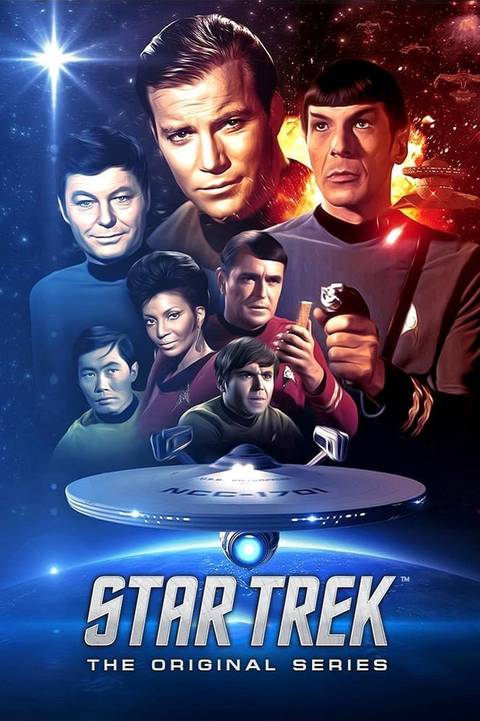
- Release Date
- 1966 - 1969-00-00
- Network
- NBC
- Showrunner
- Gene Roddenberry
- Directors
- Marc Daniels, Joseph Pevney, Ralph Senensky, Vincent McEveety, Herb Wallerstein, Jud Taylor, Marvin J. Chomsky, David Alexander, Gerd Oswald, Herschel Daugherty, James Goldstone, Robert Butler, Anton Leader, Gene Nelson, Harvey Hart, Herbert Kenwith, James Komack, John Erman, John Newland, Joseph Sargent, Lawrence Dobkin, Leo Penn, Michael O'Herlihy, Murray Golden
- Writers
- D.C. Fontana, Jerome Bixby, Arthur Heinemann, David Gerrold, Jerry Sohl, Oliver Crawford, Robert Bloch, David P. Harmon, Don Ingalls, Paul Schneider, Shimon Wincelberg, Steven W. Carabatsos, Theodore Sturgeon, Jean Lisette Aroeste, Art Wallace, Adrian Spies, Barry Trivers, Don Mankiewicz, Edward J. Lakso, Fredric Brown, George Clayton Johnson, George F. Slavin, Gilbert Ralston, Harlan Ellison
KioskNews shows a cleaned-up reading view extracted from the publisher’s page — the original always lives on their site, not ours.