All eyes on US Fed to tackle high inflation
CHOICES: The decision on rates would be Fed chief Kevin Warsh’s first test — whether he chooses to disappoint markets or risk angering the US president — an expert said
The US Federal Reserve goes into a key rate-setting meeting this week with markets expecting policymakers to pull the trigger on a rate hike to tackle persistently high inflation — and analysts said central bank chief Kevin Warsh’s credibility is on the line.
The world’s largest economy has been dealing with years of higher-than-target inflation, and prices have surged in the wake of US President Donald Trump’s war on Iran, his signature tariff policies and the ongoing artificial intelligence (AI) boom.
The Fed has held rates steady since January, choosing to wait to gauge the effects of energy price shocks and let the tariffs’ effects on prices ripple through the economy.
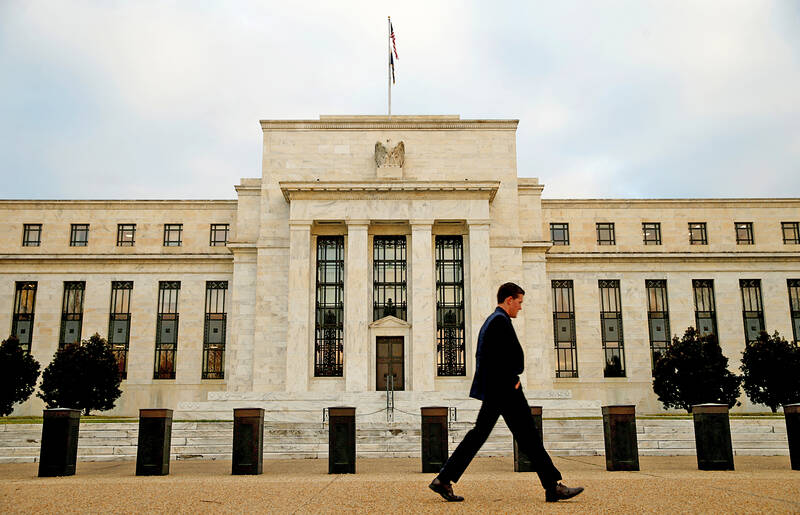
A man walks past the US Federal Reserve building in Washington on Dec. 16, 2015.
Photo: Reuters
However, over the past few weeks, several Fed policymakers — including Warsh — have hinted that if inflation does not show clear signs of slowing, the central bank would have to act by raising interest rates.
On Friday, new data on consumer inflation for last month showed it remaining steady at 3.4 percent — no change from the month before, but still well above the Fed’s long-term two percent target.
Market expectations of a 25-basis-point rate hike on Wednesday surged in the wake of the data, with the probability at more than 85 percent, the FedWatch said.
The Fed last raised rates three years ago, when it was fighting surging inflation in the wake of the COVID-19 pandemic. They stand at between 3.50 and 3.75 percent.
Warsh was appointed by Trump and analysts say this is his first real test since taking office: Would the Fed raise rates to combat inflation, or hold steady in line with what the White House prefers?
“This is the test. This is what comes with that job, and now he has to decide how to handle it,” Brookings Institution senior fellow David Wessel said. “He’s either going to completely disappoint the markets, or he runs the risk that he’s going to start to anger Donald Trump.”
The Fed’s Federal Open Market Committee, with its 12 voting members, would announce its decision after a two-day meeting on Wednesday at 2pm.
“It’s quite likely that the Fed will raise interest rates next week,” New Century Advisors chief economist Claudia Sahm said.
“It’s not a done deal,” she said. “This is a difficult decision for them to make.”
The Fed could hold rates steady rather than raise them, but it would have to explain its decision clearly to markets, Sahm said.
“If they surprise markets and they can’t explain why they’re surprising markets, then Wednesday afternoon will be pretty messy,” she said.
Warsh has advocated in the past for lower interest rates due to expected productivity gains from AI technology, but in recent weeks he has doubled down on the Fed’s mandate to bring inflation down.
“There’s always been this doubt about whether Kevin Warsh is going to be like his predecessors and do what’s right for the economy, even if it’s politically inconvenient,” Wessel said. “If he raises rates now and Trump goes ballistic, he will have established his credibility as an independent Fed chair for the rest of his term.”
KioskNews shows a cleaned-up reading view extracted from the publisher’s page — the original always lives on their site, not ours.