Crude Oil Surges 29% In A Month: Finance Ministry Flags Risks For Indian Economy

India's economy may be growing strongly, but a fresh global shock is creating a new challenge.
Crude oil prices have jumped sharply in September. At the same time, uncertainty over India's trade ties with the US has increased. The Finance Ministry has flagged both developments as risks to the economy in its latest Monthly Economic Review.
The sharp rise in oil prices is particularly important for India, which imports a large share of its crude oil requirement.
Also Read | Layoffs Are Rising In Tech, But These Skills Are Helping People Unlock Better Pay
According to data from the Petroleum Planning and Analysis Cell (PPAC), the Indian crude oil basket averaged $116.04 per barrel in September, compared with $90.19 per barrel in August.
That is a jump of $25.85 per barrel, or 28.66 per cent, in just one month. The Indian basket was also trading at $116.52 per barrel on September 29.
The Indian crude basket represents a combination of sweet crude, based on dated Brent, and sour crude, based on the average of Oman and Dubai grades imported by Indian refiners.
Why The Oil Price Rise Matters
A sustained rise in crude prices can put pressure on India's import bill. It can also push up costs across the economy, from transportation and logistics to manufacturing and other businesses.
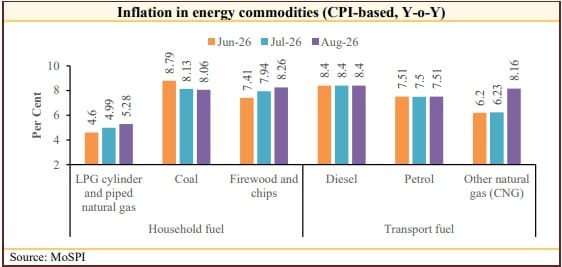
The Finance Ministry said domestic price pressures intensified across retail, wholesale and producer levels because of renewed global oil market pressures and weather-related volatility.
However, it said overall inflation remained largely anchored. The latest numbers also show that India's domestic economy continues to have strong momentum.
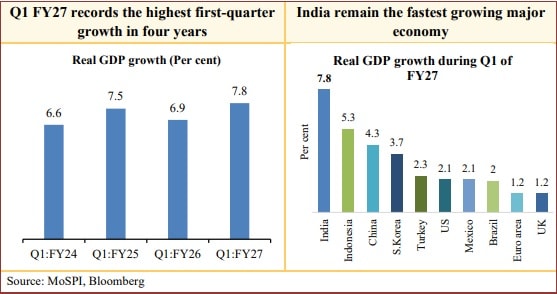
Real GDP grew 7.8 per cent in the first quarter of FY27. Manufacturing, construction and services all recorded strong growth. Real Industry GVA rose 7.7 per cent year-on-year, with manufacturing growing 9.2 per cent.
Financial, real estate, IT and professional services grew 12.1 per cent during the quarter. The problem is that stronger domestic growth is now being tested by a less favourable global environment.
US Trade Risk Adds To India's Challenges
The Finance Ministry has also pointed to growing uncertainty around global trade. A US bill giving the President powers to impose tariffs of up to 100 per cent on countries buying Russian crude has added another layer of uncertainty to India's external environment.
The ministry said global supply chains are increasingly being used as economic instruments. Developed economies are also competing to attract investment for new manufacturing plans.
For India and other developing economies, this makes attracting global capital more challenging. There is, however, one positive signal. The Finance Ministry said indicators suggest that net FDI inflows could improve in FY27 compared with the previous year.
Strong capital inflows, including higher net FDI and increased banking capital, have already supported India's balance of payments.
KioskNews shows a cleaned-up reading view extracted from the publisher’s page — the original always lives on their site, not ours.