Houthis are testing the patience of Saudi Arabia, Türkiye and Pakistan — Phar Kim Beng
OCTOBER 6 — The Houthis may be approaching a strategic threshold. Their repeated attacks against Saudi Arabia are no longer testing Riyadh alone. They are beginning to test the credibility, patience and deterrent capacity of Türkiye and Pakistan too.
That distinction became considerably sharper on October 5.
Saudi Arabia, Türkiye and Pakistan agreed in Riyadh to move immediately towards the practical implementation of their collective defence commitments under the Makkah Alliance for Defense.
More significantly, they agreed to take the necessary measures for the provision and “rapid deployment” of agreed military forces and capabilities inside Saudi Arabia.
This is a major development.
The Makkah Joint Defence Agreement, signed on August 7, stipulates that an armed attack against one member is regarded as an attack against all.
Türkiye has described the arrangement as technically comparable to Nato’s Article 5, although Ankara has repeatedly emphasised that the pact is defensive and is not directed specifically against Iran or any other state.
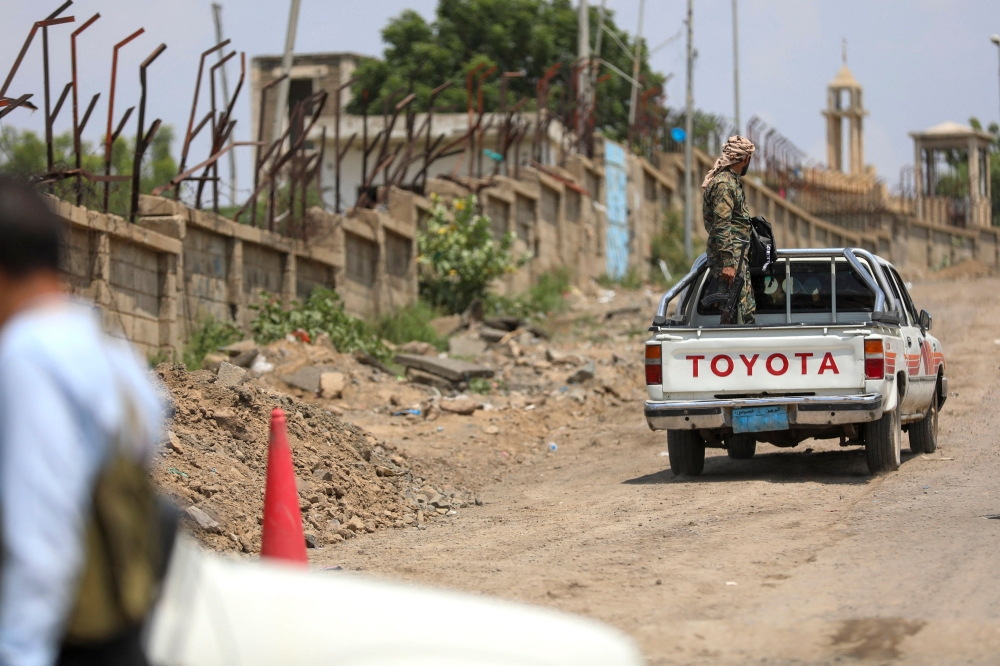
Saudi-backed Yemen government soldiers ride in a pick-up truck near the Jabal Han front, west of the city of Taiz, October 3, 2026. — AFP pic
Until now, the most important question surrounding the Makkah pact was whether its collective-defence provisions constituted primarily political deterrence or whether the three countries were genuinely prepared to operationalise them. That ambiguity is disappearing.
The Houthis have continued attacking Saudi cities, civilian and economic facilities, while the three governments specifically condemned attempted attacks against Makkah and Madinah.
The targeting of Islam’s two holiest cities introduces a dimension that transcends conventional calculations of military deterrence.
For Pakistan and Türkiye, remaining indifferent becomes progressively more difficult.
Türkiye possesses Nato’s second-largest military and has accumulated extensive operational experience across several theatres.
Pakistan possesses one of the world’s largest armed forces and remains the only Muslim-majority nuclear-armed state.
Saudi Arabia, meanwhile, possesses enormous financial resources, sophisticated weapons systems and immense strategic importance to global energy markets.
Combining these three states therefore creates something potentially consequential: an indigenous security architecture emerging from within the wider Muslim world. But this should not be misunderstood as an automatic declaration of war against the Houthis.
The distinction between deterrence and automatic retaliation remains crucial.
The deployment of Turkish and Pakistani forces does not necessarily mean that either country must immediately conduct offensive operations inside Yemen whenever Saudi Arabia is attacked.
The October 5 statement itself says deployment will proceed according to agreed arrangements and the respective national laws of the three parties.
It does not publicly specify the precise missions that deployed forces will perform.
They could reinforce air and missile defence. They could protect critical infrastructure. They could provide intelligence, surveillance and reconnaissance capabilities.
They could strengthen electronic warfare and counter-drone operations. They could assist logistics and military planning.
Indeed, the alliance had already envisaged joint land, naval and air exercises as well as cooperation involving air defence, unmanned systems, electronic warfare and artificial intelligence.
All these measures would strengthen deterrence without necessarily requiring Turkish or Pakistani troops to enter Yemen.
This is precisely why the Houthis should interpret the latest announcement carefully.
Deterrence works through uncertainty.
An opponent must understand that continuing escalation could eventually produce consequences considerably greater than the advantages obtained from another missile or drone strike.
The Makkah pact has now crossed an important line from declaration towards implementation.
The appointment of retired Pakistani Lieutenant General Nauman Mahmood as the alliance’s first Secretary-General further suggests that the institution is acquiring bureaucratic and military permanence rather than remaining merely a political declaration.
Yet Saudi Arabia, Türkiye and Pakistan must simultaneously resist the temptation of uncontrolled escalation.
The Middle East already contains overlapping conflicts, proxy networks, missile exchanges and strategic rivalries.
Another major war in Yemen would create repercussions extending far beyond the Arabian Peninsula.
The Red Sea and Bab al-Mandeb remain vital arteries of international commerce.
Saudi energy infrastructure remains central to global petroleum supplies.
Any prolonged conflict involving three major regional militaries could consequently transmit instability directly into global shipping, insurance, energy and food costs.
Asean therefore has reasons to pay close attention.
South-east Asia may appear geographically distant from Yemen, but its economies remain heavily dependent on stable maritime trade and energy flows.
Disruption in the Red Sea, Bab al-Mandeb or Persian Gulf ultimately reaches Asean through transportation costs, inflationary pressures and supply-chain instability.
There is also a broader lesson about regional security.
The Makkah Alliance demonstrates what happens when states conclude that existing international security arrangements are insufficient. They begin constructing supplementary mechanisms of their own.
Asean has traditionally pursued something very different: dialogue, consensus, diplomatic centrality and moral suasion.
The two models should not be conflated. Yet their underlying objective is similar — to create sufficient collective weight that external actors think carefully before destabilising the region.
The Houthis therefore face a dangerous strategic calculation. Every successful attack may demonstrate their military reach.
But every additional attack also strengthens the argument inside Riyadh, Ankara and Islamabad that stronger collective action has become unavoidable.
Military capability is not identical to strategic wisdom.
The Houthis may believe they are exposing Saudi vulnerability.
Instead, they could be accelerating the transformation of the Makkah Alliance from a diplomatic agreement into an operational military institution.
That would be a profound strategic miscalculation.
Saudi Arabia, Türkiye and Pakistan have so far left room for deterrence to work without making large-scale war inevitable.
The Houthis would be wise to recognise that space while it still exists. Testing an adversary’s patience can sometimes produce concessions.
Testing three increasingly coordinated military powers simultaneously can produce something altogether different.
* Phar Kim Beng is Professor of Asean Studies at International Islamic University Malaysia (IIUM) and Director at the Institute of International and Asean Studies (IINTAS).
** This is the personal opinion of the writer or publication and does not necessarily represent the views of Malay Mail.
KioskNews shows a cleaned-up reading view extracted from the publisher’s page — the original always lives on their site, not ours.