Azcatitlan Codex returns to Mexico after 186 years, on loan from France
A monumental illustrated account of Aztec history — from the Mexica migration to the Spanish conquest of Tenochtitlán — is back in Mexico for the first time in 186 years under a loan agreement with France’s national library.
The centuries-old Azcatitlan Codex, on loan through Dec. 6, chronicles the origins, expansion and collapse of the Mexica world. Tenochtitlán was the island capital of the Mexica empire, built on Lake Texcoco where Mexico City now stands.
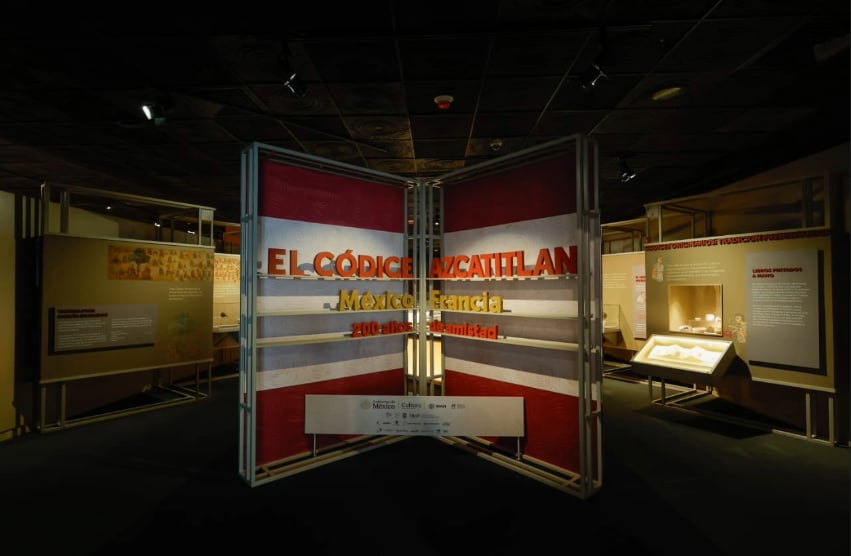
The document left Mexico in 1840 and remained in Europe through a succession of private and institutional collections. It has been held by the National Library of France since the 1890s, making its temporary return a rare cultural and diplomatic event for Mexico.
The loan is not a repatriation — unlike Mexico’s 2024 recovery of three 16th-century codices and Spain’s 2023 return of a Tlaquiltenango Codex fragment, which was expected to fetch more than US $100,000 at auction before Spain’s Civil Guard withdrew it.
But it comes as Mexico continues to seek the return of pre-Hispanic and colonial-era objects that left the country in earlier centuries, and after President Claudia Sheinbaum described codices in France as a top priority for recovery before French President Emmanuel Macron’s 2025 visit.
Instead, Sheinbaum and Macron agreed to a temporary, reciprocal exchange to honor the 200 years of diplomatic relations between their two countries.
Where to see the Azcatitlan Codex
The Azcatitlan Codex arrived in Mexico City this month for an exhibition at the National Museum of Anthropology, while Mexico has sent the Boturini Codex to Paris for display at the French national library.

The exchange is part of the Great Franco-Mexican Festival, a binational cultural program featuring nearly 200 activities, according to a joint release from Mexico’s Ministry of Foreign Affairs, Culture Ministry and National Institute of Anthropology and History.
The Azcatitlan Codex is a significant record of the Mexica, the Nahuatl-speaking people often called Aztecs. “Aztec” is widely used for the empire centered on Tenochtitlán, while “Mexica” more specifically identifies the people who founded and ruled it.
Created in the Valley of Mexico in the late 16th or early 17th century, the manuscript combines Mesoamerican pictorial writing with European paper, bookbinding and Spanish text.
The manuscript is divided into three broad sections: the Mexica migration from Aztlán; the reigns of Tenochtitlán’s rulers; and the 1519 arrival of Spanish forces led by Hernán Cortés, the conquest and evangelization.
The codex’s images have made it a particularly vivid source. One scene depicts Cortés and Spanish conquistadors, accompanied by Indigenous people carrying loads. Another depicts Mexica warriors defending Tenochtitlán’s great pyramid.
Tres grandes momentos atraviesan las páginas del Códice Azcatitlan: la migración desde Aztlan, la historia de Tenochtitlan y los primeros años de la Nueva España.
En el marco de la Gran Fiesta Franco-Mexicana, el Museo Nacional de Antropología presenta por primera vez en México… pic.twitter.com/wF8hjc3PO3
— Secretaría de Cultura (@cultura_mx) September 18, 2026
The museum is exhibiting the original under low light, opened to pages four and five. They depict eight Indigenous groups setting out to find the site where Huitzilopochtli instructed them to found Tenochtitlán, El País reported.
Photographic reproductions of the remaining pages are displayed on the wall of the anthropology museum, located in the capital’s Chapultepec Park.
The exhibition also includes 25 archaeological and ethnographic objects and facsimiles of nine manuscripts, including the Codex Mendoza, the De la Cruz-Badiano Codex and the Boturini Codex.
The Boturini Codex, also known as the Tira de la Peregrinación, traces the Mexica journey from Aztlán to Tenochtitlán. It belongs to Mexico’s National Library of Anthropology and History and is due to return from France in December, when the Azcatitlan Codex will also return to Paris.
The temporary exchange is part of wider efforts to preserve, digitize and recover Indigenous documentary heritage, such as the digital public release of the Florentine Codex, a 12-book encyclopedia of Mexica life compiled by Nahua scholars in the 16th century.
KioskNews shows a cleaned-up reading view extracted from the publisher’s page — the original always lives on their site, not ours.