Advocate urges protection for persecuted activists
By Sam Garcia / Staff writer, with CNA


Taiwanese democracy advocate Lee Ming-che (李明哲) on Tuesday met with the European Parliament, calling for greater protection for human rights advocates, follow-up action on resolutions concerning Hong Kong and deeper cooperation between Taiwan and Europe in the face of China’s transnational repression.
A delegation led by Lee met with European Parliament members Bernard Guetta and Engin Eroglu, joined by Representative to the EU and Belgium Hsieh Chih-wei (謝志偉), the New School for Democracy said in a statement last week.
Lee thanked the European Parliament for its solidarity when he was detained in China for five years.
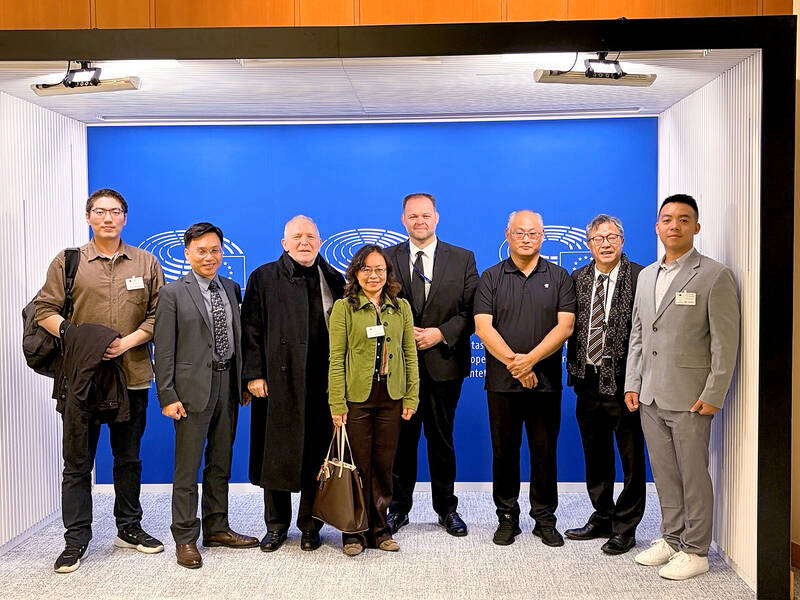
Human rights activist Lee Ming-che, third right, European Parliament members Bernard Guetta, third left, and Engin Eroglu, fourth right, and Representative to the EU and Belgium Shieh Jhy-wey, second right, pose for a picture in Brussels yesterday.
Photo courtesy of the New School for Democracy via CNA
Transnational repression not only targets advocates, but also often involves threats against their family members, deterring persecuted people from speaking out, he said.
Lee said that while he was detained, China threatened his wife with concerns about his safety, and demanded that she stop speaking out and cut off contact with the Taiwanese government and civil society groups.
Family members of other people detained in China have reached out to him for help since he returned to Taiwan, he said.
They fear that speaking out or seeking help from the Taiwanese government could impact their loved ones’ safety, Lee said, adding that threats to loved ones’ safety silence people, cover up the truth and leave advocates isolated.
He called on democratic countries to provide state protection and work with non-governmental organizations to ensure that people facing threats can safely seek help and continue participating in public affairs.
Guetta and Eroglu drew parallels between the cross-strait situation and Russia and Ukraine, asking about Taiwan’s assistance to Ukraine and how the nation is resisting Chinese repression and infiltration.
Taiwan’s resistance is visible and invisible, Taiwanese human rights advocate Hsiao I-ming (蕭逸民) said.
For example, China exploits criminal cases and manipulates information to deepen distrust of the government and divide Taiwanese society, Hsiao said.
Supporting and protecting victims, and fostering a society built on mutual assistance and trust are part of the everyday work of defending democracy, he said.
Lee uses the Internet to introduce Chinese to Taiwan’s democratic experience and built a network to support the families of Chinese political prisoners, Hsiao said, citing it as an example of resistance that goes unseen.
This cross-border exchange of democratic ideas and mutual support helps people facing political persecution, he said.
China’s threats against Taiwan do not only involve the military, but also directly impact people’s freedom and democratic rights, he said, adding that judicial reform, protecting victims and advocating for human rights are all part of resisting authoritarianism.
KioskNews shows a cleaned-up reading view extracted from the publisher’s page — the original always lives on their site, not ours.