US Army detonates bomb chemicals, says area is safe
The US Army on Wednesday blew up the nation’s entire stockpile of lead azide, a chemical used to make explosives, saying the first checks showed that the controlled detonation in Iowa did not spread toxic dust to nearby homes and farms.
Earthen barriers were put up, and foam and water were poured onto a pair of bunkers holding the 4.5 tonnes of lead azide.
Officials said that the measures appear to have absorbed much of the blast.
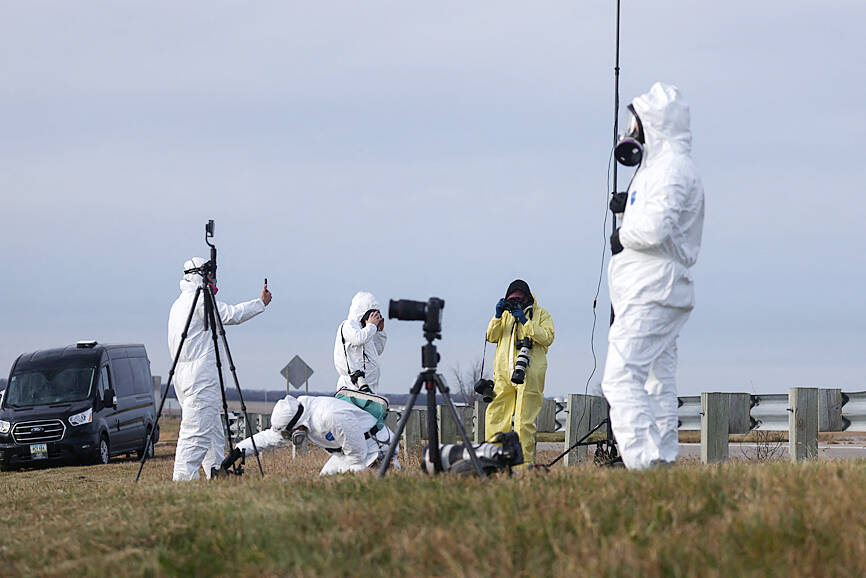
Members of the media in personal protective gear await a US Army detonation at the Iowa Army Ammunition Plant in Middletown on Wednesday.
Photo: Reuters
US Environmental Protection Agency air monitors were detecting no lead in the air around the Iowa Army Ammunition Plant in Middletown and an alert sent to cellphones said that it was safe to resume normal activities.
Still, government agencies and independent researchers plan to do extensive environmental testing for lead — a heavy metal that is especially dangerous to children and pregnant women — in the weeks ahead on water sources, farms, homes and playgrounds.
The army said the safest option had been detonating the stockpile right away because it was degrading and might explode uncontrollably at any time as the weather got colder.
Some experts cautioned that it was too early to know whether communities are in the clear.
However, US Major General Eric Shirley, who led the army operation, said the risk was “reduced as close to zero as it’s absolutely humanly possible.”
Since the military announced and then delayed plans for the detonation over the past two weeks, residents and environmental groups have voiced concerns about potential health and environmental impacts and about a lack of information about what to expect.
An Associated Press reporter filmed the blasts from less than 2km and upwind from the site.
Following two loud booms at about 9am, a pair of white plumes rolled high in the air before quickly dissipating.
The army attributed the smoke to the foam sprayed on the bunkers to tamp down any dust.
Bystanders who parked on the side of a road to watch came away unimpressed by the size of the explosion.
Burlington resident Tim Brandt said he wanted to feel the ground shake, but instead the detonation reminded him of the noisemakers that crack when thrown on the ground.
“It was nothing,” he told reporters. “It seemed like government put fear in a lot of people over nothing.”
KioskNews shows a cleaned-up reading view extracted from the publisher’s page — the original always lives on their site, not ours.