Senegal regaining Afcon title is the right end to embarrassing farrago but issues do not stop here | Osasu Obayiuwana
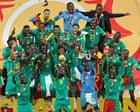
A journey of 310 days and three legal proceedings to confirm two things we know – that Senegal beat Morocco 1-0 to win the 2025 Africa Cup of Nations and, most importantly, that the decision of a referee remains final and sacrosanct – has produced the longest, most comical and embarrassing Afcon final in the tournament’s 69-year history.
As the Confederation of African Football (Caf) executive committee member Samir Sobha told the Guardian, the decision of the organisation’s appeals board in March to overturn Senegal’s victory and award the title to Morocco, prompting a legal charade ended by the court of arbitration for sport’s verdict on Tuesday, was a “big joke” that brought Caf and the Afcon into needless disrepute.
“Correcting one injustice with another cannot be considered an acceptable response, either from a sporting or an ethical standpoint,” Sobha said. “Football is founded on core values: fairness, merit and the truth of what happens on the field. Awarding a title outside these principles, even when supported by regulatory provisions, undermines the credibility of the competition and damages the integrity of the game.
“Rather than restoring balance, such a choice risks intensifying frustrations and calls for a deeper reflection on how to safeguard fairness and uphold the honour of African football.”
Managing the huge reputational damage from the crisis over the past 10 months has been arguably the biggest governance test for the five-year Caf presidency of the South African billionaire Patrice Motsepe.
In a frustrated, exasperated moment, he admitted he was “sick and tired” of it all, navigating the treacherous diplomatic minefield of wounded Moroccan and Senegalese feelings, while reiterating his neutrality and belief in the integrity of the judicial process to bring the dispute to a just end.
The Cas resolution of the dispute compels Caf to carry out a desperately needed and long overdue task: the root-and-branch reform of its justice system, particularly the appeals board chaired by the Nigerian judge Roli Harriman.
The Cape Verdean Faustino Varela Monteiro, the board’s vice-chair, is a notable, honourable exception, standing for the correct legal position in his dissenting judgment.
The appeals board needlessly overturned the verdict of Caf’s disciplinary committee, which struck the right balance of upholding the result of the final while imposing fines and bans on the Senegal team for the egregious act of disrupting the match, and in so doing exposed its acute lack of understanding of the critical role it is duty-bound to play in the dispensation of football justice.
“You are right,” says a Caf executive committee member about the need to dissolve the appeals board and reconstitute it with jurists possessing the knowledge needed to restore confidence in the African football justice system.
Ensuring that politically exposed people are no longer members of a reconstituted appeals board is also imperative, if confidence in the impartiality of its verdicts is to be restored. No federation president should have a place on it. The presence of Moez Nasri, the president of the Tunisian Football Federation, strips it of credibility, as Motsepe acknowledged when I pointed this out to him in March.
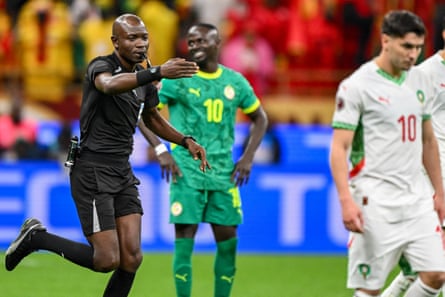
But the poor quality of Jean-Jacques Ndala Ngambo’s refereeing of the Afcon final and Safari Olivier Kabene’s equally bad chairing of Caf’s referees committee – whose selection of match officials was responsible for the inadequate quality of game management throughout the last tournament – remain the proverbial elephants in the governance room.
When I asked a high-ranking Caf official why Ngambo has not faced a disciplinary hearing for his management of the final, he claimed its hands were tied by the Cas judicial process. That excuse expired on Tuesday.
after newsletter promotion
Ngambo’s decision to allow a restart of the game, after Senegal illegally walked out for about 15 minutes in protest against a penalty awarded to Morocco, was a deeply questionable, some would say unacceptable, use of his discretionary powers, which should have leaned towards a declaration of match abandonment, with Morocco being declared the winners.
That said, the referee’s earlier failure to award Senegal what appeared to be a clear goal, subsequently giving a penalty to Morocco in second-half stoppage time, was the trigger for the chaos.
Ngambo’s lack of fortitude and experience, to cope with the demands of an Afcon final, is an indictment of the committee that picked the wrong man to handle it. And Kabene is responsible for that. “We have to do a clearout of the referees committee,” says a member of the Caf executive committee.
It is a situation in sharp and sad contrast to the world-class officiating at the 2024 Afcon in Côte d’Ivoire, under the competent general management of the Ivorian Noumandiez Doué, who would be the ideal person to restore sanity.
But after the shabby way he was treated, losing his job while on assignment at the last Championship of African Nations, for domestic-based players, in Kenya, Uganda and Tanzania – the countries staging the 2027 Afcon – it is easier for a camel to pass through the eye of a needle than it would be to convince him to return to his old job.
With just over eight months to the next Afcon and 20 months to the 2028 tournament, yet to have a designated host, Caf’s governance and organisational challenges are far from over.
The last two Afcons of Motsepe’s presidency, which ends in March 2029, will be decisive in shaping his legacy.
KioskNews shows a cleaned-up reading view extracted from the publisher’s page — the original always lives on their site, not ours.