Bank of England expected to slow bond-selling programme and hold interest rates today – business live
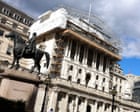
Although the Bank of England may not raise rates today, money market pricing suggests borrowing costs are going to increase over the next year or so.
As of last night, investors were pricing in four quarter-point increases by the end of 2027, which would lift Bank rate from 3.75% to 4.75%.
Good morning, and welcome to our rolling coverage of business, the world economy and the financial markets.
It’s a crunch day for the Bank of England. The UK central bank will announce its latest interest rate decision at noon, and also reveal whether it has made any changes to its bond-selling programme.
The City are pretty confident that the Bank will leave rates on hold, at 3.75%, despite inflation rising further away from its 2% target yesterday.
But while perhaps three members of the monetary policy committee might vote for a hike, they’ll probably be outvoted by the other six…. (but you never know for sure!).
The problem facing the Bank of England is that it has a mandate to control inflation, but there are signs that consumers are struggling – and a rate hike would add to that pressure on households.
Kathleen Brooks, research director at XTB, explains:
The labour market is weak, payrolled employment is falling, wage growth is negative in real terms and job vacancies are also at a multi-year low.
July growth was stronger than expected, however, this was driven by AI Capex spend, and construction and manufacturing contracted last month.
BoE policymakers might also feel slightly uncomfortable that other central bankers have been raising rates – including the US Federal Reserve yesterday (to the annoyance of Donald Trump).
As Fed chair Kevin Warsh pointed out:
“The plain fact is that [US] inflation is too high, and has been for too long.
“This summer’s inflation readings do not tell me that underlying trends have meaningfully improved.”
The Bank’s decision on quantitative tightening (QT) – the sale of bonds bought to stimulate the economy – is harder to call, and potentially more explosive.
Economists expect the Bank to slow the pace of QT – perhaps to an annual pace of £50bn, down from £70bn over the last year. It might even halt the sale of long-dated bonds, where it has faced criticism for helping to push borrowing costs to multi-year highs.
[This is because bond yields rise when prices fall, and prices are pushed down if one major bond-holder is determined to sell their gilts].
The Bank has already faced criticism from the Reform party for pressing on with QT, given the losses being incurred by taxpayers.
The Guardian wrote earlier this week that QT needs to be revised, explaining:
No other major central bank carries on in this way. Whatever one thinks of the losses, making the Treasury settle them immediately turns monetary choices into fiscal interventions. A report this week says that the Bank and Treasury are drawing up changes to QT to reduce pressure on raising interest rates. Independence seems to have been discarded in favour of quiet coordination. The MPC’s decisions cannot be beyond challenge.
Andrew Bailey, the Bank’s governor, calls the overall cost of QT “neutral” – but only, as the economist Patricia Pino points out, when assessed over six decades. In fact, billions in cash demands fall within a parliament. Governments do not set budgets, fight elections or run public services over 60 years. It is unsustainable for the Bank to make decisions and have ministers face voters for the political consequences.
The agenda
-
10am BST: Eurozone inflation report for August
-
12pm BST: Bank of England decision on interest rates and QT
-
1.3pm BST: US initial jobless claims data
KioskNews shows a cleaned-up reading view extracted from the publisher’s page — the original always lives on their site, not ours.