Hungarians face secrets as communist files unsealed
When Hungary opened its communist-era informer files earlier this month in a long-delayed attempt to confront its repressive past, septuagenarian filmmaker Jozsef — not his real name — knew that his decades-old shame would be laid bare.
He was among the tens of thousands of people named in a searchable online database, the first stage of a two-part disclosure process that has raised questions about deceased loved ones and sparked a political row.
Unlike many public figures identified in the records, Jozsef — who wanted to speak anonymously to protect others connected to him from possible reputational harm — did not downplay or deny his involvement.
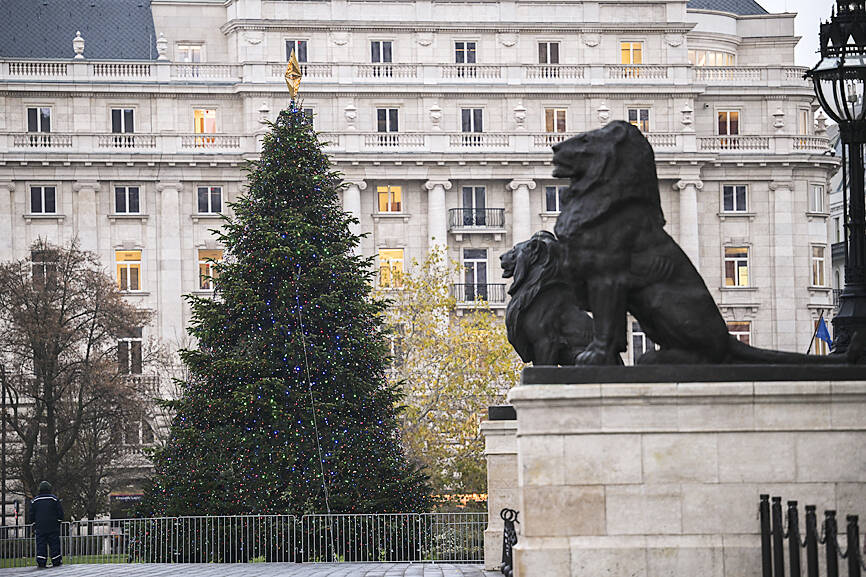
A Christmas tree stands in Kossuth Square in Budapest on Wednesday.
Photo: EPA
In a social media post, he acknowledged cooperating with the secret police in the 1970s before severing ties with them a few years later.
“I became guilty, but also a victim of a regime I did not know how to resist,” the filmmaker told reporters, adding that he was recruited through a mixture of intimidation and blackmail.
This “sin” had been “burning him from within” for nearly half a century, but he hoped that his later involvement in the democratic opposition had helped him atone.
He feels a “little lighter” now, he said. “It felt like a kind of catharsis.”
Like other Soviet-bloc countries, communist Hungary relied on an extensive network of informants, recruiting ordinary people through persuasion and coercion to monitor colleagues, neighbors and even relatives.
Hundreds of thousands of Hungarians were surveilled between 1949 and 1989. In the early 1950s, informant reports often resulted in arrests, show trials and even executions.
In later decades, they were more likely to lead to career setbacks, travel restrictions, and other forms of social and professional marginalization — refusal to cooperate with the secret police often had similar consequences.
About 60,000 names were published on Nov. 4, drawn from surviving files and magnetic backup tapes, representing about one-third of the estimated number of informants.
The release triggered a surge of interest.
The Historical Archives of the State Security Services (ABTL) said 10,000 people requested access to more records within the first week alone, equivalent to four years of typical demand.
Among them was Hajnalka, in her 50s, who asked that her surname be withheld to speak freely about a deeply personal matter.
She found her late father’s name in the database, alongside a code indicating that the secret police broke ties with him at some point.
“The possibility that he may have been an informer for the communist regime has shockingly intruded upon the image I had always held of him,” Hajnalka said. “Yet at the same time, it perhaps also explains certain breaks and derailments in his life that had remained mysterious.”
Since the fall of communism in Hungary, efforts to fully open the communist-era archives had repeatedly stalled, with critics blaming successive governments’ reluctance to potentially implicate public figures across the political spectrum.
Opening the files was a key campaign pledge of Hungarian Prime Minister Peter Magyar, who won the April elections, ousting former Hungarian prime minister Viktor Orban after 16 years in power.
However, detractors said the rollout was rushed and not well thought out.
Former deputy parliamentary speaker Sandor Lezsak, a prominent figure in the democratic transition and an Orban ally, was misidentified as an informant.
Head archivist Gergo Bendeguz Cseh apologized and offered his resignation over the clerical error, which wrongly listed 164 victims of state surveillance.
Magyar also issued an apology.
Gabor Demszky, 74, another leading figure in the democratic transition who was monitored, assaulted and prosecuted by the communist authorities, said the release was a “step in the right direction.”
“As long as those records are not public, everyone can say they never reported anything,” the former mayor of Budapest told reporters.
Sociologist Mate Zombory from ELTE University argued that too much time had elapsed since the fall of communism for some “grand public reckoning,” blaming government rhetoric for creating unrealistic expectations.
However, “if this triggers a process of people exploring their own families and immediate social environment rather than public gestures and apologies, that would still be valuable,” he said.
KioskNews shows a cleaned-up reading view extracted from the publisher’s page — the original always lives on their site, not ours.