Netflix’s 6-Part Sci-Fi Series Is the Smartest Horror Show Since ‘Haunting of Hill House’

Miranda Adama is a writer, variety streamer, and all-around creative who loves violence on screen and what it says about pop culture. She's the host of Be Seeing You: A John Wick Podcast and has been featured on podcasts like Motherfoclóir, Girls Gone Canon, and Tights & Fights.
Sign in to your Collider account
Netflix’s hit limited series, Cassandra, is a German thriller with a concept that would feel right at home in Black Mirror. The Prill family – artist Samira (Mina Tander) and author David (Michael Klammer), their teen son Flynn (Joshua Kantara) and 9-year-old daughter Juno (Mary Amber Oseremen Tölle) – move to the countryside for a fresh start after a harrowing chapter in their lives. With an indoor pool and a serene woodland setting, the home has plenty to offer before the family discovers a household bot and accompanying central AI system.
The program – all interfaced through the maternal, well-mannered Cassandra (Lavinia Wilson) – comes to life on television screens in every room of the house. Yes, even the bathroom. Cassandra can cook, clean, and even read bedtime stories or give advice as a human being would. But like The Haunting of Hill House, Cassandra understands that the scariest homes are the ones that know exactly how to prey on the family living inside them. The emphasis on Cassandra’s humanity and how it shapes this family makes for a fresh take on fears around AI and technology.
'Cassandra' Treats Tech Like a Haunting
Part family drama, part tech thriller – and ultimately a haunted house story – it’s no wonder the series is hanging out at the top of Netflix’s charts. Unlike the techno-horror of films like Ex Machina or even Disney’s Smart House, Cassandra doesn’t limit itself to technological tropes. As the Prill family reckons with the tragedy that inspired their move – the death of Samira’s sister – the show gives us glimpses into Cassandra’s similarly tragic past. Unlike the Alexas or Siris that fill modern homes across the world, Cassandra was once a real person. Her charm at times captures a sincere humanity. But that same humanity gives Cassandra deeper desires and an emotional range that easily turns sinister.
As the past timeline of the 1970s slowly reveals the darkness of Cassandra’s family life, Cassandra increasingly longs to call the warm, loving, comparatively perfect Prill family her own. Reflecting the rigidity of family life she came to expect from her past, she begins working to get rid of Samira and curb less desirable, non-traditional behavior in the rest of the family, to finally claim the perfect life she always wanted.
COLLIDERInteractive
Long-range scan active
Movies/Science Fiction/Survival Assessment
Collider Survival Assessment
Which Sci-Fi World
Would You Survive?
8 questions · 5 worlds · one honest verdict
Five of the great screen futures, and not one of them is built for comfort. Answer eight questions about instinct, loyalty and the line you would cross, and the scan will tell you which one you would still be standing in. Worlds in range
▦︎The Matrix
◈︎Mad Max
◑︎Blade Runner
▲︎Dune
✦︎Star Wars
Signal lock01 / 08
Question 01 of 08INSTINCT
The world as you know it ends overnight. What is your first move? No wrong answer. There is a wrong hesitation.
Keys 1 to 5 or A to E · Enter to advance
Signal lock02 / 08
Question 02 of 08RESOURCE
You can stockpile exactly one thing. What is it? Choose carefully. You are not getting a second run.
Keys 1 to 5 or A to E · Enter to advance
Signal lock03 / 08
Question 03 of 08THREAT
Which kind of enemy scares you the most? Be honest about what keeps you up.
Keys 1 to 5 or A to E · Enter to advance
Signal lock04 / 08
Question 04 of 08AUTHORITY
How do you handle the people in charge? Every world has them. Even the ones that pretend otherwise.
Keys 1 to 5 or A to E · Enter to advance
Signal lock05 / 08
Question 05 of 08ENVIRONMENT
Pick the place you would rather wake up in: You will be there a while.
Keys 1 to 5 or A to E · Enter to advance
Signal lock06 / 08
Question 06 of 08ALLIANCE
Who do you want standing next to you? Pick one. You only get one.
Keys 1 to 5 or A to E · Enter to advance
Signal lock07 / 08
Question 07 of 08MORALITY
Which line would you cross to survive? Everybody crosses one.
Keys 1 to 5 or A to E · Enter to advance
Signal lock08 / 08
Question 08 of 08PURPOSE
What are you really fighting for? Last question. Make it count.
Keys 1 to 5 or A to E · Enter to advance
Scan completeYou would survive
▦︎ The Matrix The Resistance, Zion You take the red pill, you stay in Wonderland, and I show you how deep the rabbit hole goes.
You would survive The Matrix because you were never fully sold on the version of reality you were handed. You notice the seams. You ask the second question. In a world built to keep people comfortable and incurious, that instinct is the whole fight, and it is why Morpheus would have found you long before you found him. From the Collider file
- The Wachowskis' 1999 film won four Academy Awards, including Visual Effects and Film Editing.
- Bullet time was shot with a rig of roughly 120 still cameras firing in sequence around the actors.
- Keanu Reeves trained in martial arts for about four months before a frame was shot, recovering from neck surgery the whole time.
- It opened the same year as Fight Club and eXistenZ, in a run of films about not trusting the world in front of you.
Red pill energy Pattern spotter Built to question
◈︎ Mad Max The Wasteland Oh, what a day. What a lovely day.
You would survive the Wasteland because you do not waste energy mourning the world that ended. You move, you improvise, and you are very good with whatever is bolted to the thing in front of you. Furiosa would let you drive. That is not a compliment anybody earns easily. From the Collider file
- Mad Max: Fury Road won six Academy Awards in 2016, more than any other film that year.
- George Miller storyboarded the entire film as roughly 3,500 panels before there was a script.
- The chase was shot almost entirely practical in the Namib Desert, with real vehicles and real stunt performers.
- Anya Taylor-Joy and Chris Hemsworth carried the prequel, Furiosa: A Mad Max Saga, in 2024.
Keeps moving Improviser Good with engines
◑︎ Blade Runner Los Angeles, 2049 All those moments will be lost in time, like tears in rain.
You would survive 2049 because you know how to be small in a very loud city. You keep your head down, you do the job, and you hold onto one private thing that belongs only to you. That quiet stubbornness is exactly what both Deckard and K run on, and it is what keeps either of them going when the case stops making sense. From the Collider file
- Blade Runner 2049 won Roger Deakins his first Oscar for cinematography, on his fourteenth nomination.
- The film also took Best Visual Effects, 35 years after Ridley Scott's 1982 original.
- Villeneuve shot it on large-format film and kept the fog and rain practical on set wherever he could.
- Three short films by Luke Scott and Shinichiro Watanabe bridge the 30-year gap between the two movies.
Keeps her head down Private Noir soul
▲︎ Dune Arrakis Fear is the mind-killer. Fear is the little-death that brings total obliteration.
You would survive Arrakis because you think in decades while everyone around you thinks in weeks. You read the room, you learn the customs, you wait. The desert does not reward speed. It rewards people who understand that patience is a weapon, which is the one lesson the Fremen never had to be taught. From the Collider file
- Denis Villeneuve's Dune won six Academy Awards in 2022, including Cinematography and Original Score.
- Hans Zimmer turned down Christopher Nolan's Tenet so he could score Dune instead.
- Dune: Part Two arrived in 2024 and brought in Austin Butler, Florence Pugh and Christopher Walken.
- David Lynch's 1984 version and Alejandro Jodorowsky's unmade one are both their own legends by now.
Plays the long game Reads the room Patient
✦︎ Star Wars A Galaxy Far, Far Away Rebellions are built on hope.
You would survive the galaxy because you never try to survive it alone. You collect people. You end up in the middle of other folks' problems and you stay anyway. Every version of this story, from the Falcon's crew to the Ghost's, runs on somebody exactly like that holding the group together. From the Collider file
- The 1977 original won six Academy Awards plus a special achievement award for sound effects.
- John Williams' score was recorded by the London Symphony Orchestra and became the best-selling symphonic film soundtrack ever.
- Andor took the galaxy somewhere colder and earned Emmy nominations for drama series in both seasons.
- The saga now runs across eleven feature films and a growing shelf of series on Disney+.
Collects people Shows up Hope merchant
Compatibility readout · top three
1
2
3
Copied to your clipboard
Scan filed byCOLLIDERCollider.com · The Sci-Fi Desk
To viewers, Cassandra’s interest in the children, especially little Juno, feels sinister early on. Like plenty of haunted house stories, the children are charmed, so the parents are happy. That is until subtle changes start to worry Samira. And like so many husbands before him, David doubts Samira’s concerns time and again. For David, occupied children, completed household chores, and the expectation that these things might ease his wife’s grief are worth what he insists are mild glitches, coincidences, or perhaps overly-familiar AI design. What’s more, the home was built in the 1970s, an era rife with haunted house mania, and the flashes between the past and present drive home that this home is haunted. With parlor games gone wrong, a seemingly friendly entity escalating into acts of force, and a house that seems to turn on the family, Cassandra has more in common with The Conjuring than Companion.
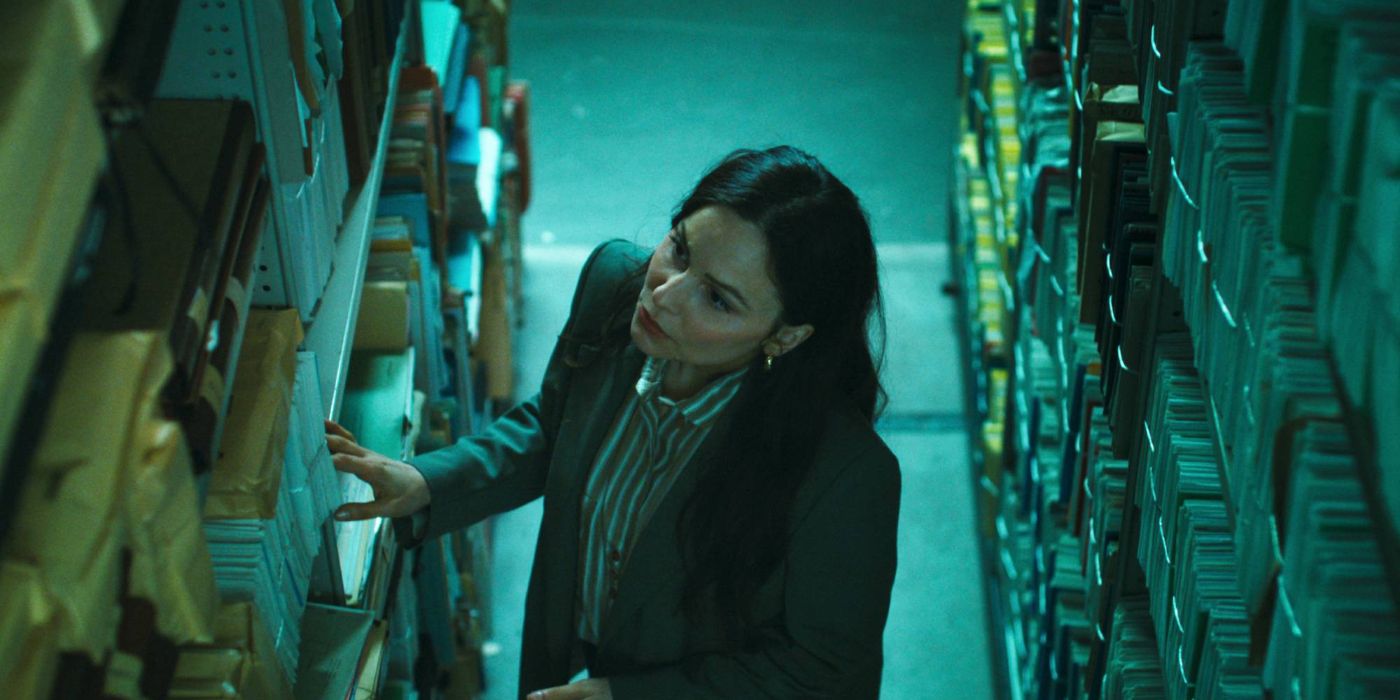
Like all good ghost stories, Cassandra has a dual center – a mystery to unfold and a family to protect. It’s Samira who is most targeted by Cassandra and Samira who digs in the deepest, trying to understand the artist formerly known as a person. Mina Tander’s performance stays truthful, no matter how wild the subject matter around her gets, and it allows the show’s bigger themes of isolation, grief, and parenthood – with emphasis on the challenge of being a good mother in the eyes not only of your children but of society’s current feminine standards – to flourish.
Similarly, Lavinia Wilson’s voice in the present-day scenes and her full range of acting ability in the past make it impossible to see Cassandra as an empty AI operative. Top it off with Michael Klammer’s easy charm and infuriating horror-movie-dad tendencies, the teen-angst and growing pains beautifully captured by Joshua Kantara, and a blessing of a child actor in Mary Amber Oseremen Tölle, and this is a sensational update to the ever-growing AI-horror genre.
'Cassandra' Raises the Stakes
Cassandra combines the vulnerability of a family who needs a new life more than a new home with the dread inherent in an exhausting age of technological change. Without sacrificing the human story or regurgitating the overly menacing AI trope that is churned out fairly often these days, it warns viewers of the consequences of convenience overall. With a family and an AI both deep in grief, Cassandra aims at how Big Tech makes us feel we can last forever, even as copies, replicas, or lesser versions of ourselves, and how, ultimately, that’s just denying our human need to mourn.
Where plenty of films position a robot girlfriend to experience the cruelty of men, Cassandra looks deeper into how women are discarded before they’re turned to AI, and how rigid ideas about motherhood or the traditional family often warp love into something brutal.
KioskNews shows a cleaned-up reading view extracted from the publisher’s page — the original always lives on their site, not ours.