Thai PBS funding in spotlight
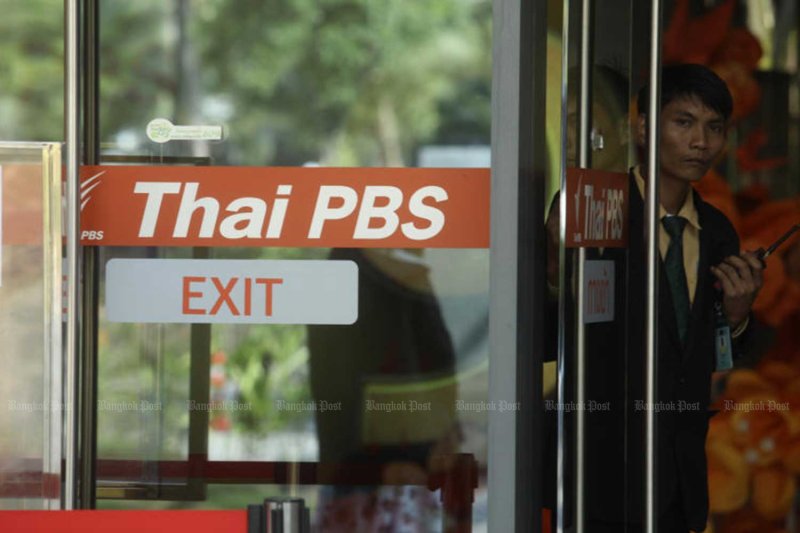
A proposal by the ruling Bhumjaithai Party (BJT) to amend laws governing four public bodies has sparked debate over their funding and accountability.
They are the Thai Public Broadcasting Service (Thai PBS), the Thai Health Promotion Foundation (ThaiHealth), the Elderly Fund and the National Sports Development Fund. All four receive earmarked revenue from alcohol and tobacco excise taxes.
The proposal, spearheaded by BJT legal affairs chairman Suphachai Jaismut, seeks to change how the organisations are funded. Thai PBS is drawing the most attention as the country's first public television station, established in 2008 as part of media reform efforts.
Under the law, Thai PBS receives funding equivalent to 1.5% of excise taxes collected on alcohol and tobacco, subject to an annual ceiling of 2 billion baht.
Any revenue above the cap must be transferred to the state. The tax is collected by the Excise Department and the Customs Department and transferred to Thai PBS. The finance minister can adjust the ceiling every three years, subject to legal conditions.
The BJT-proposed amendments concerning Thai PBS are open for public consultation from Sept 30 to Oct 14. The main proposal would overhaul the broadcaster's funding structure, replacing its earmarked revenue with allocations from the national budget.
A matter of transparency
While the move raises concerns about the independence of public media, Mr Suphachai has emphasised the need to strengthen financial discipline and ensure long-term stability and sustainability.
He cited Section 26 of the State Fiscal and Financial Disciplines Act, which prohibits laws from earmarking tax or fee revenue for specific state agencies to spend without transferring it to the state, except for revenue collected for local administrative organisations.
Section 82 exempts existing laws from this restriction, but Mr Suphachai views the exemption as a transitional measure. As it has no expiry date, he believes laws that conflict with fiscal discipline should be repealed.
Mr Suphachai said the proposed amendments are a serious effort, adding that the process has progressed too far to be dismissed as a test of public reaction.
He said Thai PBS's spending also warrants greater scrutiny over transparency and efficiency.
Concerns about potentially expensive outsourced programmes and overlapping internal operations have been raised by former employees and people familiar with the organisation, he said.
"An organisation using public tax revenue should not be exempt from scrutiny," he said.
Responding to concerns the proposal could undermine media independence, Mr Suphachai said it is not intended to interfere with Thai PBS's work, pointing out the organisation's law already contains provisions protecting press freedom.
Requiring the broadcaster to submit an annual budget request to the House of Representatives would be a normal procedure, he said.
Other state and independent bodies, including the National Broadcasting and Telecommunications Commission (NBTC), also go through the budget process, he said.
"We can't intervene with their work. The process would allow elected representatives to scrutinise public spending better," he said.
Mr Suphachai said most critics and opponents of the proposal are from civil society groups or parties with interests in the funding, adding that it is natural for them to defend those interests.
After the public consultation ends, the proposal will be submitted to the cabinet before proceeding to parliament, he said.
It is unlikely to complete the process during the current parliamentary session but will follow the normal legislative procedure, he said.
Safeguards for independence
Six media organisations have called for safeguards to protect Thai PBS's independence amid a proposal to change its funding structure, urging a broader review of its role, governance and operations.
They said legal changes must not weaken these principles or undermine Thai PBS's status as a media organisation serving the public, rather than the government or political interests.
The groups said fiscal discipline and editorial independence could coexist, but replacing dedicated funding with annual budget allocations could expose the broadcaster to political pressure.
Any changes should ensure adequate, stable and predictable funding to support long-term planning without dependence on political discretion.
Safeguards should cover budget allocation, review and adjustment, as well as the organisation's management, to prevent financial mechanisms from being used to interfere with or pressure its professional work.
They called on parliament to conduct a comprehensive review and public consultation covering not only funding but also Thai PBS's role, mission, governance structure and operational performance.
Media professional organisations, academics, civil society groups and the public should be given opportunities to participate, they said.
They also called for impact assessments and alternative funding options to be studied and made public before any decision is made to change the organisation's funding structure.
The groups urged Thai PBS's policy board and management to encourage wider public participation and set clear, measurable performance targets to demonstrate the value of public spending on the broadcaster.
Funding reform, not control
Responding to the call, Mr Suphachai said he supports an independent public broadcaster but argued editorial freedom and the management of public funds are separate issues.
He said changing Thai PBS's funding system should not automatically be seen as an attempt to control the media.
Instead, the focus should be on finding a system that protects media independence while ensuring public money is spent transparently, with accountability and in line with the country's fiscal discipline, he said.
"If Thai PBS insists on being 'the people's media', it must also accept that its funding comes from the public purse. People therefore have the right to ask how the money is spent, how efficiently it is used and whether the current funding mechanism remains appropriate for the country's circumstances," he said.
"Scrutiny of these matters is not a threat to media freedom, and legal amendments should not automatically be labelled interference in the newsroom if they contain no provisions or mechanisms allowing politicians to dictate news content," he said.
He said the issue should not be framed as a choice between media freedom and fiscal discipline, adding Thailand should have both.
The case for public media
Prof Pirongrong Ramasoota, an NBTC commissioner and media scholar, said a key principle of public media is independence from both the state and commercial interests.
She said that stable funding is essential to allow public media to serve as a public space and scrutinise those exercising legislative, executive and judicial power, as well as the power of capital.
"Fairly assessed, Thai PBS has delivered clear public value, not only through its scrutiny of those in power but also by giving a voice to marginalised groups, promoting citizen journalism and tackling false information and disinformation, areas that other media outlets may not be able to cover," she said.
Criticism of Thai PBS's budget and spending should be treated as a management and resource-allocation issue, separate from the question of whether public media should exist, she added.
"Public media remains essential to Thai society," she said.
Questions over political motive
Supinya Klangnarong, a former NBTC commissioner, questioned the rationale and timing of the proposed funding change, although she agreed that continued funding without efforts to change could lead to "stagnation".
In her view, Thai PBS provides more public-interest content and is more independent of political influence than other channels. Its dedicated funding helps provide a degree of protection for that independence, she said.
Before proposing legal amendments, the government should study alternative funding sources and explain how any replacement would work, she said.
A feasibility study should examine how much funding would be needed, where it would come from and how editorial independence would be protected, she said.
The public should have confidence that the changes are not driven by political interests, she added.
"The key is to preserve public television with secure funding and safeguards against dependence on the political interests of the government of the day. There must also be a transition period to give the organisation time to prepare and adapt," Ms Supinya noted.
She said Thai PBS and ThaiHealth are linked to civil society movements in Thailand, helping sustain the voices of vulnerable and grassroots groups. Their work is necessary to strengthen civil society networks as a counterbalance to state power, she said.
"Cutting this funding would weaken the voices and strength of civil society, benefiting state power and commercial interests," she said.
Ms Supinya said she opposes the latest proposal, questioning political motives. Any genuine reform should begin by asking Thai PBS to present its own restructuring plan, she said.
Prove it matters
Assoc Prof Warat Karuchit of the National Institute of Development Administration said switching to the government's budget process could create an "invisible hand" that indirectly pressures the broadcaster.
Thai PBS may be under pressure to produce content in line with government policies, leading to self-censorship or content designed to please the authorities, he said.
Retaining the current funding system, which carries the lowest risk of interference, would be a better option for protecting editorial independence, he said.
However, scrutiny of Thai PBS's annual budget of more than 2 billion baht and a review of its operations are necessary to improve efficiency and transparency.
The broadcaster must show whether its funding delivers value for money compared with alternative uses, such as building hospitals or schools, he said.
"It must demonstrate that it is not simply a 'comfort zone' where little is expected of it, but an organisation that uses every baht to deliver tangible benefits to society," he said.
Comparing Thai PBS with established public broadcasters such as the BBC and Japan's NHK, Assoc Prof Warat said it should shift its focus away from contentious political issues.
The broadcaster should work towards improving quality of life, promoting cultural appreciation and media literacy, and developing a more informed society to support the country's growth.
It should strengthen investigative reporting to expose deeper structural problems, an area where commercial media may be constrained by sponsors and business interests, he said.
Assoc Prof Warat said Thailand still needs public media and Thai PBS should not be abolished, but the broadcaster must reform and "demonstrate why it matters to the public".
KioskNews shows a cleaned-up reading view extracted from the publisher’s page — the original always lives on their site, not ours.