10 Best Whodunits for Beginners, Ranked


Andrea M. Ciriaco is a long-time script reader and former entertainment editor who specializes in classic movies and Hollywood history. She was a student film critic at Kent State University for three years and worked at Warner Bros Studio in Burbank and The Safran Company for several years. Based on her vast taste and range of knowledge, many consider Andrea to be a walking IMDb who knows dozens of underrated movies and is a vital assesst to any trivia night. While movies are her expertise, Andrea is also a diehard fan of iconic shows including The Sopranos, Boardwalk Empire, Rod Serling's The Twilight Zone, Will & Grace and South Park. Some of her favorite filmmakers are Walt Disney,John Huston, Fritz Lang, Alfred Hitchcock, John Ford, Mel Brooks, Quentin Tarantino, Martin Scorsese and Howard Hawks.
Sign in to your Collider account
Society has always been fascinated by mysteries. Whether it is a case of true crime or a major conspiracy, the cryptic puzzles and thought-provoking stories have a way of hooking us in with pure intrigue. When it comes to movies, the classic whodunit murder mystery stands to be a majority favorite among film fans who are lured in by life-altering stakes and the unwavering sense of suspense and unpredictability.
In the early days of cinema, the work of famous authors such as Agatha Christie, Raymond Chandler, and Sir Arthur Conan Doyle set the standard for the essential whodunit and had a major influence on the film genre, which continues to inspire writers and filmmakers today. For those who are interested in the genre but are unsure of where to start, the following films, such as Murder on the Orient Express, Clue, and Witness for the Prosecution, are an ideal place to start for any newcomer to the whodunit movie mystery.
10 'Presumed Innocent' (1990)

Harrison Ford stars in the legal thriller Presumed Innocent as an attorney, Rozat 'Rusty' Sabitch, who works in the prosecution office and is the right-hand man for the district attorney (Brian Dennehy). When a colleague is found brutally murdered in her apartment, the district attorney assigns Sabitch to the case but is unaware of the young attorney's previous affair with the victim. Faced with a moral conflict, Sabitch does his best to conduct his investigation, but after a new district attorney is elected, he becomes the prime suspect in the case.
Based on the 1987 novel written by Scott Turow, Presumed Innocent is a twisted whodunit, full of high intensity and a premise that easily lures audiences into a constant debate over Ford's character. Unlike other whodunit movies, Presumed Innocent doesn't feature a room full of potential suspects but instead puts one at the forefront while introducing other possible assailants as the film progresses, making Presumed Innocent a great starter flick to the film genre.
9 'The Last of Sheila' (1973)

James Coburn takes on the role of a movie producer, Clinton Greene, who invites a group of guests for a week's vacation aboard his yacht. Unbeknownst to the invitees, Coburn had specifically invited them because they were all together at Clinton's home a year ago when the producer's wife was killed as a result of a hit-and-run. While the guests think they're in for a relaxing cruise in the Mediterranean, Clinton is prepared to play detective and find the person who murdered his late wife.
The Last of Sheila puts a modernized twist on the traditional whodunit and is an exceptional throwback to the genre's classic formula. Between the perplexing mystery and the array of stellar performances, audiences are effectively tangled up in a web of greed, deception, and murder, which all leads up to a highly unexpected conclusion that leaves viewers floored. The Last of Sheila earned generally positive reviews and is easily one of the most underrated whodunit movies that deserves more recognition than it typically receives.
8 'Evil Under the Sun' (1982)

Evil Under the Sun is a solid adaptation of Agatha Christie's 1941 novel and features the author's infamous detective, Hercule Poirot (Peter Ustinov), who, while working on a case for an insurance company, suddenly finds himself investigating an unexpected case when an unpopular actress is found murdered. While Poirot begins to conduct his investigation, he soon discovers that both of his cases are surprisingly connected.
Christie is regarded as the queen of the classic whodunit mystery and, with several of her novels adapted for the silver screen, Evil Under the Sun often times gets lost in the mix of other mainstream titles. Initially, the movie received mixed reviews, with many comparing it to the previous films starring Ustinov as the famed Poirot. Despite the critical response, Evil Under the Sun still follows an intriguing mystery and is carried by an exceptional cast which also includes Maggie Smith, Game of Thrones' Diana Rigg, and James Mason, ultimately deeming the marginalized whodunit classic worthy of any beginner's watchlist.
7 'Gosford Park' (2001)

Robert Altman's Gosford Park is a humorous whodunit set in England during the 1930s and centers around a group of wealthy and pretentious people who are all invited for a weekend-long getaway. While the guests arrive ready to unwind and relax, their initial plans take an unexpected turn when one of them winds up dead, leading everyone to become a potential suspect in the mysterious murder.
Gosford Park is inspired by Jean Renoir's classic film, The Rules of the Game, and features an ensemble cast including Helen Mirren, Michael Gambon, Maggie Smith, and Ryan Phillippe. Like most of Altman's work, Gosford Park focuses heavily on the characters involved rather than the plot, which essentially adds an emotional depth and curious allure that ultimately sets it apart from other whodunit mysteries. Overall, Gosford Park received positive reviews from audiences and critics, including film critic, Roger Ebert, who gave the movie four out of four stars, citing it as one of Altman's finest works.
Collider Exclusive · Oscar Best Picture Quiz
Which Oscar Best Picture
Is Your Perfect Movie?
Parasite · Everything Everywhere · Oppenheimer · Birdman · No Country
Five Oscar Best Picture winners. Five completely different visions of what cinema can be — and what it can do to you. One of them is the film that was made for the way your mind works. Ten questions will figure out which one.
🪜Parasite
🌀Everything Everywhere
☢️Oppenheimer
🐦Birdman
🪙No Country for Old Men
01
What kind of film experience do you actually want? The best movies don't just entertain — they leave something behind.
02
Which idea grabs you most in a film? Great films are driven by a central obsession. What's yours?
03
How do you like your story told? Form is content. The way a story is shaped changes what it means.
04
What makes a truly great antagonist? The opposition defines the protagonist. What kind of opposition fascinates you?
05
What do you want from a film's ending? The final note is the one that lingers. What do you want it to sound like?
06
Which setting pulls you in most? Where a film takes place shapes everything — mood, stakes, what's even possible.
07
What cinematic craft impresses you most? Every great film has a signature — a technical or artistic element that makes it unmistakable.
08
What kind of main character do you root for? The protagonist is the lens. Who you choose to follow says something about you.
09
How do you feel about a film that takes its time? Pace is a choice. Some films sprint; others let tension accumulate slowly, deliberately.
10
What do you want to feel walking out of the cinema? The best films leave a mark. What kind of mark do you want?
The Academy Has Decided Your Perfect Film Is…
Your answers have pointed to one Oscar Best Picture winner above all others. This is the film that was made for the way your mind works.
Parasite
You are drawn to films that operate on multiple levels simultaneously — that begin in one genre and quietly, brilliantly migrate into another. Bong Joon-ho's Parasite is a film about class, desire, and the architecture of inequality that manages to be darkly funny, deeply suspenseful, and genuinely shocking across a single extraordinary running time. Your instinct is for cinema that hides its true intentions until the moment it's ready to reveal them. Parasite is exactly that — a film that rewards close attention and punishes assumptions, right up to its devastating final image.
Everything Everywhere All at Once
You want it all — and this film gives you all of it. The Daniels' Everything Everywhere All at Once is one of the most maximalist films ever made: action comedy, multiverse sci-fi, family drama, existential crisis, and a genuinely earned emotional core that sneaks up on you amid the chaos. You are someone who responds to ambition, who doesn't want cinema to choose between being entertaining and being meaningful. This film refuses that choice entirely. It is overwhelming by design, and its overwhelming nature is precisely the point — because the feeling of being crushed by infinite possibility is exactly what it's about.
Oppenheimer
You are drawn to cinema on a grand scale — films that understand history not as a backdrop but as a force, and that place their characters inside that force and watch what happens. Christopher Nolan's Oppenheimer is a film about the terrifying gap between what we can do and what we should do, told with the full weight of one of the most consequential moments in human history behind it. You want your films to feel important without feeling self-important — to earn their ambition through sheer craft and the gravity of their subject. Oppenheimer does exactly that. It is enormous, complicated, and refuses easy comfort.
Birdman
You are drawn to films that foreground their own construction — that make the how of the filmmaking part of the what it's about. Alejandro González Iñárritu's Birdman, shot to appear as a single continuous take, is cinema examining itself through the cracked mirror of a fading actor's ego. You respond to formal daring, to the feeling that a film is doing something that probably shouldn't be possible. Michael Keaton's performance and Emmanuel Lubezki's restless camera create something genuinely unlike anything else — a film that is simultaneously about creativity, relevance, self-destruction, and the impossibility of ever truly knowing if your work means anything at all.
No Country for Old Men
You are drawn to cinema that trusts silence, that refuses to explain itself, and that treats dread as a form of meaning. The Coen Brothers' No Country for Old Men is a film about the arrival of a new kind of evil — implacable, arbitrary, and utterly indifferent to the moral frameworks we use to make sense of the world. It is one of the most formally controlled films ever made, and its controlled restraint is what makes it so terrifying. You want your films to haunt you, not comfort you. You are not interested in resolution if resolution would be dishonest. No Country for Old Men is honest in a way that most cinema never dares to be.
6 'Death on the Nile' (1978)

While aboard a luxury cruise, detective Hercule Poirot (Peter Ustinov) learns that one of the passengers, Jacqueline de Bellefort (Mia Farrow), is a former friend of a wealthy heiress, Linnet Ridgeway (Lois Chiles), who recently married Jacqueline's former fiancé, leading to an intense confrontation between the trio. When Linnet is murdered, Poirot doesn't believe the scorned Jacqueline is responsible and, with the help of a trusted associate, Colonel Race (David Niven), the men begin to conduct an investigation, questioning everyone aboard.
Death on the Nile is based on Agatha Christie's 1937 novel of the same name and also features an all-star cast including Bette Davis, Angela Lansbury, Olivia Hussey, and George Kennedy. Even though the movie does have a striking resemblance to Christie's other works, the lineup of epic performances and an intelligently woven mystery (which is one of the few that doesn't involve Poirot working a case solo) makes Death on the Nile a vital pick for anyone who wants to get their feet wet in the whodunit genre.
5 'Clue' (1985)
Clue is a cheeky murder mystery based on the famous board game of the same name and is considered to be one of the best modern whodunits. The movie centers around six people who are invited to an isolated mansion by an unknown host who is blackmailing them all with damning and secretive information. Upon their arrival, the guests are given pseudonyms to conceal their identities, but when the lights suddenly go off and eventually come back on, they realize one of the guests has been murdered.
Clue features an effective combination of thrills and witty humor that makes it not only a unique whodunit but also a crucial choice for any newcomer to the genre. Like the board game, Clue was originally released in theaters with several different endings, adding a clever flare and lasting intrigue for audiences which resonated long after the end credits rolled. Initially, Clue received mixed to poor reviews, with many critics noting the plot dragged after the beginning and toed the line of being absurd, but through the years, the film has since gained a considerable cult following and stands to be one of the most overlooked movies of the 1980s.
4 'Murder on the Orient Express' (1974)

When detective Hercule Poirot (Albert Finney) is called back to London, he boards the luxurious Orient Express and finds himself in the company of several known passengers, including an American businessman, Samuel Rachett (Richard Widmark), who confides in Poirot that he believes his life is in danger. Shortly after its departure, the train is delayed by a snow storm, leaving the passengers stranded, but things take a shocking turn when Rachett is discovered murdered, leading Poirot to take on the case.
One of the best 1970s murder mysteries, Murder on the Orient Express is another Agatha Christie novel that has been adapted several times for the silver screen, but the 1974 version is cited as one if not the best adaptations. The film is widely recognized for being a flawless tribute to classic filmmaking, accurately depicting a quintessential style of glamour and sophistication that effortlessly immerses audiences into Poirot's investigation. Murder on the Orient Express was both a critical and commercial success, earning several Academy Award nominations, including Best Actor and Best Adapted Screenplay, and went on to win Best Supporting Actress for Ingrid Bergman.
3 'Laura' (1944)

Otto Preminger's must-watch classic film noir, Laura stars Dana Andrews as a New York detective, Mark McPherson, who is assigned to investigate the recent murder of a young advertising executive, Laura Hunt (Gene Tierney). As Mark meets with Laura's friends and colleagues, he soon finds himself enamored with her, falling under her unavoidable spell that many men have fallen victim to many times before. When Laura returns home to find Mark in her home, the case goes from who killed Laura to who wanted her dead.
Laura is regarded as one of the greatest movies of all time and is celebrated for redefining the formula of the traditional whodunit and its top-notch cast, which also includes Vincent Price, Clifton Webb, and Judith Anderson. Based on the 1943 novel written by Vera Caspary, Laura is a thrilling murder mystery but stands out for its main focus on the consuming elements of human nature such as control and obsession, making the film a well-versed murder mystery with emotional substance. Laura received several Academy Award nominations, including Best Director and Best Supporting Actor for Webb, and went on to win for Best Cinematography.
2 'And Then There Were None' (1945)
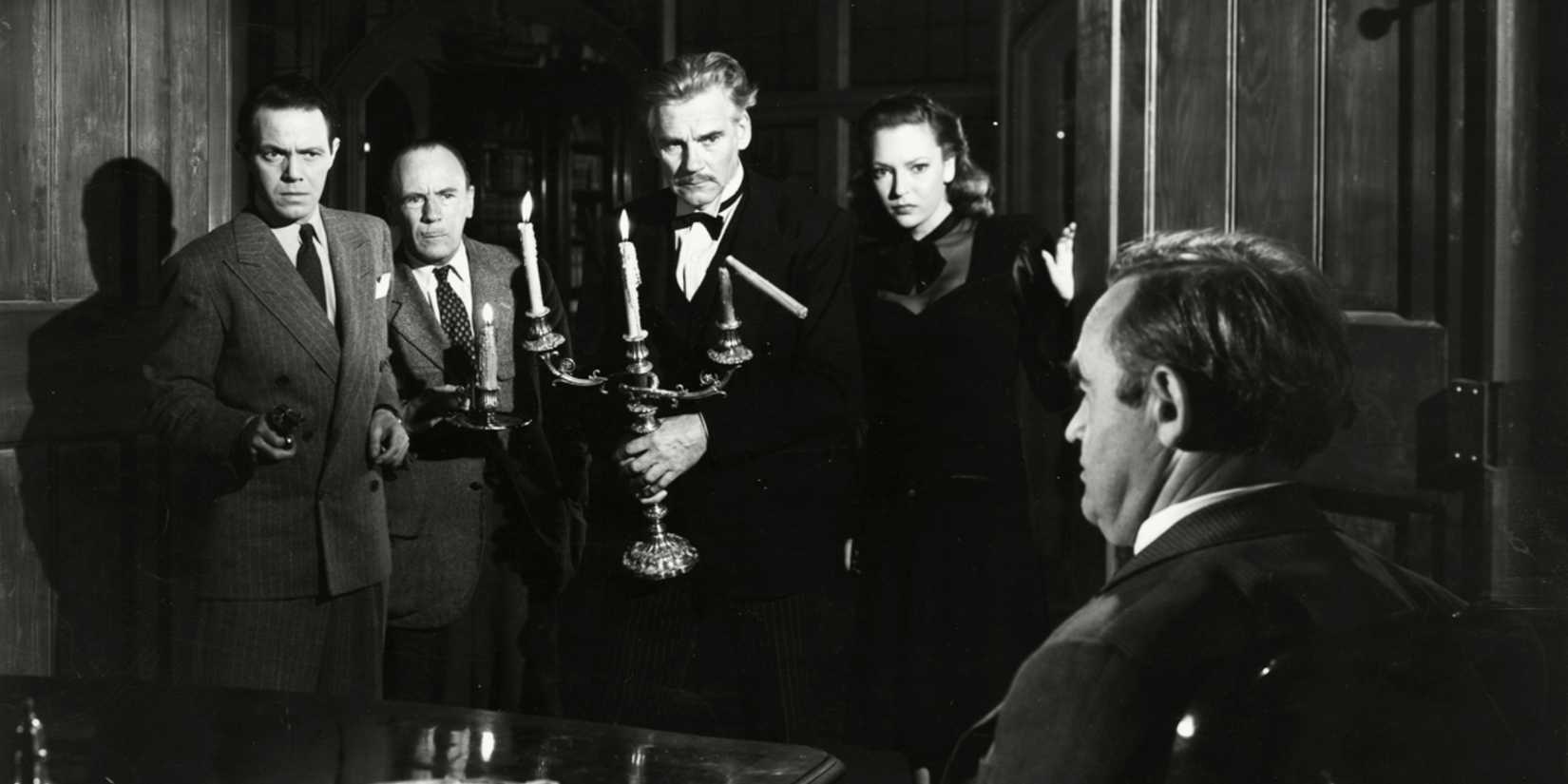
And Then There Were None is an exceptional adaptation of Agatha Christie's 1939 novel of the same name and follows ten strangers who are all invited to a large manor on an island by an unknown host. Once they arrive, they wait to meet their mysterious host but are instead greeted with a recording of a voice claiming to have sensitive information on all of them. As they try to figure out what they have gotten themselves into, madness ensues as each of the guests is slowly picked off one by one.
Unlike Christie's other whodunits, And Then There Were None has a ghostly feel to it which is conveyed by the isolated setting and haunting atmosphere, which solidifies it as a top-tier pick for anyone who is new to the genre. The defining element of the film lies within the plot's unwavering sense of mystery, cultivating an excitement of anticipation and intensity in audiences that is simply indescribable. And Then There Were None received glowing reviews, with many commending the film's balance of humor and suspense, spectacular performances, and, of course, a tightly constructed plot executed with sheer precision.
1 'Witness for the Prosecution' (1957)

Charles Laughton stars in Billy Wilder's Witness for the Prosecution as a legendary attorney, Wilfrid Robarts, who, despite being close to retiring, agrees to take on the case of Leonard Vole (Tyrone Power), who has been charged in the murder of a wealthy woman who had named Voles in her will as her beneficiary. Unfortunately, Leonard's alibi relies on his resentful wife (Marlene Dietrich), who, through a legal loophole, decides to testify against her husband, resulting in a series of shocking revelations and key information that could turn the entire case in a whole different direction.
Witness for the Prosecution is an all-consuming legal thriller based on Agatha Christie's 1925 story, The Witness for the Prosecution, which was adapted into a stage production in 1953 before making its big-screen debut. There is never a dull moment in this twisted tale of murder and deception, which is effectively conveyed by an A-list cast who are the heart and soul of this essential whodunit classic. Witness for the Prosecution was a smash hit and received several Academy Award nominations, including Best Picture, Best Director, and Best Actor, ultimately cementing its spot as the best whodunit for any newcomer.

Witness For The Prosecution
- Release Date
- December 17, 1957
- Runtime
- 116 Minutes
- Director
- Billy Wilder
-

Tyrone Power
-
Marlene Dietrich
A veteran British barrister must defend his client in a murder trial that has surprise after surprise.
KioskNews shows a cleaned-up reading view extracted from the publisher’s page — the original always lives on their site, not ours.