No regulations, no ‘group’ hunt: Why court quashed petitions against CJ Koome, judges
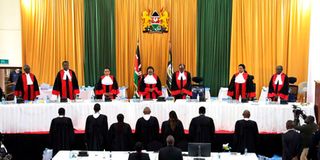
Supreme Court judges led by Chief Justice Martha Koome at the Supreme Court on Wednesday, August 31, 2022.
Photo credit: File | Nation Media Group

By Sam Kiplagat
Court Reporter
Nation Media Group
The High Court has barred the Judicial Service Commission (JSC) from processing petitions seeking the removal of Supreme Court judges until regulations governing the process are put in place.
The court also ruled that judges cannot be targeted collectively through a single removal petition, holding that complaints under Article 168 of the Constitution must be directed at individual judges and contain clear particulars of the alleged misconduct.
Justices Charles Kariuki, Lawrence Mugambi and Bahati Mwamuye held that the constitutional language requires an individualised process because judges are appointed, sworn in and held accountable as individuals, even when they sit as members of the same bench.
The declared the several complaints as unconstitutional, null and void and quashed the notices and related proceedings, and further, prohibited JSC from taking further action on defective notices, petitions or complaints arising out of the same facts.
The decision freezes several petitions before the JSC that sought the removal of judges of the Supreme Court judges, including Chief Justice Martha Koome, over decisions made by the apex court.
The court said the complaints against the Supreme Court judges centered around contested legal issues or decisions, including some matters that were before court hence did not fall within the JSC’s mandate and ought not to have progressed beyond preliminary threshold.
“Participation in collegial decision making does not immunize an individual Judge from accountability under Article 168. However, removal Petitions must be against each Judge individually, not jointly, as Article 168 consistently refers to removal of a Judge,” said the court.
The court said collective, composite or omni-bus Petitions pending before the JSC against Supreme Court Judges jointly as a group is incompatible with the constitutional framework.
The dispute arose from a series of complaints filed before the JSC following a unanimous Supreme Court decision in January 2025 banning lawyer Ahmednasir Abdullahi and members of his law firm from appearing before the apex court.
The lawyers claimed they had effectively been tried and punished in absentia and accused the seven judges of gross misconduct and violating their constitutional rights.
The complaints were followed by another petition for the removal of judges by Law Society of Kenya and its former president Nelson Havi, who also accused the judges of misconduct.
Former cabinet secretary Raphael Tuju had also filed a petition seeking the removal of five judges of the apex court, although he later withdrew the case.
The petitions triggered a wider legal and institutional dispute, with the Judiciary warning against threats to occupy the Supreme Court after the LSK threatened protests over the ban.
Federation of Women Lawyers (FIDA-Kenya) filed a petition challenging the petitions warning that the process could trigger a constitutional crisis if it resulted in the simultaneous removal of several or all seven Supreme Court judges.
The court found that the complaints fell short of the threshold required for such proceedings and that the JSC had, in the cases before it, risked infringing judicial independence by entertaining complaints based substantially on collegial decisions of the Supreme Court.
The judges said Article 168 provides a constitutional mechanism for removal of a judge for incapacity, gross misconduct or misbehaviour, but warned that the process must be exercised within clear procedural safeguards.
The court stressed that judicial independence does not give judges immunity from accountability. However, the JSC cannot turn the removal process into an alternative avenue for appealing or reviewing judicial decisions.
“The Judicial Service Commission should not purport to become a review chamber or an appellate court,” the court said, noting that parties dissatisfied with decisions have established avenues of appeal and review.
The judges said the commission could examine a judicial decision in limited circumstances where it forms part of a clear allegation of misconduct, such as where a decision is alleged to have been procured through bribery, corruption or other improper conduct.
The judges also faulted the JSC for failing to provide sufficient particulars in the complaints and communications sent to the affected judges.
They said each judge should be given clear information on the nature of the complaint, the specific ground for removal, the facts and particulars relied upon and any supporting material.
The court rejected the argument that Article 168 allows a collective petition against the entire Supreme Court.
Follow ourWhatsApp channel for breaking news updates and more stories like this.
KioskNews shows a cleaned-up reading view extracted from the publisher’s page — the original always lives on their site, not ours.