China team produces endless energy from lotus stems with water evaporation power
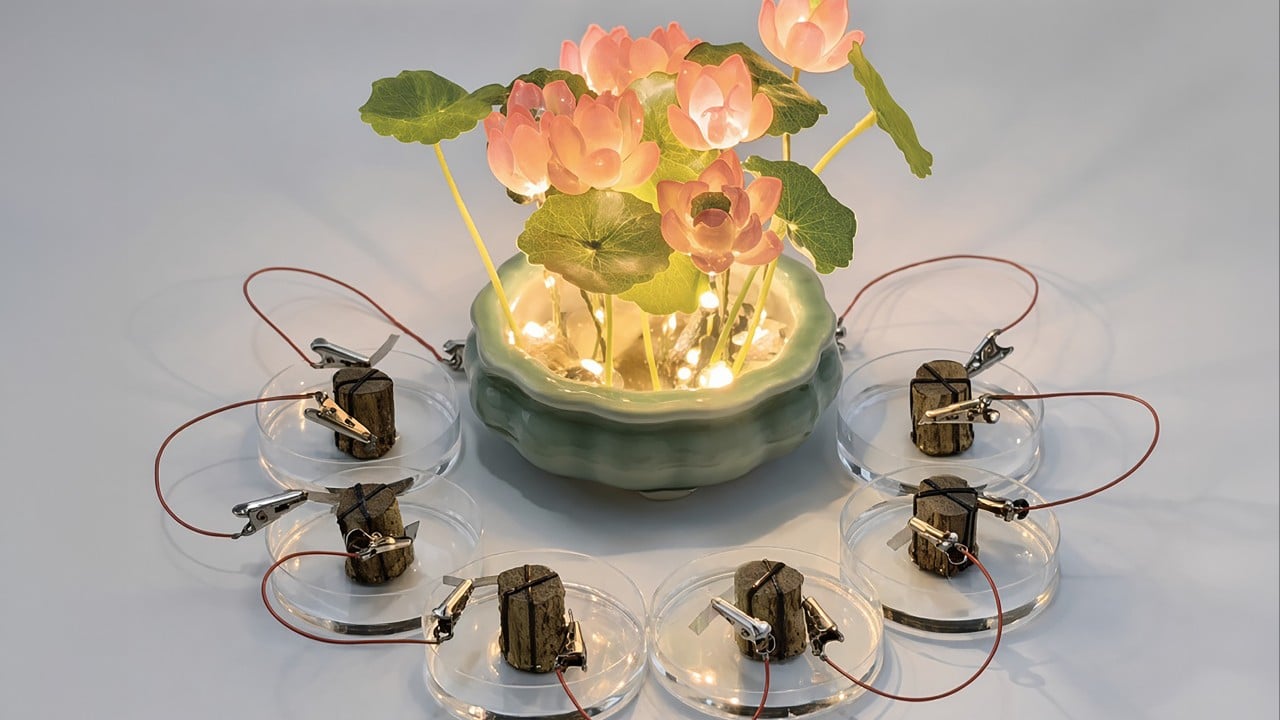
Chinese scientists have harnessed the process of water evaporation to generate continuous electricity day and night using a unique device made from lotus plants, according to a paper published in the peer-reviewed journal Device.
The hydrovoltaic technology could provide low-maintenance power for distributed sensors and low-power electronics in off-grid locations next to large water bodies, said the paper, which appeared on November 2.
The team’s lotus-stem and bacteria generator achieved continuous, stable power generation for more than 30 days. When combined into a scalable array of stem channels, the system was able to power a mobile phone, it said.
“The stable output and scalable integration of our device indicate its potential for distributed low-power energy supply,” the scientists wrote.
Unlike renewable energy sources that depend on fluctuating environmental conditions such as sunlight, natural evaporation is a “round-the-clock” process that occurs day and night across seasons.
“This technology holds great promise for applications in distributed, low-power, self-powered sensing and environmental monitoring,” said Hu Qichang, the study’s corresponding author and a professor at Fujian Agriculture and Forestry University.
According to Hu, this could include agricultural Internet of Things along with soil and water-quality monitoring as well as environmental surveillance through vast numbers of continuously operating sensors.
While the sensors typically consumed little power, their widespread distribution posed a challenge. Conventional batteries required regular maintenance and replacement which could be difficult in remote locations, he observed.
“We aim to explore the integration of hydrovoltaic power generation with other energy-harvesting technologies – such as solar or wind power – to develop multi-source, complementary energy supply systems.”
This approach could improve power reliability in complex environments, noted Hu, whose team has previously published research on harnessing the natural transpiration of lotus leaves to generate electricity and power small electronic devices.
According to Hu, the team’s research highlighted the potential of using water-transport structures in plants to generate energy, but found there were still inherent limitations to using living plant systems.
This prompted the scientists to look for a new approach that “retains the advantages of these natural structures while overcoming the constraints of using living organisms”, he said.
Unlike traditional hydroelectricity, which typically relies on large-scale infrastructure to harness power from water spinning turbines, hydrovoltaic technology generates electricity directly from the interaction of water with solid materials.
“Technologies that harvest low-grade environmental energy can provide power for sustainable and decentralised power systems,” the researchers wrote. One method is to harness power from water evaporation.
01:36
China’s largest photothermal power facility drives development of new form of energy
Hu pointed out that moisture evaporates from the environment in a continuous process, unlike solar power, which requires sunlight, or batteries, which need to be charged or replaced.
“This offers certain advantages for unattended applications where frequent maintenance is difficult,” he said.
However, the performance of existing water-evaporation generators is constrained by disordered internal pores, making it harder for water molecules and ions to travel efficiently and produce power.
The team took inspiration from nature, where beneficial bacteria living inside plants help to regulate water and nutrient transport – a synergy that provided a “blueprint” for overcoming the performance challenges of hydrovoltaic devices, Hu said.
According to the paper, the researchers developed a generator that paired the vertically aligned pore channels of lotus stems with the electroactive bacteria Geobacter sulfurreducens.
To build the generators, the team soaked lotus stems in a bacterial mixture for 24 hours, allowing the microbes to colonise the internal channels. The stems were then freeze-dried and titanium mesh electrodes attached to both ends.
The scientists found that when a stem was placed in water, its vertical channels drew moisture and charged ions upwards.
As the water evaporated, positively charged ions accumulated at the top electrode, creating a voltage difference that generated continuous electricity. Testing showed that the device could sustain continuous low-voltage power generation for more than 30 days.
Next, the researchers wired together multiple individual generators to establish whether they could run small devices. They connected three in a series that powered a calculator and a group of six to power a small lamp and an electronic ink display.
02:59
China’s Great Green Wall stands against the spread of desert sands
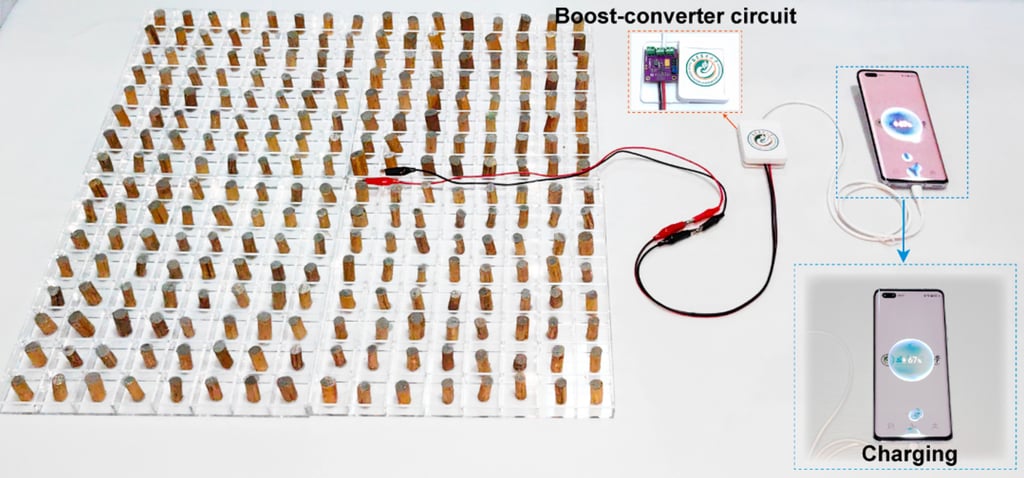
They then scaled the system up to a 16 by 16 grid of 256 lotus-stem generators, which produced enough electricity to power a mobile phone after passing through a voltage boost converter, the scientists said.
“To assess compatibility with digital electronics, a single [generator] was connected to the gate terminal of a field-effect transistor and triggered switching behaviour, demonstrating its potential for digital logic applications,” they added.
Hu said that achieving long-term operation of these generators not only required the material and electrodes to be stable but also a sustained supply of moisture and efficient evaporation.
“Consequently, our future work will focus on the long-term stability of internal transport channels, the durability of material interfaces and the device’s adaptability to varying temperature and humidity conditions,” he said.
“By optimising the device’s structure and operational parameters, we aim to further extend its effective service life.”
Remaining challenges include cost and processing hurdles, according to the paper. “Development will inevitably trend towards more compact, highly integrated devices,” Hu said.
The inherent variability found in natural lotus stems and bacterial biofilms could make it difficult to satisfy the consistency requirements for mass production.
“Therefore, future efforts must focus on utilising artificial materials to construct structures with oriented microchannels, which can serve as the foundation for developing standardised power-generating units.”
According to Hu, the research team’s goal is to extract the structural and functional principles from natural systems to develop fully synthetic devices for hydrovoltaic power generation.
“We believe this represents a crucial pathway for advancing hydrovoltaic power generation technology from laboratory research towards practical, real-world application,” he said.
Passionate about science? Dive deeper with the Dark Matters newsletter, a weekly in-depth analysis on China’s rise in science, technology and military that goes beneath the surface. Sign up for free now.
KioskNews shows a cleaned-up reading view extracted from the publisher’s page — the original always lives on their site, not ours.