We must save the poor, just not see them or hear them
As expected, Thailand made sure IMF-World bank luminaries never got to meet the people they claim to help
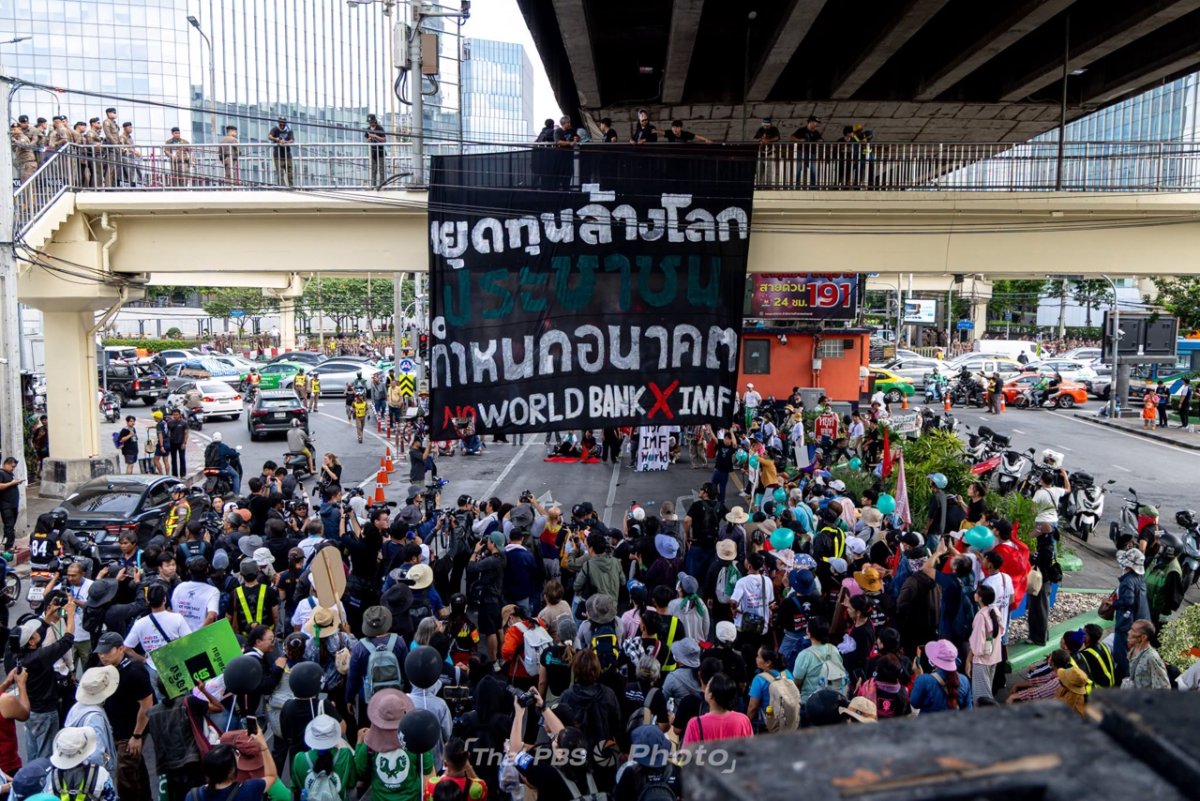
Fully acknowledging that international financial bodies do not have direct influence over the decisions of countries like, say, Thailand, it is still difficult to deny the disconnect as conference delegates gravely discuss “safety nets” for the vulnerable while police keep those very people physically at bay.
The International Monetary Fund and World Bank annual meetings this week devoted hundreds of hours of consideration — and international media hundreds of thousands of words — to protecting the poor and economically precarious.
We heard about “safety nets” during the “Food Security in the Age of Shocks” seminar, when Rodrigo Valdes, director of the IMF’s fiscal affairs department, underlined how poor households are particularly exposed to food price fluctuations spurred by conflict, trade and transport disruptions, volatile energy and fertiliser costs and extreme weather.
The conversation took place as actual representatives of the poor, indebted and economically vulnerable were told, and even shown in no uncertain terms, by host Thailand that they should not attempt to inject themselves into the talks.
A cynical observer could not help but conclude that the poor deserve protection, but they do not deserve an audience.
The contradiction was particularly on display on Oct 15, when about 600 members of the People’s Network Against the World Bank and IMF marched towards the Queen Sirikit National Convention Center.
Police blocked their advance near the Rama IV intersection and directed them to a designated protest area. At one point during that process, a brief scuffle broke out on a pedestrian bridge when some of the demonstrators attempted to unfurl a banner.
International media described the march as peaceful apart from the minor scuffle, which took place despite protesters having said they intended to express their concerns, not disrupt the meetings.
The deterrence evolved into a full-on barricade on Oct 16 that stopped the Assembly of the Poor and La Via Campesina from getting near the meetings, whether from the Asok Montri or Khlong Toey intersections.
Reform and reaction
Inside the convention centre, officials from across the globe spoke of resilience, reform, fiscal space and targeted support.
IMF managing director Kristalina Georgieva urged Southeast Asian governments, like the one facilitating the meetings, to do more to protect vulnerable households against economic shocks.
The demonstrators outside were raising precisely these sorts of issues. As well, they argued that policies associated with international financial institutions and large development projects tend to favour corporations while leaving communities to absorb the environmental and financial costs.
The validity of such concerns could be debated, but the decision to keep the demonstrators at a significant distance signalled that no such discourse would take place.
Ultimately, it is understandable that a conference bringing together world leaders and the globally significant needs to ensure high security, and that the meetings would go nowhere if scheduled discussions were allowed to be interrupted by any group showing up with a list of grievances.
Contradiction clear
But the organisers of an event such as this, if they genuinely wish to uphold the principles they espouse, surely must see the contradiction when they push back those who believe their voices should be heard in the conversations that pertain directly to them.
Taking a less philosophical view, it is especially suspect for Thailand, a country of great and obvious economic disparity, to assume the role of enabler for an event aimed at finding remedies to economic inequality but to show no restraint from its usual approach to the disadvantaged.
Perhaps great strides can be made as a result of the meetings. Maybe the talks laid the groundwork for the “Wonderful World” our prime minister heralded with his saxophone performance on Friday night.
But it is admittedly difficult to have faith when a more elegant solution for the simple handling of peaceful protesters seemed too great a task.
KioskNews shows a cleaned-up reading view extracted from the publisher’s page — the original always lives on their site, not ours.