Ex-US commander urges arms sales to Taiwan
2027 INVASION? Retired US Admiral Philip Davidson praised Taiwan’s defense reforms, including extending mandatory military service and boosting nationwide preparedness
By Aaron Tu and William Hetherington / Staff reporter, with staff writer


A former US naval commander urged Washington to expedite US$14 billion in arms sales to Taiwan and warned of China’s information warfare, as he expressed hope that his earlier warning of a potential conflict in the Taiwan Strait by next year would prove wrong.
Former US Indo-Pacific commander admiral Philip Davidson, who in 2021 warned that China’s military threat to Taiwan could materialize by next year, discussed his assessment in a podcast — Why Should We Care About the Indo-Pacific? — that aired on Friday.
Davidson praised Japan’s shift in security policy and Taiwan’s decision to restore a one-year compulsory military service period.
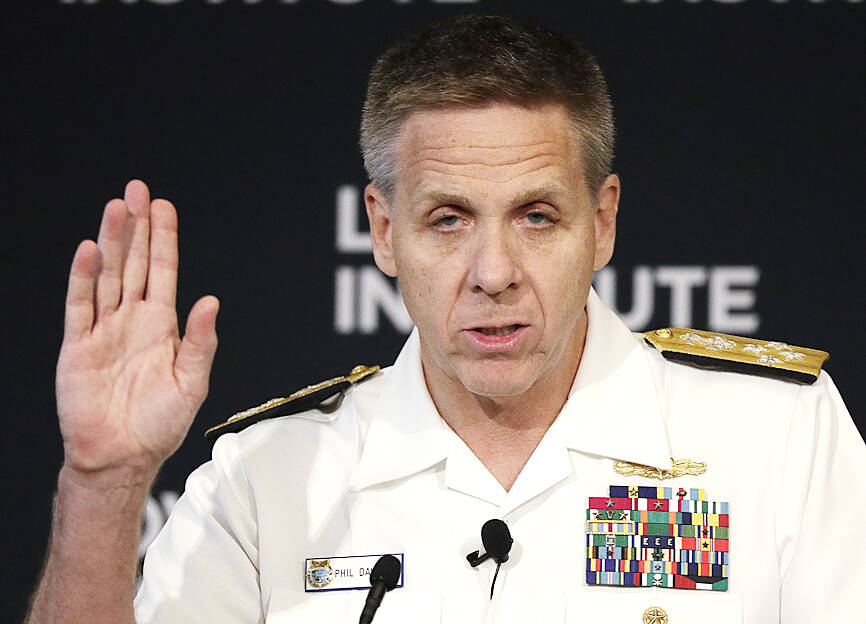
Then-US Indo-Pacific commander Admiral Philip Davidson speaks at the Lowy Institute in Sydney on Feb. 13, 2020.
Photo: AP
However, he also urged Washington to accelerate US$14 billion in pending arms sales to Taiwan and warned that China’s information warfare poses an increasingly serious threat.
In a testimony before the US Senate Committee on Armed Services on March 9, 2021, Davidson said China had long sought to replace the US as the leading global power by 2050, but Beijing could accelerate its ambitions.
Taiwan was among its key targets, he said, warning that the threat could emerge within six years. The assessment became known as the “Davidson window.”
Then-CIA director William Burns in 2023 said that Chinese President Xi Jinping (習近平) had instructed the People’s Liberation Army to be ready to invade Taiwan by 2027.
However, Burns said that this did not mean Beijing had decided to launch an invasion that year.
In the podcast, Davidson said a series of military reforms that the US and its allies have undertaken in the past few years might have changed the original threat assessment.
He cited continued adjustments to US military deployments in the Indo-Pacific region, including increased army, Marine Corps and missile deployments along the First Island Chain and in the Philippines as examples of those reforms.
Greater integration of land, sea and air firepower has also helped bolster deterrence against China, he said.
Japan’s shift in security policy has been particularly significant.
Japan revised its National Security Strategy in 2022, raising its defense spending target to 2 percent of GDP while strengthening its space and cyberwarfare capabilities and redeploying ground and air forces to Okinawa and the Ryukyu Islands, Davidson said.
Compared with when he served as Indo-Pacific commander, Japan has taken a more assertive security stance toward China, which it identifies as a regional strategic threat, while deepening military cooperation with the US, he said.
“We have deepened the relationship with Japan and Australia in the Keen series of exercises over the last five years,” he said. “And, in a way that was kind of unheard of in my day, which I think is a profound improvement.”
Davidson also praised Taiwan’s defense reforms, including extending compulsory military service from four months to one year and strengthening nationwide emergency preparedness.
He referred to the Overall Defense Concept proposed by former chief of general staff Admiral Lee Hsi-ming (李喜明), saying Taiwan should rely on asymmetric capabilities, including drones, uncrewed surface vessels, mobile precision weapons and naval mines, to offset China’s military advantage.
However, Davidson expressed concern about the pace of US arms deliveries to Taiwan.
He urged the US to accelerate the approval and delivery of US$14 billion in weapons, saying the equipment should reach Taiwan within the next several months to a year.
The proposed sales, which are still awaiting completion of the US approval process, primarily involve Patriot Advanced Capability-3 (PAC-3) and NASAMS air defense missiles.
In addition to US-China relations, the war in the Middle East, US military assistance to Ukraine and rising global demand for interceptor missiles are putting pressure on US weapons production capacity.
Beyond conventional military threats, Davidson said China’s information warfare has become one of his greatest concerns, with the information environment significantly worse than when he led US Indo-Pacific Command.
“The one thing that has really jumped out at me — that was a problem, certainly, when I was the IndoPacCom commander, though, but I think it’s worse now — is the information environment,” he said.
China is attempting to undermine Taiwan’s democratic processes while using social media to erode public trust in political, military and business leaders in Taiwan and the US, he said.
Beijing exploits accidents and personal hardships by flooding social media with information intended to influence public opinion and deepen divisions.
Davidson added that these efforts are not limited to China, but also involve Russia, Iran and other actors in other regions, highlighting the growing number of players seeking to manipulate the information environment, he said.
Describing the scale of social media manipulation, Davidson said: “It’s really dangerous.”
He cited estimates suggesting that bots and propaganda operators could account for as much as 70 percent of activity in some social media discussion threads, making the information environment increasingly difficult to navigate.
Davidson did not identify the specific source of the statistic during the interview.
The US must devote more resources to strengthening its information warfare capabilities rather than focusing exclusively on conventional weapons and emerging military technologies, Davidson said.
KioskNews shows a cleaned-up reading view extracted from the publisher’s page — the original always lives on their site, not ours.