Broken Hill strikes thick copper sulphides beneath SA goldfield
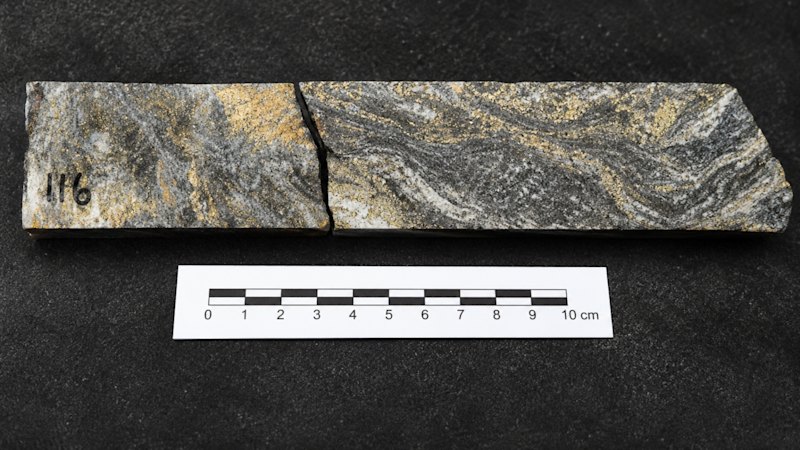
Broken Hill Gold has kicked off maiden diamond drilling at its Icebreaker prospect in South Australia with a bang, intersecting broad zones of visible copper sulphides in the first two holes. The results suggest the company could be onto a significant iron-oxide copper-gold (IOCG) system, sitting right beneath its established White Dam gold project.
The first hole hit veined and disseminated copper sulphides in multiple zones from 61.4m to 329.8m, including standout visual intervals across 65.2m from 89.1m depth, 23.7m from 169.8m and 17m from 311m.
The second hole, collared 80m south, encountered a strong sulphide zone from 58.9m to 111m, including an 11.4m interval from 98m, with weaker copper-bearing mineralisation extending to 258m.
Management says the widespread sulphides hint at a sizeable IOCG-style system, comprising a cocktail of alteration minerals and sulphides, including magnetite, pyrite, chalcopyrite, molybdenite and pyrrhotite - the kind of geological elephant explorers dream of finding in South Australia.
‘The next few months for BH6 have the potential to be transformational.’
Broken Hill Gold managing director Matthew Boyes
The diamond holes targeted deeper extensions of earlier reverse circulation (RC) discoveries beneath Icebreaker’s shallow oxide gold resource. Formerly known as White Dam North, the prospect previously delivered impressive assays of 28m at 2.4 grams per tonne (g/t) gold and 0.7 per cent copper from 93m, and 20m at 2.5g/t gold and 0.5 per cent copper from 58m.
Notably, the latest visual intersections sit directly beneath and appear geologically continuous with those earlier assayed copper-gold hits, suggesting the mineralisation may have serious legs at depth.
The holes sit on the north-western edge of a three-square-kilometre target lit up by overlapping electrical, magnetic and gravity anomalies. The strongest induced polarisation (IP) responses, potentially signalling buried sulphides, remain effectively untested. Analysis of the geophysical data, alongside the new drill results, will help pinpoint the next targets.
Adding to the intrigue, the company’s Icebreaker, Rolling and historic Hannaford gold deposit fringe these anomalies, potentially forming part of one much larger alteration system.
Broken Hill Gold managing director Matthew Boyes said: “It is rare to get such compelling outcomes from initial holes of a new program, and I am confident that we are on the cusp of a major discovery at Icebreaker.”
Buoyed by early success, the company has ramped upto double-shift drilling, with more rigs expected shortly. The diamond program will push into 2027, testing fresh targets along more than 3km of prospective strike, where mineralisation is still open in all directions and at depth.
A parallel RC campaign will test for lateral extensions. Icebreaker’s oxide resource infill is due to finish in late November before the rig shifts 400m south to the company’s Rolling prospect, where shallow gold hits remain largely untested below 100m.
Core samples are in Adelaide for gold, copper and multi-element assays, with results due mid-to-late December, while the assays from October’s deeper drilling beneath its nearby Vertigo target are due shortly.
The company’s White Dam grounds sit 80km west of Broken Hill in South Australia’s Olary region of the Curnamona Province. The former operation pumped out some 180,000 ounces between 2010 and 2018 and retains open pits, heap-leach infrastructure and an operational gold extraction plant.
The project also packs a resource of 5.2 million tonnes at 0.7g/t gold for 118,496 ounces across Vertigo (54,795 ounces), Hannaford (43,300 ounces) and Icebreaker (20,400 ounces). Rolling remains outside the resource inventory.
Broken Hill Gold now has two irons in the fire: a potential near-term oxide gold restart and an emerging copper-gold discovery that could transform the scale of its White Dam ambitions.
The wider Curnamona IOCG district belongs to the same family of giant copper-gold systems as Olympic Dam and Prominent Hill. It also hosts giant Kalkaroo, 40km north of White Dam, with 1.1 million tonnes of copper and 3.1 million ounces of gold, adding pedigree to the South Australian Government’s push for one million tonnes of annual copper production by 2030.
The first visual results from Broken Hill Gold’s diamond drilling campaign appear to deliver on the promise hinted at by geophysics and earlier RC drilling. With assays on the way and the drill bits set to keep turning into the new year, the market will be watching closely to see if this old goldfield has a much larger copper-gold beast hiding at depth.
Is your ASX-listed company doing something interesting? Contact: mattbirney@bullsnbears.com.au
KioskNews shows a cleaned-up reading view extracted from the publisher’s page — the original always lives on their site, not ours.