More road accidents, injuries in first half of 2026 even as fatalities fall: Traffic Police
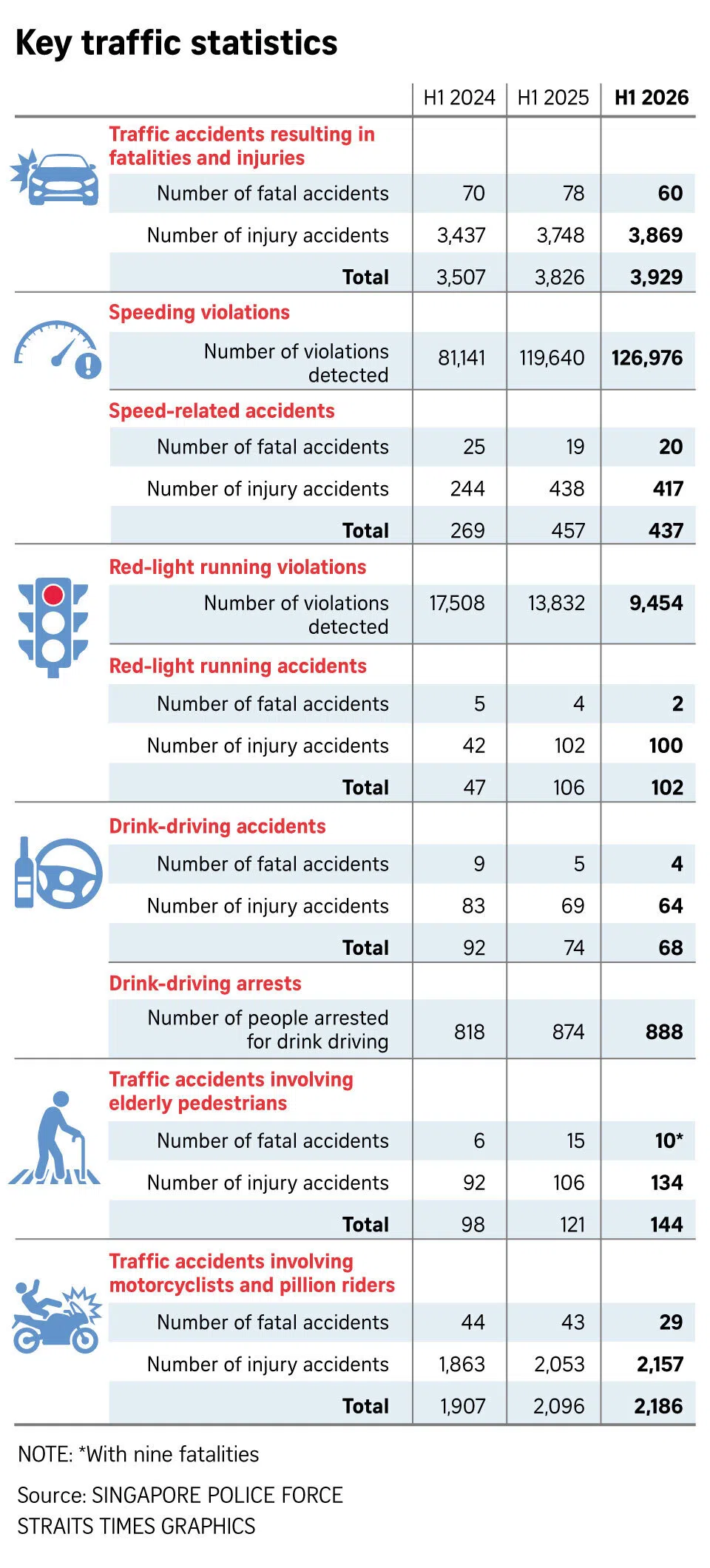
SINGAPORE – The Republic’s traffic situation remains worrying, with more accidents and more people getting injured in the first half of 2026 than in the same period in 2025.
There were also more speeding violations and fatal speed-related accidents.
The number of elderly pedestrians getting injured or killed increased, although there were fewer injured motorcyclists and pillion riders.
One significant bright spot was fewer deaths on the roads.
Releasing these figures in their mid-year road traffic statistics on Aug 28, the Traffic Police (TP) said the number of road traffic accidents and casualties in the first half of 2026 continued to show an upward trend over the past three years.
Given the dire statistics, The Straits Times has been running stories to improve Singapore’s road culture and to remind all road users to be more responsible.
The number of traffic accidents resulting in injuries increased from 3,748 in the first half of 2025 to 3,869 in 2026.
Injuries increased from 4,894 in the first half of 2025 to 5,090 during the same period in 2026.
The number of fatalities decreased from 79 in the first half of 2025 to 61 in the first half of 2026, and the number of fatal accidents decreased from 78 to 60.
TP said the drop in fatalities was largely due to fewer deaths among motorcyclists and pillion riders.
Ironically, the number of accidents involving motorcyclists increased from 2,096 in the first half of 2025 to 2,186 in 2026.
Correspondingly, injuries went up from 2,335 in the first half of 2025 to 2,470 in the first half of 2026.
Motorcyclists and pillion riders were involved in 55.6 per cent of all traffic accidents from January to June.
The number of motorcyclist and pillion deaths decreased from 43 in the first half of 2025 to 28 in 2026.
However, motorcyclist and pillion deaths continued to be the largest group of road users involved in fatal accidents, accounting for 45.9 per cent of all road deaths.
To improve road safety among motorcyclists, TP will work with the Land Transport Authority and the Singapore Road Safety Council to launch the Singapore Ride Safe campaign on Sept 12.
More injured elderly pedestrians
Another area of concern was that accidents involving elderly pedestrians increased from 121 in the first six months of 2025 to 144 cases in 2026.
And the number of injured elderly pedestrians increased from 106 to 132 during these periods.
Of the reported cases in 2026, 38.9 per cent involved elderly pedestrians who engaged in unsafe pedestrian behaviour, such as jaywalking and crossing outside designated pedestrian crossings.
The good news was that the number of elderly fatalities decreased from 15 in the first half of 2025 to nine in the first half of 2026. However, these deaths accounted for half of all pedestrian fatalities, said TP.
There were 10 fatal accidents involving elderly pedestrians in the first half of 2026.
To address this, TP will continue its public education efforts for elderly road users, which involve working with community partners to reinforce road safety habits and encouraging greater vigilance among elderly pedestrians.
TP said family members, friends and caregivers can play a role in reducing such accidents by reminding and encouraging the elderly to use designated pedestrian crossings.
Jump in speeding violations
The number of speeding violations jumped from 119,640 in the first half of 2025 to 126,976 in the same period in 2026.
TP said this could be due to the enhanced enforcement operations and the activation of the speed enforcement function in more red-light cameras islandwide.
Since January, speedsters have received heavier penalties, including more demerit points and higher composition sums.
Speed-related accidents decreased from 457 in the first six months of 2025 to 437 in the first half of 2026. There were 19 fatal speed-related accidents in 2025 and 20 in 2026.
Red-light running violations decreased from 13,832 in 2025 to 9,454 in 2026. There were also fewer red-light running accidents, with 106 in the first half of 2025 and 102 for the same period in 2026.
There were four fatal red-light running accidents in the first six months of 2025, and two in 2026.
TP said it will enhance speed enforcement on expressways by trialling a new Expressway Average Speed Enforcement (EASE) system, which will be installed on the BKE.
The system uses police cameras at the entry and exit of enforcement zones to detect and compute motorists’ average speed, based on the distance travelled and time taken.
Vehicles that exceed the speed limit will be flagged for speeding violations, although no summons will be issued during the trial period.
TP said it will make an announcement when the EASE system is ready. Signs will be installed at enforcement zones to inform motorists before the zones are operationalised.
In response to queries from ST, TP said it deploys enforcement resources based on accident and traffic violation patterns, adding that enforcement has also been intensified at accident-prone stretches along the BKE.
Drink driving arrests up
More people were arrested for drink driving, with 874 in the first half of 2025 and 888 during the same period in 2026.
But there was a dip in drink driving accidents, from 74 in 2025 to 68 in 2026.
There were four fatal cases in 2026, from five in 2025.
To deter drink driving, new laws were passed in Parliament in July to lower the prescribed alcohol limits from 35 micrograms (mcg) of alcohol per 100ml of breath to 15mcg.
Blood alcohol limits, which were 80 milligrams (mg) of alcohol per 100ml, will be lowered to 30mg.
There will be upcoming guidelines to recommend jail time for first-time offenders with very high blood alcohol levels.
From 2027, the demerit points system will be tightened, and motorists will be allowed to accumulate only 18 points within 24 months before being suspended.
For probationary motorists, the threshold within their 12-month probation period will be reduced from 13 demerit points to 12.
Suspension periods will be increased from 12 weeks to four months for first-time suspensions.
Those suspended a second time will not be able to drive for six months, up from the current 24 weeks.
The third suspension will last two years, and suspensions beyond that will each last five years.
KioskNews shows a cleaned-up reading view extracted from the publisher’s page — the original always lives on their site, not ours.