Govt implements over 250 changes for deregulation


MSMEs, environment, health, education, oil and gas, food safety mining, trade, pharma and IPR, among others have reportedly been covered
NEW DELHI: Fifteen months after a deregulation push, govt has implemented nearly 250 changes based on recommendations by a high-level committee led by Niti Aayog member Rajiv Gauba, with at least 300 more changes in the pipeline and new areas, such as railways and several proposals cutting across sectors likely to be taken up in the coming months.The committee has so far submitted over a dozen reports covering MSMEs, environment, health, education, oil and gas, food safety mining, trade, pharma and IPR, among others. The implementation varies from over 50% of recommendations to a quarter of the proposals. But given the push by the PM's Office and Gauba's own initiative, including detailed consultations before the committee finalises the report, most of the recommendations will be rolled out over time, with several involving legislative changes.
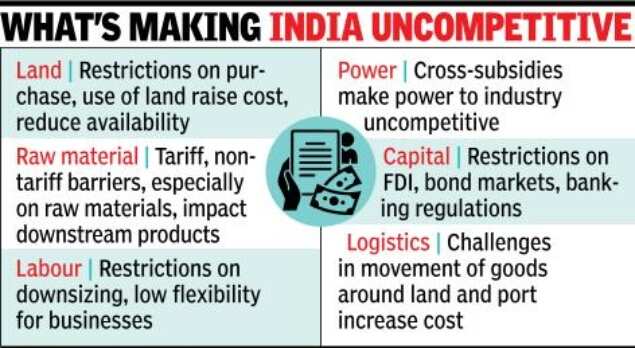
What's makes India uncompetetive
While there has been attention on nearly 900 provisions across laws that have been decriminalised, some of the changes to the GST rules, which were implemented last month, also flowed from the panel's recommendations.For instance, for lapses with no specific penalty, a general penalty of Rs 25,000 could be levied, irrespective of the size of business, which has now been capped at Rs 10,000. Similarly the panel sought easing of the registration process as well as simplifying the filing process for registering.
Ditto for auto generation of refund acknowledgement.According to an assessment done by govt, tangible gains are flowing from the changes. For example, high-value export consignments (of Rs 10 lakh or more) through couriers have helped reduce the time to half a day instead of eight days that it took to transport by sea. Similarly, allowing e-commerce players, including overseas-controlled entities, to hold stocks for exports, is expected to translate into $4 billion additional shipments.Many of the changes are "nuts and bolt issues", officials said, meant to make life easier for businesses. For instance, the green cover required for factories in new industrial estates. Unlike the earlier prescription of 33-40% cover irrespective of the unit type, green cover set at 10% for new industrial estates, 15% for red category units and 10% for orange category, and made has been optional for green and white category units.
For MSMEs in these estates, consent to notify is self-certified by them unlike earlier when they had to apply and wait for clearance. Some 15,000 renewal applications have been done away with as the consent to operate is now valid for life, and does not need to be renewed every five, 10 or 15 years.To cut the storage cost for small businesses, govt, based on the committee's recommendations, has allowed companies to share storage space for fuel, gas and chemicals from licenced entities, instead of setting up individual capacity -- a move that is expected to lower the cost for each firm to around Rs 90 crore from Rs 1.3 crore.For setting up medical education facilities, non-section 8 companies have been made eligible to apply for setting up and running colleges.
KioskNews shows a cleaned-up reading view extracted from the publisher’s page — the original always lives on their site, not ours.