World News Quick Take
A NASA researcher has found a massive, recently formed crater on the moon, a rare occurrence that only happens “once in a century or even longer,” scientists said. The crater, dubbed “McGetchin,” measures 222m wide, NASA said in a blog post. It is believed to have been created in the spring of 2024 from a comet or asteroid colliding with the moon, with researchers describing the object that caused it to be the size of a building three-to-six stories high. “Scientists estimate that an impact of this magnitude happens on the moon about once in a century or even longer,” NASA said in the blog post. Although the crater had been there for years, it was not discovered until Robert Wagner, a researcher with NASA’s Lunar Reconnaissance Orbiter, noticed it in a new scan of the moon’s surface.
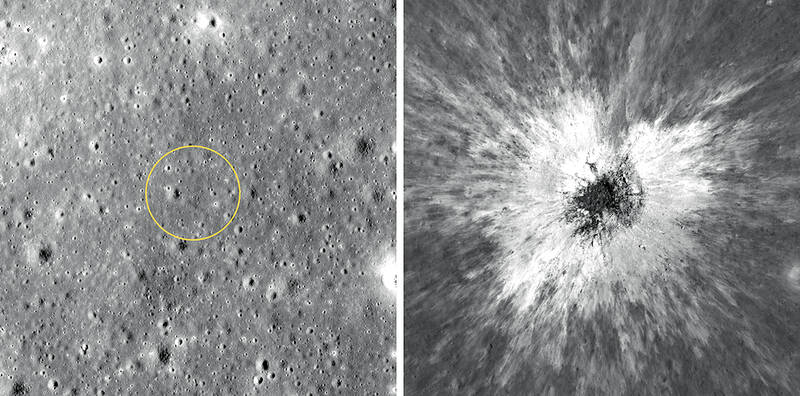
Photo: AFP / Handout / NASA
FIJI
HIV emergency declared
The Pacific island nation has declared a national HIV crisis as sexual transmission and illicit drug use help to spread the virus. New HIV diagnoses surged to 2,016 cases last year — 16 times the level recorded in 2019, authorities said, vowing a “whole of government” response. “I am formally declaring a national HIV emergency in Fiji,” Minister of Health Atonio Lalabalavu told reporters on Wednesday. “This decision recognizes the seriousness of the epidemic and the urgent, coordinated response our country now needs.”
AUSTRALIA
Visa rules tightened
Canberra will stop foreign students from bringing partners and children to accompany them while they study and tighten working holiday visa rules, Minister for Home Affairs Tony Burke said yesterday. Burke dismissed suggestions that the changes were politically motivated by the One Nation party, which has promised to cut migration. “It’s simply demonstrably wrong to suspect that somehow this is a recent bit of work done to deal with a political climate — it’s not,” he told reporters. The reforms are expected to bring annual net migration down to about 225,000 by 2028.
BOLIVIA
Paraguay border finalized
The nation and Paraguay on Wednesday finalized the course of their shared border after nearly nine decades of negotiations that began after a territorial war between them, the Ministry of Foreign Affairs said in a statement. The two countries fought between 1932 and 1935 over the Chaco Boreal region in a conflict that left between 80,000 and 100,000 people dead. Bolivia lost an area equivalent to more than half of Paraguay’s current territory as a result. “Bolivia and Paraguay have completed the delineation of their entire international boundary, a process carried out over 88 years by technical commissions from both countries,” the ministry said.
COLOMBIA
Airstrike ban lifted
A judge on Wednesday lifted a ban on airstrikes on guerrillas, which had been suspended to protect minors, but may now proceed with “caution,” a ruling said. President Abelardo de la Espriella has ordered a series of attacks on guerrilla camps to make good on his promise of flushing out the country’s armed groups. On Sept. 2, a Bogota court ordered the temporary suspension of airstrikes against rebel camps, a document obtained on Wednesday showed. Attacks may now resume, but with “a reinforced standard of precaution” when “there is certain, objective or reasonably verifiable information about the presence of boys, girls or adolescents” recruited by guerrillas, it said.
KioskNews shows a cleaned-up reading view extracted from the publisher’s page — the original always lives on their site, not ours.