Rayzher, Messer ink deal over semiconductor gases
By Lisa Wang / Staff reporter, in Hsinchu County


Semiconductor gas-system engineering firm Rayzher Industrial Co (銳澤) has signed an agreement to form a joint venture with German industrial gas giant Messer SE & Co KGaA to tap the semiconductor specialty gas market.
Partnering with Messer is more than just business expansion, but a pivotal opportunity to evolve from a specialty gas piping installer into a high-value specialty gas provider, Rayzher vice chairman Joe Chou (周谷樺) told a news conference in Hsinchu County yesterday.
The partnership is expected to inject new growth momentum into the company over the mid-to-long term, Chou said.
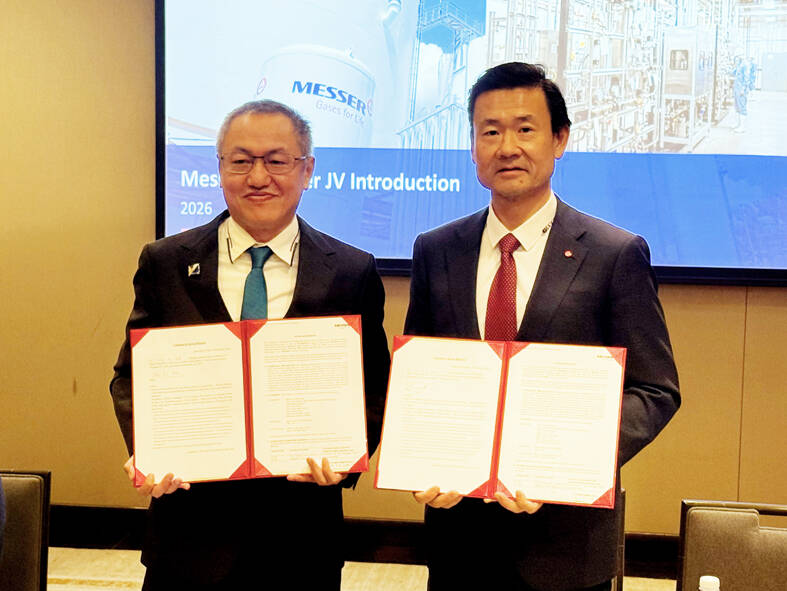
Rayzher Industrial Co vice chairman Joe Chou, left, and Messer executive Foo-sing Wong hold signed documents at a news conference in Hsinchu County yesterday.
Photo: Lin Yi-ju, Taipei Times
Based in Bad Soden, Germany, Messer ranks as the world’s largest privately owned specialist in industrial and specialty gases, with an international footprint spanning more than 30 places across the Americas, Europe and Asia.
Foo-Sing Wong (黃富聲), a Messer executive, would be chairman and general manager of the joint venture, called Messer Electronics Taiwan Co (梅塞爾銳澤電子材料).
“If you look at this joint venture, we’re actually very complementary,” Wong said.
“Together, we’re most capable of delivering Messer’s proven products for semiconductor production,” covering ultra-high purity bulk gases, electronic specialty gases and other rare gases, he said.
Demand for semiconductor specialty gases is surging, as advanced process nodes and advanced packaging solutions, such as chip-on-wafer-on-substrate, scale into volume production, Chou said.
Beyond growing demand, geopolitical turmoil in the Middle East during the first half of this year disrupted helium supplies, underscoring the urgency of supply chain resilience, he said.
“We have already approached major semiconductor manufacturers about supplying specialty gases, and orders are currently under discussion,” Chou said.
Before commercial supply begins, specialty gases typically require a customer qualification period ranging from several months to a year, Rayzher said.
The companies have also discussed establishing local specialty gas manufacturing plants in Taiwan over the long term, Chou said.
For Acter Group Co (聖暉), parent company of Rayzher, the partnership with Messer provides a new specialty gases source for its overseas projects in the US and Southeast Asia, Acter spokesman Jeff Liang (梁鈞幃) said.
Acter found it challenging to secure sufficient supply from major global specialty gas suppliers due to its relatively small operational scale and low international profile, Liang said.
Acter specializes in installing cleanroom electromechanical integration and pipelining systems for semiconductor, substrate and copackaged optics makers with significant exposure to artificial intelligence (AI) chips and infrastructure.
The company has NT$84 billion (US$2.55 billion) in orders, of which 60 to 70 percent come from Taiwanese customers, Acter said.
Political developments such as the US midterm elections have not slowed AI data center deployment, Liang said, adding that material supply constraints and labor shortages remain the primary bottlenecks.
Although the company hired about 600 people last year to expand its workforce to 2,944, capacity still lags behind surging demand, he said.
KioskNews shows a cleaned-up reading view extracted from the publisher’s page — the original always lives on their site, not ours.