Georg Baselitz: The Heroes review – astonishing paintings take a savage swipe at history
When the German painter Georg Baselitz died this year a chunk of Europe’s rapidly diminishing historical memory went with him. Baselitz was born in 1938, experienced Hitler’s Germany and the second world war as a young child, then found himself growing up in communist East Germany before escaping to the west and becoming an artist. His acidic, honest perceptions of the history he’d lived through will no longer be those of the living person I was lucky enough to encounter. But he has left us a gift: an exhibition in London he helped plan of his most astonishing history paintings, The Heroes.
It’s a savage, merciless vision of modern history with feelings of horror, disgust and irreparable guilt hanging heavy in the poisoned air. But there’s a terrible joy too, the thrill of speaking the truth. You sense the liberation Baselitz must have felt when he set brush to canvas to start these paintings in 1965. Comparing the explosive rage and nihilism of his art to punk may be inadequate but the title of this series of colossal imaginary portraits is so scathingly ironic it’s like being spat at.
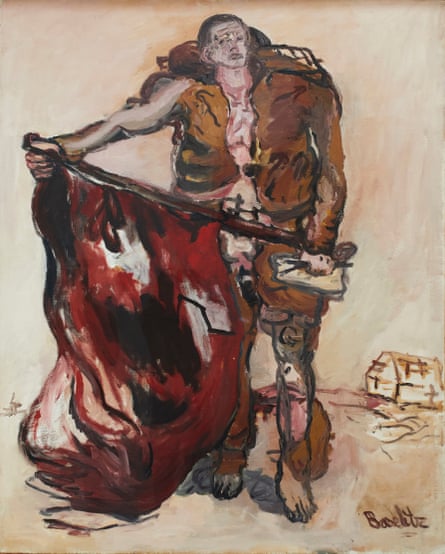
Mit Rote Fahne – or With the Red Banner – depicts a massive, square-shouldered yet exhausted soldier holding a half-lowered flag that is a smear of red and black. A banner of blood, the redness congeals to form black scabs that suggest the shadow of the swastika. All around the soldier is a wasteland. Do we owe him compassion? No, he had none. The devastated world at his feet was destroyed by Germany’s heroes who fought in the second world war. When Baselitz painted these furious homages in the mid-1960s, these men were running West Germany’s banks and car companies.
Another long-haired Hero, in a uniform with shorts, stands in a trashed, blood-stained landscape. This bland-faced character balances two crimson mittens, preparing apparently to let them go and to live on without these gory encumbrances, with clean hands.
It’s as if Baselitz was walking around the increasingly affluent streets of West Germany, seeing healthy, optimistic faces and retching at how easily the crimes of the second world war could be shoved into the past. The Holocaust only ended 20 years ago, these paintings scream, when the armies advancing on Hitler’s Reich discovered the places where six million Jews were systematically murdered – how can we Germans hold our heads high and strut on?
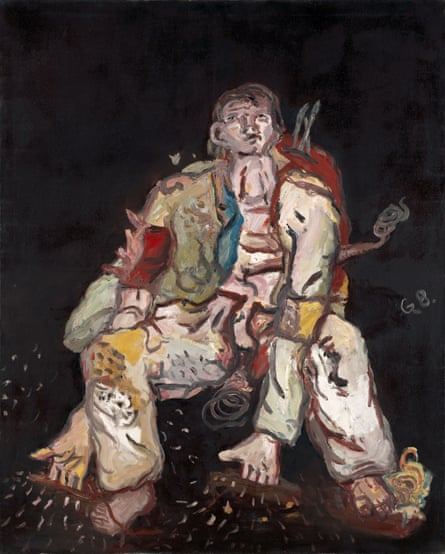
But if Germany is mired in shame, what about German art? Baselitz and his artistic peers Joseph Beuys and Anselm Kiefer, all of whom face German history head on, were sometimes accused by critics of glorifying it, or feasting on it, but there’s no hint of Teutonic grandeur here. In Ein Moderner Maler – A modern painter – Baselitz depicts an artist who can’t work because both hands are caught in man-traps. He sits defeated on the ground in military-looking clothes with armbands, as guilty and mad as all the other Heroes. He literally spills his guts in a parody of inner angst: a curl of intestines lies between his legs, while another section of bowel emerges from his side and becomes a spiralling pig’s tail. This is what the German artist’s romantic inner life has become. It’s OK to laugh. His hair is flattened on his head and he has a hint of a square moustache to remind you that Hitler, too, fancied himself an artist.
Baselitz reserves his deepest disgust for his own artistic mastery: painting has been smashed, it is no longer possible, say these brilliant paintings. Their uncoordinated, lumpen figures look like Frankensteinian monsters, made from bits and pieces of mud and flesh pathetically sewn together. One soldier, sitting under the trees, has a square head on top of a slumped, square body as blood drips on his head from two branches. He is a ghost inside his garments, there and not there.
This way of depicting the human figure makes Baselitz unique. He has little in common with British postwar figurative artists such as Bacon and Freud for whom there is always a real, pulsing body they’re trying to record. Baselitz’s bodies are abstract, designed with irony and black humour, their sufferings absurd. Another Hero stands with his flies undone, grey spurts of semen emerging from his black trousers as he towers over a shattered landscape. His ecstatic expression tells us he’s turned on by it all while at his feet is a Disneyish duck, an emblem perhaps of the innocence he will feign in postwar life.
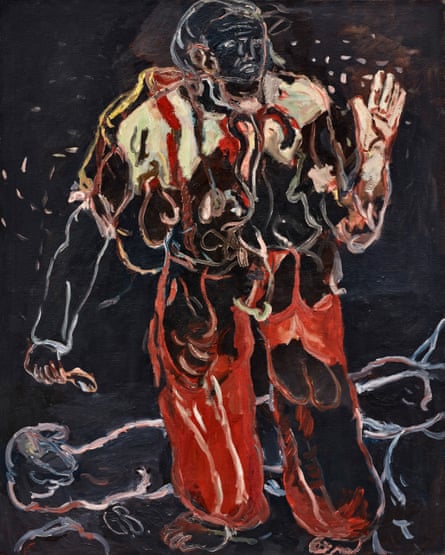
What has happened to the art of memory? After all the artistic reckonings, the history books and Holocaust memorials, the far-right AfD is winning one election after another in Germany. For extremists of all hues it isn’t even necessary to deny the Holocaust – nowadays you can shrug it off, trivialise it, dismiss it as belonging to the distant past. And the Heroes walk again. Baselitz paints one of them waving, or is it saluting, in blood-soaked trousers with a ghostly shadow of a face. Around him in the European night white flecks fall slowly, like snow or ashes.
KioskNews shows a cleaned-up reading view extracted from the publisher’s page — the original always lives on their site, not ours.