Chinese scientists chill atoms to record low on Tiangong space station
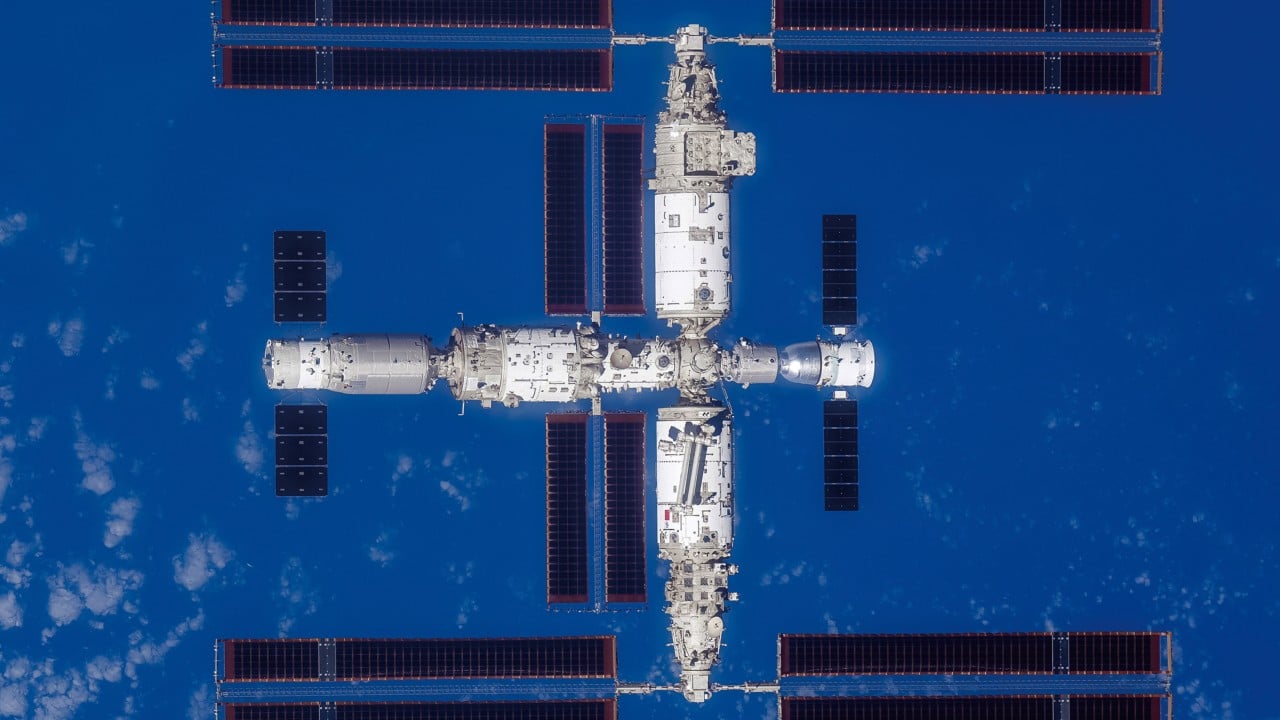
Chinese scientists have chilled atoms aboard the Tiangong space station to the lowest temperature ever measured, smashing US and German records and paving the way for ultra-precise space sensors that could find hidden minerals, track climate change and test Einstein’s theory of gravity.
Researchers from Peking University and the Chinese Academy of Sciences brought thousands of rubidium atoms, packed into a cloud smaller than a grain of sand, to less than 10 trillionths of a degree above absolute zero. The results were published in the journal Science on Friday.
That is about four times colder than the previous best, set in a German drop tower, and colder than anything reached by Nasa’s Cold Atom Lab on the International Space Station (ISS). The cloud held together for seven seconds, much longer than the two seconds achieved in the drop tower and about one second aboard the ISS.
Nick Bigelow, a physicist at the University of Rochester who has led experiments on Nasa’s lab, called the findings “wonderful results”. He said his own team has since cooled atoms to about 15 trillionths of a degree, in work not yet published, so the Chinese result still comes out on top.
Ernst Rasel of Leibniz University Hannover, whose group set the earlier mark, said the experiment led by Chen Xuzong of Peking University “sets a new record” for how cold and how long a quantum gas can be observed in free fall.
He said the gas would be “a formidable source” for quantum sensors “with plenty of applications in fundamental physics and Earth observation”.
Scientists have spent decades racing towards absolute zero – the bottom of the temperature scale – because the colder atoms get, the slower they move and the easier they are to study.
Their first big tool was beams of light, fired from all sides to slow the particles down and hold them in place.
01:31
Hong Kong’s first astronaut Lai Ka-ying among Shenzhou-23 crew entering Tiangong space station
Chill them even further and something strange happens: the atoms stop acting alone and move in perfect lockstep, like one giant “super atom” known as a Bose-Einstein condensate. First made in 1995 in a Nobel-winning feat, this exotic form works like a magnifying glass on the quantum world.
But on Earth, gravity gets in the way. It drags the ultracold atoms down, forcing researchers to grip them tightly and cutting short how long they can be watched.
Drop towers and rockets buy only a few seconds of free fall, but in orbit the atoms can float freely, making space the ideal lab for such experiments.
On the Tiangong, the Chinese team first cooled about 2 million rubidium atoms in a tight laser trap until they formed a condensate. They then shifted the cloud into a wider trap and dimmed the light, letting the particles slow almost to a standstill.
Unlike the German and Nasa experiments, which rely on magnets, the Chinese set-up holds the atoms with lasers alone.
That means it can work with a wider range of elements, opening the door to the world’s most accurate clocks and new detectors for ripples in space-time, according to Rasel.
Only a small fraction of the atoms survived the cooling process, but a laser trap with an adjustable size could boost the count in future runs, the researchers wrote. That mattered because quantum sensors worked best with large numbers of atoms, he said.
Rasel’s group wants to turn such ultracold atoms into gravity sensors that would run far longer in orbit, and hopes to test the idea soon on a new instrument bound for the ISS.
Bigelow said the next goal should be to drop two different kinds of atoms side by side to see whether they fell at exactly the same rate, a quantum version of Galileo’s legendary experiment of dropping two balls from the Leaning Tower of Pisa.
KioskNews shows a cleaned-up reading view extracted from the publisher’s page — the original always lives on their site, not ours.