Australian scavengers don’t just eat everything and slink away. They approach a carcass like a buffet
When scientists talk about scavengers, you might imagine an animal sniffing out or stumbling across a carcass, eating as much as possible, and slinking away.
But like all foods, a dead animal holds a variety of macronutrients – carbohydrates, lipids (fats), and protein – all within the same carcass, or meal. Just as an egg has a high-protein white and a higher fat yolk, carcasses are similar.
Scavengers are typically thought of as unfussy scroungers that will eat whatever is available, but our new research suggests this isn’t the case. So, which part of the carcass does a hungry dingo, wedge-tailed eagle, or red fox eat first?

How animals feed
We know that many species – mostly herbivores or animals in a lab context – choose foods to meet their nutritional targets. Like a bodybuilder aiming to hit a protein goal, wild spider monkeys and orangutans choose foods that allow them to maintain a stable intake of protein.
While there’s no reason a similar phenomenon should not exist in wild carnivores, there is little to no data on the feeding choices of carnivores. This lack of data is due to the logistical challenges in tracking them as they can be very elusive, and typically have large home ranges.
Scavengers offer scientists a great model for examining how animals decide what to eat. If different parts of a carcass offer different nutritional rewards, then scavenging may be less like eating leftovers, and more like choosing from a buffet.
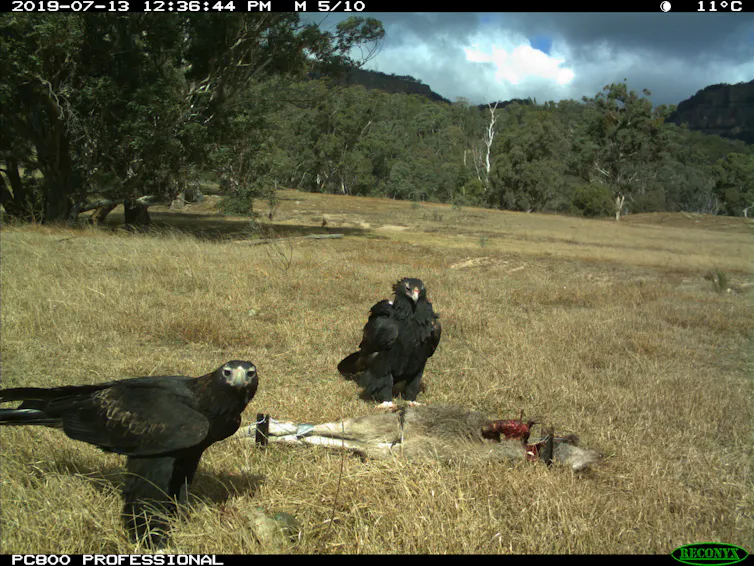
To find out, we monitored the carcasses of 40 eastern grey kangaroos in the Blue Mountains of New South Wales over a summer and a winter, with camera traps recording all activity. Three common and important scavengers in this area are dingoes, wedge-tailed eagles and red foxes. We took note of the kangaroo body parts they fed on, and how long they fed each time.
When eagles first arrived at an intact carcass, we found they consistently chose to feed at the head and abdomen, while dingoes targeted the tail most often. Foxes, on the other hand, were completely outcompeted in choosing a “favourite” body part – dingoes and eagles consistently beat them to the resource and so foxes were limited to the scraps.

This finding was not entirely surprising, because dingoes and eagles are classified as apex scavengers. This means they are the dominant species in their respective communities, and structure the ecosystem around them. As apex scavengers, they arrive to carcass sites very quickly and can consume large amounts of biomass rapidly. And because they arrived first and consumed their preferred parts, foxes had less choice.
When considering the choices our apex scavengers made, it became clear they targeted areas high in fat. Kangaroos are generally extremely lean animals, but they do carry concentrated fat in a few key places – around the base of the tail, surrounding the internal organs, and within the brain.
But carcasses are also changing in composition as they decompose. While high fat areas were targeted early on, scavengers shifted their preferences over time. Most notably, eagles shifted their feeding to more protein-dense areas, such as the muscly hindlimbs of the kangaroo.
Choosing the right food
When we looked at what happened across seasons, we found something very interesting. Both dingoes and eagles increased their feeding on the abdomen in winter compared to summer. Cooler conditions and the lack of alternative food may increase the importance of fats in a scavenger diet. This could also explain why there was a such a strong preference for fat-rich areas when the apex scavengers first discovered the carcasses.
It used to be thought that wild animals foraged to eat as much as possible for the least amount of energy expenditure. However, we now know they have to balance different nutritional requirements. This is known as nutritional geometry. It explains how animals choose what to eat to get the right balance of nutrients they need. Essentially, they have an inbuilt tracker to ensure they don’t eat too much or too little of any one macronutrient.
More than just competition
Our research shows scavengers make informed decisions about what to eat from a carcass – they seem to prioritise fat-rich body parts before shifting to other areas. But the availability of such parts depends on who has first access.
So the next time you see roadkill, remember it’s probably a site for complex interactions as scavengers vie to get to their preferred part of the buffet.
KioskNews shows a cleaned-up reading view extracted from the publisher’s page — the original always lives on their site, not ours.