Taiwan hails F-16V delivery as sign US support holds after Xi-Trump summit
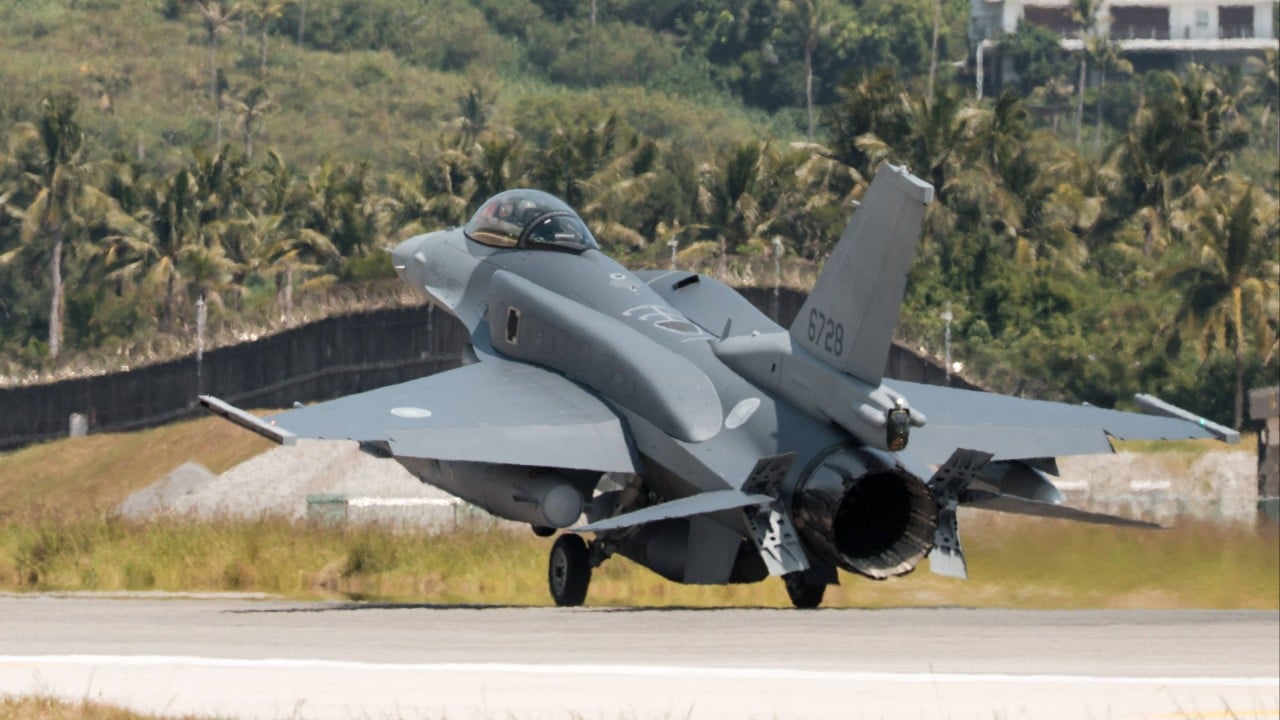
Taiwan has hailed the much-delayed arrival of two F-16V fighter jets as a demonstration of continuing US military support, despite the summit between President Xi Jinping and US President Donald Trump.
The two single-seat aircraft, which reached Chihhang Air Base in the eastern county of Taitung on Friday, are the first new F-16s received by the island since deliveries of its original F-16A/B fleet began in 1997.
Compared with the earlier versions, the F-16V configuration incorporates the Northrop Grumman APG-83 active electronically scanned array radar, updated avionics and improved target detection and tracking capabilities.
The pair are part of a NT$247.2 billion (US$7.76 billion) sale of 66 F-16Vs approved by Washington in August 2019, during Trump’s first term.
The two jets had been expected to arrive in Taiwan in late August, about a month before Xi’s state visit to the United States. Neither Taipei nor Washington has given a public explanation for the delay.
A separate weapons package for Taipei worth about US$14 billion, which has cleared informal congressional review, remains on hold pending presidential approval.
Friday’s delivery was hailed by Taiwan’s ruling Democratic Progressive Party (DPP) after Trump’s warm welcome for Xi caused some uncertainty on the island.
04:52
‘New joint arrangement’ on trade as Xi meets Trump at White House
Taiwanese leader Lai Ching-te thanked Washington for its “long-term support” for Taiwan’s self-defence and for continuing to deepen security cooperation between the two sides. He also linked the delivery to regional stability, saying it showed the US commitment to “working with Indo-Pacific partners, including Taiwan, to advance security.”
Chen Kuan-ting, a DPP legislator, also said that the delivery showed that there had been “no structural change” in US arms sales after the summit.
By contrast, opposition Kuomintang legislator Ma Wen-chun said the planes’ arrival should not distract from the delays to the programme, urging the defence ministry to provide a clear schedule for the remaining aircraft. “Two have arrived; the remaining 64 must arrive on time,” she said.
Taiwan’s defence ministry had originally hoped to receive all 66 fighters by the end of the year, but the programme has fallen far behind schedule. Taiwanese officials have cited production-line relocation and supply chain disruptions among the main factors affecting the timetable.
Defence Minister Wellington Koo Li-hsiung said on Friday that further F-16Vs would be handed over by the end of the year, without offering a specific number.
The journey of the first two fighters was itself unexpectedly drawn out.
They left the United States mainland on August 17 and reached Joint Base Pearl Harbour-Hickam in Hawaii on August 21, using aerial refuelling for the trans-Pacific journey. They had been expected to continue towards Taiwan within days but instead remained at the base for almost six weeks.
Taiwanese media and military observers raised several possible explanations, including technical problems, adverse weather and the unavailability of tanker aircraft.
The unexplained delay also prompted speculation in Taiwan that Washington may have wanted to avoid a politically sensitive delivery shortly before Xi’s state visit to the United States.
Taiwan’s United Daily News, citing an unnamed source, reported this week that after an equipment problem delayed the aircraft in Hawaii, Washington did not want the delivery to create further complications around Xi’s visit.
Neither US nor Taiwanese authorities have linked the delivery timing to Xi’s Washington visit.
02:55
Taiwan concludes annual war games, including preparing for PLA sea blockade
The SCMP reported before Xi’s Washington visit that the administration was considering postponing major new Taiwan arms sales, with sources saying Beijing had privately pressed Washington to refrain from approving new deals around Xi’s trip.
The US$14 billion weapons package had already been put on hold earlier this year, while Secretary of State Marco Rubio has emphasised that Washington must also take account of its own military requirements, production capacity and the need to replenish weapons stocks when considering arms sales.
During the summit with Trump last week, Xi reiterated hopes that the US would oppose “Taiwan independence”, and handle the Taiwan question with caution.
The US State Department sought to stress that broader US policy towards Taiwan remained unchanged after the summit.
Taiwan has placed considerable importance on the F-16V programme as it seeks to strengthen its air force amid increasing People’s Liberation Army activity around the island and growing demands on its existing fighter fleet.
Taiwan has already upgraded its older F-16A/B fleet to the F-16V configuration, including installing the APG-83 radar, so the new aircraft do not introduce those capabilities to the air force for the first time.
But the purchase adds 66 newly built fighters rather than relying solely on upgraded aircraft whose airframes date from the 1990s. The new jets also incorporate airframes designed for a longer service life and have conformal fuel tanks that increase fuel capacity without occupying underwing weapon stations.
KioskNews shows a cleaned-up reading view extracted from the publisher’s page — the original always lives on their site, not ours.