UK to invest £9.5m in Ukraine windfarm to bolster war-hit energy system
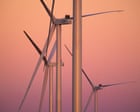
Britain will add to its multimillion pound investments in rebuilding Ukraine’s energy system by funding a windfarm project capable of powering 300,000 Ukrainian households.
Ed Miliband, the UK foreign secretary, said Britain would invest £9.5m to build a 200 megawatt windfarm in an undisclosed location to bolster Ukraine’s energy reserves as its war with Russia approaches the five-year mark.
Kyiv believes Moscow’s strikes have destroyed or damaged more than 80% of Ukraine’s prewar power generation capacity, which was mostly fuelled by gas imported from Russia.
The UK government has offered more than £770m to rebuild Ukraine’s power system, which has included emergency support and long-term investments in renewables and nuclear generation to cut the country’s reliance on gas.
Ukraine is estimated to have installed more than 3GW of renewable energy capacity since the 2022 full-scale invasion, or 20% of the country’s installed generation capacity. About a third of that is from wind power.
Miliband said the money would help deliver “major new renewable generation, strengthen Ukraine’s energy independence and support its recovery, while deepening the economic partnership between our two countries”.
The new windfarm is expected to be built and operated by Elementum Energy, a company registered in the UK with offices in London, Kyiv and Odesa.
“While Russia seeks to plunge Ukrainians into darkness, the UK is helping Ukraine build the secure and resilient energy system it needs for the future,” Miliband said.
He set out the plans to help rebuild Ukraine’s electricity infrastructure within days of Moscow’s renewed attacks on the country’s energy system. On Wednesday, Russian strikes on a thermal power plant near Odesa in the south-west of Ukraine led to power, heating and water supply outages in parts of the city.
Ukraine’s largest private energy investor, DTEK, said that attack was the third massive strike against the company’s power plants in November alone as winter temperatures plunge.
after newsletter promotion
DTEK became the first company to build a windfarm in a war zone when it completed the first phase of the Tyligulska project, generating enough clean electricity to power about 200,000 homes just 60 miles from the frontline in the southern region of Mykolaiv in early 2023.
The second phase of the Tyligulska plant was initially scheduled to be completed by the end of 2026.
Year-end fundraiser
$0 of $2,000,000 goal
This is just the beginning …
We hope you appreciated this article. Before you close this tab, can we ask you to support the Guardian at this crucial time for democracy in the US? With Black Friday approaching, our most impactful monthly support option is just $7.50 a month for six months.
For two years, Americans have witnessed a largely unchecked assault on the foundations of US democracy. While enriching themselves through flagrant corruption, the president and his allies have launched aggressive attacks on press freedom, voting rights, due process and many other fundamental civil rights. And they have shown a troubling disregard for the truth.
On election day, America’s embattled democracy came roaring back to life: from Texas to Ohio to South Carolina, a majority of Americans rejected this path at the ballot box. The voting public claimed its right to hold power to account, and millions are now looking at politics with a new and unfamiliar feeling of hope.
The past two years demonstrated just how fragile our fundamental freedoms are, when precious few powerful institutions are willing to stand up for them. Major law firms and universities capitulated to a bullying president’s threats and intimidation. Some corporate news outlets bowed to his pressure, too.
In this atmosphere of fear, the independent press stood out as one of the only forces for accountability, dedicated to uncovering the truth – and to making sure the public understood what was at stake in the election.
A free press has an essential role to play in a robust democracy, shedding light on hidden schemes and revealing the whole picture of our flawed world. Yet these are challenging times for press freedom: Trump’s crackdown on the press shows no signs of letting up; consolidated ownership means fewer options and less diversity of perspective; and the AI industry has threatened the entire business model of journalism, resulting in extreme staff layoffs that have gutted newsrooms.
We will need a free press in 2027 as much as we relied on one in 2025 and 2026. The Guardian is fortunate to have no billionaire owner, no corporate bosses who put profit over mission. We’re accountable to the facts and to our readers. And the Guardian is fortunate to have readers who are willing to support – and commit month after month – to help sustain our independence.
From reporting on the ground to fending off legal risks and keeping our reporters safe, journalism is incredibly expensive to do well. To help fund our work in 2027, we are looking to raise $2,000,000 by the end of the year. All gifts are gratefully received, but for the next several days only, our most impactful monthly support option is $7.50 a month for the first six months. We need to know we have the resources to report on the final throes of Trump’s presidency in what may be a tumultuous year ahead.
KioskNews shows a cleaned-up reading view extracted from the publisher’s page — the original always lives on their site, not ours.