We Compared Alcohol Prices Across States. The Gap May Surprise You
The price of a bottle of alcohol in India can vary significantly depending on where you buy it. A product from the same brand, in the same bottle size, can carry a very different price tag across state borders, largely because each state has its own approach to taxing and regulating alcohol.
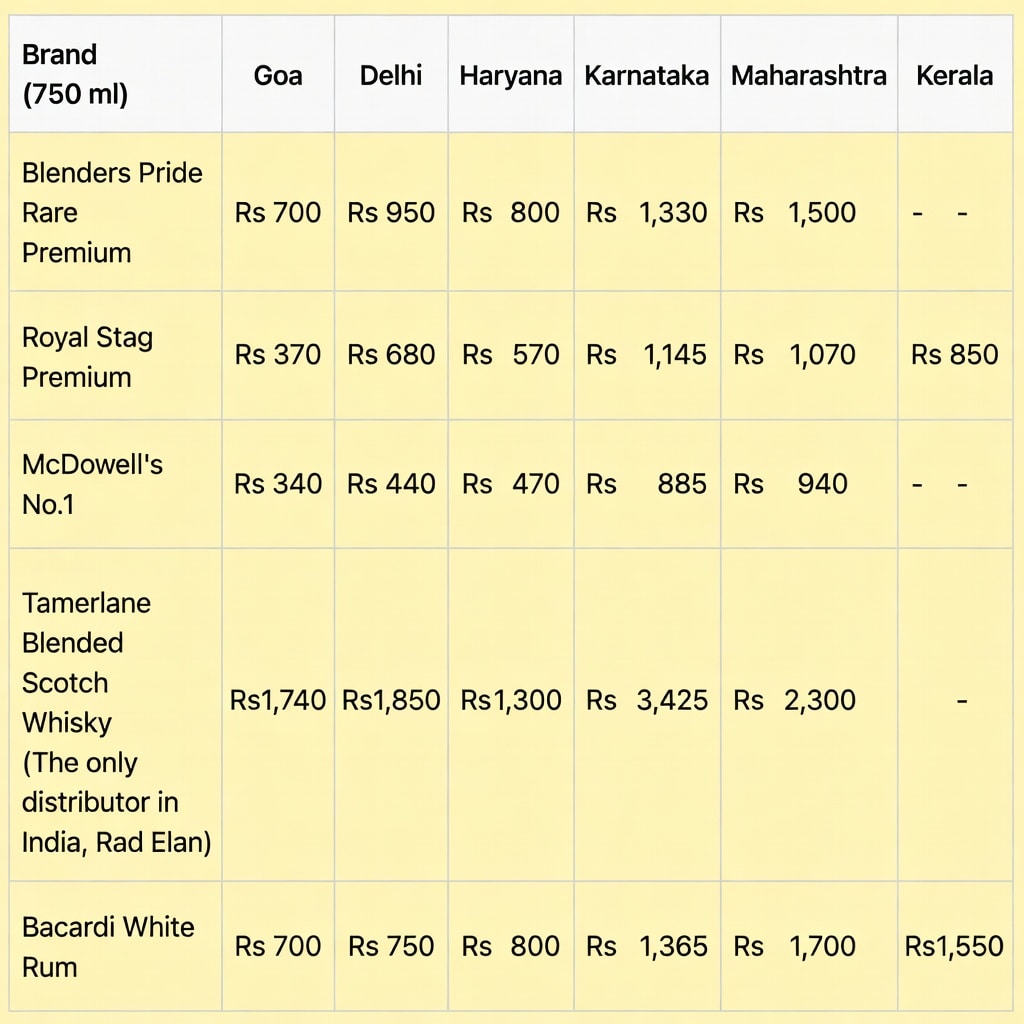
For instance, take a 750 ml bottle of quality whisky. In Haryana, current listings put the price around Rs 1,300. In Delhi, the same bottle is listed at Rs 1,850, while in Karnataka it is listed at Rs 3,425. That means the Karnataka price is more than twice the Haryana price for the same bottle. Current listings for Goa put the bottle around Rs 1,740.
So how does a product made by the same brand end up costing so much more simply because it crosses a state border?
Also Read | Layoffs Are Rising In Tech, But These Skills Are Helping People Unlock Better Pay
The answer has less to do with the whisky itself and more to do with how alcohol is taxed and regulated in India. Alcohol for human consumption remains outside the GST framework, leaving states to determine their own excise and sales-tax structures. The result is a market where the same bottle can carry very different prices depending on where it is sold.
The Price Gap: State-Wise Comparison
Tamerlane, a premium blended Scotch whisky, shared a useful illustration of the variation with NDTV. Current 2026 listings show the following prices for a 750 ml bottle:
How Much Of Liquor Price Is Actually Tax?
A Rs 2,000 bottle of whisky is not just simply whisky. A significant share of the price can go towards taxes, duties, fees and retail margins before it reaches the consumer. For a hypothetical Rs 2,000 MRP whisky bottle, a tentative industry breakdown is:
- Excise duty: Rs 425
- Import fee/Custom Duty: Rs 150
- Other fee/CST: Rs 10
- VAT/Surcharge: Rs 570
- Retail margin: Rs 150
Together, these components account for Rs 1,305 of the Rs 2,000 MRP in this illustrative example. The final price can include the product cost, excise duty, VAT or surcharge, import duties, other fees, distribution costs and retailer margins.
In other words, the price on the shelf reflects far more than the cost of the whisky itself. State-level taxes and regulations can have a major impact on the final MRP, helping explain why the same bottle can cost significantly more in one state than another.
Why Goa Is Usually Cheaper
Goa's reputation for relatively inexpensive alcohol is closely linked to its tourism economy and long-standing liquor trade. The Goa Excise Department notes that liquor availability has historically been a major attraction for the state's tourism industry.
Goa collected nearly Rs 947.9 crore in state excise revenue in 2024-25, highlighting the importance of alcohol to state finances. At the same time, its excise structure can differ from that of higher-tax states, contributing to different retail prices.
Prices are not uniformly lower, however, and can change when the state revises duties or licence fees. Overall, Goa's alcohol market reflects the intersection of tourism, taxation, consumption and distribution, creating a distinct pricing environment.
Why Kerala, Karnataka and Tamil Nadu Often End Up Costlier
The higher prices seen in markets such as Kerala, Karnataka and Tamil Nadu are closely tied to how each state taxes, regulates and sells alcohol. State excise duties, additional levies and controlled pricing or retail systems can add significantly to the final price.
Karnataka's 2026 reforms offer a recent example of how policy can reshape prices: traders quoted the new taxation structure could make cheaper liquor around 20 per cent more expensive, while premium brands could become 5-12 per cent cheaper, and in some cases up to 20 per cent cheaper. The shift towards alcohol-content-based taxation and deregulated price fixation shows how changes in state policy can directly reshape what consumers pay.
What It Means for Consumers and Brands
The difference in prices can influence consumer behaviour in several ways. A bottle that is relatively accessible in one state may become a premium purchase in another. Consumers may change brands, purchase occasions or quantities based on the price they encounter.
For businesses, the calculation is equally complex. A brand entering a new state has to account for excise duty, VAT or sales tax, registration costs, distribution expenses, retail margins and local regulations.
Amit Goel, Director, Rad Elan, puts this variation in the context of consumer demand and market dynamics. "Alcohol prices in India can vary significantly from one state to another, even when consumers are buying the same brand. A key reason is that each state has its own excise policy and taxation structure, which directly influences the final retail price. Alcohol is also an important source of state revenue, which is why many states impose substantial duties on alcoholic beverages. For instance, states like Maharashtra, Karnataka, and Delhi impose high excise duties, which significantly increase the retail price of alcohol."
Goel further said, "At the same time, states can take different approaches based on their broader economic priorities. In a tourism-driven market such as Goa, alcohol availability and pricing are closely connected with the state's tourism and hospitality economy, alongside its revenue considerations. We see the impact of pricing on consumer demand in our own products, such as Nevermind Wheat Beer and Punter Soju, which have found a market in India partly because their pricing makes them more accessible to consumers. These differences have a direct impact on consumer behaviour and market dynamics. Price can influence brand choice, purchasing occasions and perceptions of value, while businesses need to account for local taxation, retail margins, distribution costs and regulations. This makes India a market where pricing cannot be viewed uniformly, and understanding state-level differences is important for both consumers and businesses."
For consumers, this makes the state they buy in almost as important as the brand itself in determining the final price. For businesses, it creates a market where pricing cannot be reduced to a single national formula. Differences in taxation, duties, retail structures and regulation can all influence what a bottle ultimately costs.
KioskNews shows a cleaned-up reading view extracted from the publisher’s page — the original always lives on their site, not ours.