Julia Donaldson: ‘Am I the Gruffalo Granny? Not really. I’m the mouse’

In 1999 a journalist asked a then-unknown author to share her millennium wish. The author, who was 51 years old and had published only one book before, said she hoped her new one, out that year, would become a classic. “But then straight away I said: ‘Only joking!’ Because I didn’t want to sound full of myself, and I certainly didn’t think the wish would come true,” she remembers today.
That author is Julia Donaldson; the book she published in 1999 was The Gruffalo; and, as you hardly need telling, her wish did indeed come true. And how. Since its publication, more than 18.2m copies of The Gruffalo and its sequel have sold worldwide. The Gruffalo’s Child was published in 2004, and together these tales of the terrible creature with terrible claws, and terrible teeth in his terrible jaws, have helped Donaldson to sell more than 50m books in the UK. In 2025 she was named the country’s bestselling author – across all genres, children’s and adult’s – since records began.
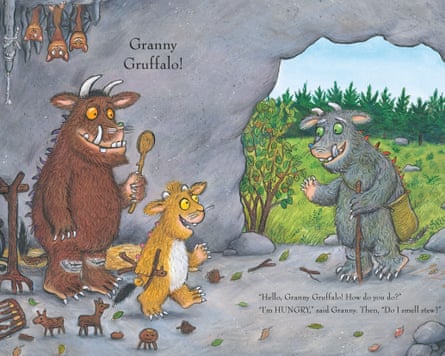
Now the Gruffalo is making what Donaldson – who was made a dame in June – confirms will be his final outing. Gruffalo Granny, out this week, extends the protagonist’s family back a generation. In the new book, the Gruffalo and his daughter are awaiting a visit from Granny Gruffalo. The mouse, who played a pivotal role in the first and second books, is again centre stage; and longtime characters owl, fox and snake are all part of the action too.
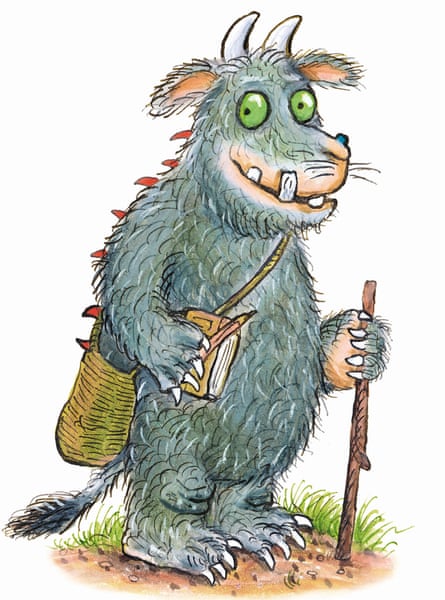
When we meet in a swish hotel in central London, I’m struck by the similarities between Donaldson and her new character. Her hair, like the Gruffalo Granny’s fur, is grey; in Donaldson’s case, it’s a neat bob, curled under at the ends. She is wearing a blue floral dress and navy shoes, and when she smiles her eyes twinkle; but I suspect that, like the Gruffalo Granny, she has prickles that reveal themselves when needed. What’s more, she has nine grandchildren, aged between five and 16. So is she the Gruffalo Granny?
“Not really,” she says. “I’m the mouse.” The new book, she says, is a celebration of storytelling. “The mouse tells stories, then the Gruffalo’s child tells the stories to the granny, and the granny is going to read them back again. So there are three storytellers in the book – everyone apart from the Gruffalo.”
The inspiration for the book – without plot-spoiling, though presumably there aren’t many under-sevens reading this – is Shahrazad from The Arabian Nights, who saves her life by never finishing her stories. “I had that idea and couldn’t think at first what the stories were going to be – and then I thought, why not use my own stories? It won’t be so much work for Axel [Scheffler, the Gruffalo’s illustrator] because he’s already done those pictures.” So the new book is a celebration of many of Donaldson’s earlier works. “It works well because a lot of the people who read this book will already have read the ones I refer to – Room on the Broom, Monkey Puzzle, and The Snail and the Whale. They’ve all been made into films, and they’re quite well known.”
“Quite well known” is an understatement: Donaldson isn’t just a children’s author, she’s the children’s author. Seeking out a book for my two-year-old grandson from Gatwick south terminal’s WH Smith a few days ago, I noticed every single book on offer in the picture book section of the small airport shop was by her. Is she concerned that, despite being a global champion of children’s literature, she has crowded out potential competitors – not to mention new talent? “I worry that some other author will stab me in the night,” she jokes. But yes, she is worried. “That’s why I have a project for the National Year of Reading [to compile] a list of recommendations of picture books not by me.” The project is still under wraps; an announcement is expected by the end of the year.
Does the new book connect with what the former current children’s laureate, Frank Cottrell-Boyce (Donaldson held the post in 2011-13), has said about the power of storytelling in a digital age? “Yes, but that follows naturally from my plot line,” she says. “I wasn’t trying to remedy the situation – to be didactic.” The Gruffalo prickles hove into view: she is irked by what she sees as the media position that it is the responsibility of children’s authors to have views on issues to do with children and reading. “An adult author isn’t asked all the time about why libraries are important.” (Donaldson has, to be fair, done plenty of campaigning to keep libraries open.) It sometimes feels to Donaldson that we’ve “gone back to Victorian times … [Children’s authors] are seen as educators.”
The new Gruffalo book highlights the role of a grandparent; so what kind of grandmother is Donaldson? “I teach them the card games that my grandmother used to teach me,” she says. “I do jigsaws with them, I play with them, and I read with them. I’m not so keen on changing nappies or doing the school run. ” Her grandchildren also provide ideas: a new book, now being illustrated, is called Baby Grandpa. “That’s because my youngest grandchild is called Malcolm. When he was born my husband, Malcolm, was over the moon, and they asked the next one up, Rita, who was only 18 months, to do a video saying ‘Baby Malcolm’, but instead of that she said ‘Baby Grandpa’. And that’s such a good title for a book: I’ve written it in prose – about a grandpa and a baby with the same name.” Baby Malcolm, she says, “will probably be about seven when it comes out”.
Sadly, Grandpa Malcolm didn’t live to see the book published: a consultant paediatrician based for much of his career in Glasgow, he died in 2024, aged 75. Losing him has been tough – “the fabric of your life totally changes” – but she had already faced tragedy with the death of their son Hamish, who had schizoaffective disorder and took his own life in 2003, aged 25. She doesn’t want to say much about it, she says, “but the thing is it wasn’t just the loss of a child, it was all the other things we faced because of what he was like – it was very hard times before he died”. His death was “devastating”, but living through the aftermath has helped her cope with losing Malcolm. “I know he’d be very proud of not just me but the boys [their other sons are Alastair and Jerry], who now play the guitars on the shows which he would have done.”
Ah, the shows: look online and you’ll find charming videos of Julia and Malcolm taking part in theatre performances and recording sessions, singing songs about the Gruffalo and her other stories. Family members joined in, including her sons, grandchildren and her great-niece Lola Young, now one of the UK’s most successful singer-songwriters, whose 2024 single Messy reached No 1 in six countries and has been streamed more than a billion times. “Some people have said she’s a nepo baby but that’s ridiculous,” says Donaldson. “I’m as nepotistic as anyone. If I could have pulled any strings I would have done. But there’s no relationship whatsoever between the world of rock and pop music and the world of children’s books.” Donaldson lives in Sussex these days, and when Young played in Brighton she was in the audience. “I’m very proud of her,” she says.
after newsletter promotion
Musicality and family are the keys to Donaldson’s life and career: she and Malcolm kept on doing what they most enjoyed, alongside two illustrious careers. As students they had busked their way round Europe together; and growing older and becoming successful in other fields seemed no reason to stop. For Donaldson – who grew up in a musical family, with a mother who sang in a choir and a father who played the cello – it has brought balance into her life as a writer. Writing, she says, is “private and creative”; performing, along with book signings, gives her opportunities to meet people. “The variety is what I like.”
As well as being a grandmother herself, she surely also drew on her memories of her own grandmother, who lived on one floor of the family house in Hampstead where she grew up with her parents and sister (another aunt and uncle had another floor). It was “like Milly-Molly-Mandy,” she says (in Joyce Lankester Brisley’s stories, three generations inhabit the same cottage); and her own grandmother bought her collections of fairytales – Hans Christian Andersen, retellings of Chaucer, myths – that she still has today. “I was heartbroken when she died. I was 16.”
Julia and Malcolm met while studying at the University of Bristol, and went on to spend most of their married life living near Glasgow. Scots is one of the 119 languages and dialects into which The Gruffalo has been translated (Latin is another).
Gruffalo Granny might be the end of the series, but it’s certainly not the end of Donaldson’s working life. She turns 78 next week, and her next book, Winifred Duck, will be out early next year with Scholastic. “It’s based on the true story of how a cargo of bath toys fell off a ship. They were carried around the world, and have helped oceanographers understand currents and tides.”
Several others, including Baby Grandpa, are in the pipeline. “Every now and then you get an idea for another one, so it seems to keep ticking over.” And she’s lucky enough to know that, if she ever did stop writing, “I’ve still got the royalties coming in.” But she sees no reason to stop: “I can go on doing what I do as long as I’m fit enough, as long as I haven’t lost my marbles.” You get the sense of someone who, despite having been through tough times, is grateful for where she now finds herself. To borrow her own analogy, and in the words of the final page of the original Gruffalo book, she is the mouse who found a nut, and the nut is good.
KioskNews shows a cleaned-up reading view extracted from the publisher’s page — the original always lives on their site, not ours.